



 Chat with AI
Exam 43: Nuclear Physics

Exam 1: Units,physical Quantities,and Vectors107 Questions
Exam 2: Motion Along a Straight Line59 Questions
Exam 3: Motion in Two or Three Dimensions50 Questions
Exam 4: Newtons Laws of Motion44 Questions
Exam 5: Applying Newtons Laws95 Questions
Exam 6: Work and Kinetic Energy54 Questions
Exam 7: Potential Energy and Energy Conservation55 Questions
Exam 8: Momentum,impulse,and Collisions50 Questions
Exam 9: Rotation of Rigid Bodies26 Questions
Exam 10: Dynamics of Rotational Motion49 Questions
Exam 11: Equilibrium and Elasticity50 Questions
Exam 12: Fluid Mechanics50 Questions
Exam 13: Gravitation50 Questions
Exam 14: Periodic Motion50 Questions
Exam 15: Mechanical Waves44 Questions
Exam 16: Sound and Hearing65 Questions
Exam 17: Temperature and Heat63 Questions
Exam 18: Thermal Properties of Matter58 Questions
Exam 19: The First Law of Thermodynamics52 Questions
Exam 20: The Second Law of Thermodynamics50 Questions
Exam 21: Electric Charge and Electric Field60 Questions
Exam 22: Gausss Law41 Questions
Exam 23: Electric Potential55 Questions
Exam 24: Capacitance and Dielectrics52 Questions
Exam 25: Current,resistance,and Electromotive Force55 Questions
Exam 26: Direct-Current Circuits53 Questions
Exam 27: Magnetic Field and Magnetic Forces42 Questions
Exam 28: Sources of Magnetic Field52 Questions
Exam 29: Electromagnetic Induction39 Questions
Exam 30: Inductance27 Questions
Exam 31: Alternating Current50 Questions
Exam 32: Electromagnetic Waves47 Questions
Exam 33: The Nature and Propagation of Light28 Questions
Exam 34: Geometric Optics81 Questions
Exam 35: Interference33 Questions
Exam 36: Diffraction49 Questions
Exam 37: Relativity51 Questions
Exam 38: Photons: Light Waves Behaving As Particles38 Questions
Exam 39: Particles Behaving As Waves52 Questions
Exam 40: Quantum Mechanics43 Questions
Exam 41: Atomic Structure53 Questions
Exam 42: Molecules and Condensed Matter31 Questions
Exam 43: Nuclear Physics90 Questions
Exam 44: Particle Physics and Cosmology54 Questions
Select questions type


Which of the following statements about β+ decay are correct? (There may be more than one correct choice.)During β+ decay
(Multiple Choice)
4.7/5  (89)
(89) A certain nucleus containing 8 protons and 7 neutrons has a density ρ.Which of the following values would be closest to the expected value of the density of a nucleus having 51 protons and 69 neutrons?
(Multiple Choice)
4.9/5 (74)
(74) A certain substance has a half-life of 5.0 hours.How many nuclei of the substance are required to give an initial activity of 6.0 μCi? 1 Ci = 3.7 ×  Bq.
Bq. (Multiple Choice)
4.8/5 (83)
(83) A radioisotope has a half-life of τ at a temperature of 150 K.If its temperature is increased to 300 K,what will its half-life be?
(Multiple Choice)
4.8/5 (76)
(76) A hospital patient has been given some  (half-life = 8.04 d)which decays at 4.2 times the acceptable level for exposure to the general public.How long must the patient wait for the decay rate to reach the acceptable level? Assume that the material merely decays and is not excreted by the body.
 (Multiple Choice)
4.9/5 (75)
(75) How much energy is released in the total fission of  of
 The average energy per fission is 200.0 MeV.(1 u = 931.5 MeV/c2 = 1.6605 × 10⁻²⁷ kg,

of The average energy per fission is 200.0 MeV.(1 u = 931.5 MeV/c2 = 1.6605 × 10⁻²⁷ kg, (Multiple Choice)
4.7/5 (81)
(81) Radium-226 decays into radon-222 plus an alpha particle.How much energy is released in this process? 1 u = 931.494 MeV/c2,and the relevant mass values are  He: 4.002603 u
 Rn: 222.017570 u
 Ra: 226.025402 u
He: 4.002603 u Rn: 222.017570 u Ra: 226.025402 u (Multiple Choice)
4.7/5 (84)
(84) In the nuclear reaction  B +
 He →
 H + X,which of the following is the missing nuclear product X?
B + He → H + X,which of the following is the missing nuclear product X? (Multiple Choice)
4.9/5 (80)
(80) Modern nuclear bomb tests have created an extra high level of 14C in our atmosphere.Suppose that future archaeologists date samples from our era,but do not know about this testing.Will their dates be too young,too old,or still correct? If correct they are correct,why?
(Multiple Choice)
4.8/5 (81)
(81) A 70-kg laboratory technician absorbs 2.9 mJ of 0.50-MeV gamma rays in a workday.How many gamma-ray photons does the technician absorb in a workday?
(Multiple Choice)
4.9/5 (75)
(75) The set of nuclear reactions that power our sun can be summarized a 4p+ → 4He+2 + 2e+.The masses of the particles involved are 938.272 MeV/c2 (proton,p+), 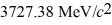 (alpha particle,4He+2),and 0.511 MeV/c2 (positron,e+).How much energy is released by each set of these reactions?
 (Multiple Choice)
5.0/5 (66)
(66) A fusion reaction releases energy because the binding energy of the resulting nucleus
(Multiple Choice)
4.7/5 (71)
(71) Which of the following descriptions best describes the process by which energy is released in a conventional nuclear reactor?
(Multiple Choice)
4.9/5 (72)
(72) Two deuterium nuclei,  H,fuse to produce a tritium nucleus,
 H,and a hydrogen nucleus.A neutral deuterium atom has a mass of 2.014102 u; a neutral tritium atom has a mass of 3.016049 u; a neutral hydrogen atom has a mass of 1.007825 u; a neutron has a mass of 1.008665 u; and a proton has a mass of 1.007276 u.How much energy is released in the process? (1 u = 931.494 MeV/c2)
H,fuse to produce a tritium nucleus, H,and a hydrogen nucleus.A neutral deuterium atom has a mass of 2.014102 u; a neutral tritium atom has a mass of 3.016049 u; a neutral hydrogen atom has a mass of 1.007825 u; a neutron has a mass of 1.008665 u; and a proton has a mass of 1.007276 u.How much energy is released in the process? (1 u = 931.494 MeV/c2) (Multiple Choice)
4.9/5 (80)
(80) The carbon in your body was formed in nuclear reactions in long-dead stars.How much energy was released when three 4He nuclei combined to make 12C? The mass of 4He is  ,the mass of 12C is
 ,and
 .
,the mass of 12C is ,and . (Multiple Choice)
4.9/5 (76)
(76) A stationary plutonium-239 nucleus decays into a uranium-235 nucleus plus an alpha particle.The energy released in the process is 5.24 MeV.Given the following mass values  He: 4.002603 u
 U: 235.043924 u what is the kinetic energy of the
 U nucleus? (1 u =931.494 MeV/c2)
He: 4.002603 u U: 235.043924 u what is the kinetic energy of the U nucleus? (1 u =931.494 MeV/c2) (Multiple Choice)
4.7/5 (87)
(87) Uranium-238 decays into thorium-234 plus an alpha particle.How much energy is released in this process? 1 u = 931.494 MeV/c2,and the relevant mass values are  He: 4.002603 u
 Th: 234.043583 u
 U: 238.050786 u
He: 4.002603 u Th: 234.043583 u U: 238.050786 u (Multiple Choice)
4.8/5 (89)
(89) If a nucleus decays by β+ decay to a daughter nucleus,which of the following statements about this decay are correct? (There may be more than one correct choice.)
(Multiple Choice)
4.9/5 (81)
(81) Consider the fusion reaction  H +
 H +
 H →
 He +
 H +
 n
The atomic masses are:
 H: 2.01410 u
 He: 4.00260 u
 H,1.00783 u
 n: 1.008665 u
What mass of deuterium fuel,
 H,is used up in producing 8.2 × 10¹³ J of energy by this reaction? (1u = 1.6605 × 10⁻²⁷ kg = 931.5 MeV/c2)
H + H + H → He + H + n
The atomic masses are: H: 2.01410 u He: 4.00260 u H,1.00783 u n: 1.008665 u
What mass of deuterium fuel, H,is used up in producing 8.2 × 10¹³ J of energy by this reaction? (1u = 1.6605 × 10⁻²⁷ kg = 931.5 MeV/c2) (Short Answer)
4.9/5 (81)
(81) 
Filters
- Essay(0)
- Multiple Choice(0)
- Short Answer(0)
- True False(0)
- Matching(0)