



 Chat with AI
Exam 20: The Second Law of Thermodynamics

Exam 1: Units,physical Quantities,and Vectors107 Questions
Exam 2: Motion Along a Straight Line59 Questions
Exam 3: Motion in Two or Three Dimensions50 Questions
Exam 4: Newtons Laws of Motion44 Questions
Exam 5: Applying Newtons Laws95 Questions
Exam 6: Work and Kinetic Energy54 Questions
Exam 7: Potential Energy and Energy Conservation55 Questions
Exam 8: Momentum,impulse,and Collisions50 Questions
Exam 9: Rotation of Rigid Bodies26 Questions
Exam 10: Dynamics of Rotational Motion49 Questions
Exam 11: Equilibrium and Elasticity50 Questions
Exam 12: Fluid Mechanics50 Questions
Exam 13: Gravitation50 Questions
Exam 14: Periodic Motion50 Questions
Exam 15: Mechanical Waves44 Questions
Exam 16: Sound and Hearing65 Questions
Exam 17: Temperature and Heat63 Questions
Exam 18: Thermal Properties of Matter58 Questions
Exam 19: The First Law of Thermodynamics52 Questions
Exam 20: The Second Law of Thermodynamics50 Questions
Exam 21: Electric Charge and Electric Field60 Questions
Exam 22: Gausss Law41 Questions
Exam 23: Electric Potential55 Questions
Exam 24: Capacitance and Dielectrics52 Questions
Exam 25: Current,resistance,and Electromotive Force55 Questions
Exam 26: Direct-Current Circuits53 Questions
Exam 27: Magnetic Field and Magnetic Forces42 Questions
Exam 28: Sources of Magnetic Field52 Questions
Exam 29: Electromagnetic Induction39 Questions
Exam 30: Inductance27 Questions
Exam 31: Alternating Current50 Questions
Exam 32: Electromagnetic Waves47 Questions
Exam 33: The Nature and Propagation of Light28 Questions
Exam 34: Geometric Optics81 Questions
Exam 35: Interference33 Questions
Exam 36: Diffraction49 Questions
Exam 37: Relativity51 Questions
Exam 38: Photons: Light Waves Behaving As Particles38 Questions
Exam 39: Particles Behaving As Waves52 Questions
Exam 40: Quantum Mechanics43 Questions
Exam 41: Atomic Structure53 Questions
Exam 42: Molecules and Condensed Matter31 Questions
Exam 43: Nuclear Physics90 Questions
Exam 44: Particle Physics and Cosmology54 Questions
Select questions type


A system consists of two very large thermal reservoirs in contact with each other,one at temperature 300°C and the other at temperature 200°C.When 600 J of heat transfers from the 300°C reservoir to the 200°C reservoir,what is the change in entropy of this system?
(Multiple Choice)
4.8/5  (85)
(85) A refrigerator has a coefficient of performance equal to 4.2.How much work must be done on the refrigerator in order to remove 250 J of heat from the interior?
(Multiple Choice)
4.7/5 (69)
(69) The entropy of an isolated system must be conserved,so it never changes.
(True/False)
4.9/5 (77)
(77) An engine manufacturer makes the claim that the engine they have developed will,on each cycle,take 100 J of heat out of boiling water at 100°C,do mechanical work of 80 J,and exhaust 20 J of heat at 10°C.What,if anything,is wrong with this claim?
(Multiple Choice)
4.8/5 (82)
(82) A perfect Carnot engine operates between the temperatures of 300K and 700K,drawing 60 kJ of heat from the 700K reservoir in each cycle.How much heat is dumped into the 300K reservoir in each cycle?
(Multiple Choice)
5.0/5 (88)
(88) A Carnot engine operates between a high temperature reservoir at  and a river with water at
 If it absorbs
 of heat each cycle,how much work per cycle does it perform?
and a river with water at If it absorbs of heat each cycle,how much work per cycle does it perform? (Multiple Choice)
4.9/5 (71)
(71) The graph in the figure shows a cycle for a heat engine for which  = 35 J.What is the thermal efficiency of this engine?
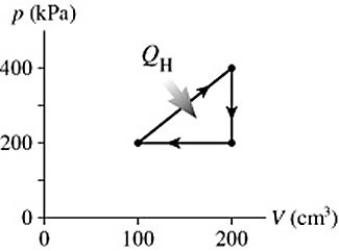
= 35 J.What is the thermal efficiency of this engine? (Multiple Choice)
4.7/5 (73)
(73) An ideal Carnot engine operates between reservoirs having temperatures of 125°C and
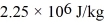
-20°C.Each cycle the heat expelled by this engine is used to melt 30.0 g of ice at 0.00°C.The heat of fusion of water is 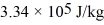 and the heat of vaporization of water is
 .
(a)How much work does this engine do each cycle?
(b)How much heat per cycle does this engine absorb at the hot reservoir?
and the heat of vaporization of water is .
(a)How much work does this engine do each cycle?
(b)How much heat per cycle does this engine absorb at the hot reservoir? (Short Answer)
4.9/5 (70)
(70) A nuclear fission power plant has an actual efficiency of 39%.If  of power are produced by the nuclear fission,how much electric power does the power plant output?
 (Multiple Choice)
4.8/5 (78)
(78) What is the change in entropy of 10.0 moles of ideal monatomic gas that reversibly undergoes the isothermal expansion shown in the figure? The ideal gas constant is  .
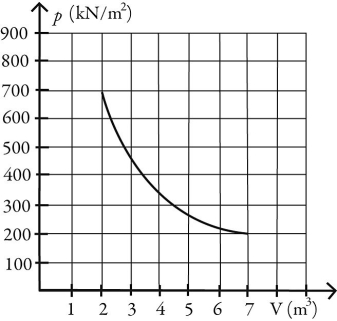
. (Multiple Choice)
4.9/5 (75)
(75) 
Filters
- Essay(0)
- Multiple Choice(0)
- Short Answer(0)
- True False(0)
- Matching(0)