



 Chat with AI
Exam 20: The Second Law of Thermodynamics

Exam 1: Units,physical Quantities,and Vectors107 Questions
Exam 2: Motion Along a Straight Line59 Questions
Exam 3: Motion in Two or Three Dimensions50 Questions
Exam 4: Newtons Laws of Motion44 Questions
Exam 5: Applying Newtons Laws95 Questions
Exam 6: Work and Kinetic Energy54 Questions
Exam 7: Potential Energy and Energy Conservation55 Questions
Exam 8: Momentum,impulse,and Collisions50 Questions
Exam 9: Rotation of Rigid Bodies26 Questions
Exam 10: Dynamics of Rotational Motion49 Questions
Exam 11: Equilibrium and Elasticity50 Questions
Exam 12: Fluid Mechanics50 Questions
Exam 13: Gravitation50 Questions
Exam 14: Periodic Motion50 Questions
Exam 15: Mechanical Waves44 Questions
Exam 16: Sound and Hearing65 Questions
Exam 17: Temperature and Heat63 Questions
Exam 18: Thermal Properties of Matter58 Questions
Exam 19: The First Law of Thermodynamics52 Questions
Exam 20: The Second Law of Thermodynamics50 Questions
Exam 21: Electric Charge and Electric Field60 Questions
Exam 22: Gausss Law41 Questions
Exam 23: Electric Potential55 Questions
Exam 24: Capacitance and Dielectrics52 Questions
Exam 25: Current,resistance,and Electromotive Force55 Questions
Exam 26: Direct-Current Circuits53 Questions
Exam 27: Magnetic Field and Magnetic Forces42 Questions
Exam 28: Sources of Magnetic Field52 Questions
Exam 29: Electromagnetic Induction39 Questions
Exam 30: Inductance27 Questions
Exam 31: Alternating Current50 Questions
Exam 32: Electromagnetic Waves47 Questions
Exam 33: The Nature and Propagation of Light28 Questions
Exam 34: Geometric Optics81 Questions
Exam 35: Interference33 Questions
Exam 36: Diffraction49 Questions
Exam 37: Relativity51 Questions
Exam 38: Photons: Light Waves Behaving As Particles38 Questions
Exam 39: Particles Behaving As Waves52 Questions
Exam 40: Quantum Mechanics43 Questions
Exam 41: Atomic Structure53 Questions
Exam 42: Molecules and Condensed Matter31 Questions
Exam 43: Nuclear Physics90 Questions
Exam 44: Particle Physics and Cosmology54 Questions
Select questions type


A Carnot air conditioner operates between an indoor temperature of 20°C and an outdoor temperature of 39°C.How much energy does it need to remove 2000 J of heat from the interior of the house?
(Multiple Choice)
4.8/5  (71)
(71) A Carnot refrigerator takes heat from water at 0°C and rejects heat to a room at 12°C.Suppose that 92.0 grams of water at 0°C are converted to ice at 0°C by the refrigerator.Calculate the mechanical energy that must be supplied to the refrigerator.The heat of fusion of water is 3.34 × 10⁵ J/kg.
(Short Answer)
4.8/5 (83)
(83) A refrigerator has a coefficient of performance of 1.15,and it extracts 7.95 J of heat from the cold reservoir during each cycle.
(a)How much work is done on the gas in each cycle?
(b)How much heat is exhausted into the hot reservoir in each cycle?
(Short Answer)
4.8/5 (71)
(71) A certain Carnot heat pump transfers energy from the outside of a house,where the temperature is -15°C,to the inside of a room where the temperature is 21°C.If this heat pump runs off of electricity,what is the minimum rate at which it uses electrical energy to deliver 150 W to the inside room?
(Short Answer)
4.8/5 (88)
(88) You want to design an ideal Carnot heat engine that wastes only 35.0% of the heat that goes into it.The lowest cold-reservoir temperature available to you is +15.0°C.If  of work is done per cycle,the heat input per cycle is closest to
 (Multiple Choice)
4.9/5 (89)
(89) An automobile engine takes in 4000 J of heat and performs 1100 J of mechanical work in each cycle.
(a)Calculate the engine's efficiency.
(b)How much heat is "wasted" in each cycle?
(Short Answer)
4.8/5 (71)
(71) A brass rod,75.0 cm long and having a cross-sectional area of 2.50 cm2,conducts heat from a large furnace at 375°C into a very large cold water bath at 10.0°C without losing any heat at the lateral surface of the rod.Steady state has been established,and the thermal conductivity of brass is  .The rate at which the entropy of the system (furnace plus water)is changing is closest to
 (Multiple Choice)
4.8/5 (73)
(73) The compressor in a certain Carnot refrigerator performs 480 J of work to remove 150 J of heat from the interior of the refrigerator.How much heat must the coils behind the refrigerator discharge into the kitchen?
(Multiple Choice)
4.9/5 (72)
(72) A 2.0-kg block of aluminum at 50°C is dropped into 5.0 kg of water at 20°C and the temperature is allowed to stabilize.What is the total change in entropy during this process,assuming no heat is exchanged with the environment? The specific heat of aluminum is 910 J/(kg • K)and the specific heat of water is 4190 J/(kg • K).
(Multiple Choice)
4.7/5 (72)
(72) A coal-fired plant generates 600 MW of electric power.The plant uses  of coal each day.The heat produced by the combustion of coal is
 .The steam that drives the turbines is at a temperature of 300°C,and the exhaust water is at 37°C.
(a)What is the overall efficiency of the plant for generating electric power?
(b)What is the maximum efficiency that this plant could possibly have using the same temperature extremes that it presently uses?
(c)How much thermal energy is exhausted each day by this plant?
of coal each day.The heat produced by the combustion of coal is .The steam that drives the turbines is at a temperature of 300°C,and the exhaust water is at 37°C.
(a)What is the overall efficiency of the plant for generating electric power?
(b)What is the maximum efficiency that this plant could possibly have using the same temperature extremes that it presently uses?
(c)How much thermal energy is exhausted each day by this plant? (Short Answer)
4.9/5 (87)
(87) A real (non-Carnot)heat engine,operating between heat reservoirs at temperatures of  and
 performs 4.3 kJ of net work and rejects
 of heat in a single cycle.The thermal efficiency of this heat engine is closest to
and performs 4.3 kJ of net work and rejects of heat in a single cycle.The thermal efficiency of this heat engine is closest to (Multiple Choice)
4.9/5 (81)
(81) At atmospheric pressure,45 moles of liquid helium are vaporized at its boiling point of  The heat of vaporization of helium,at atmospheric pressure,is
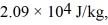 and the atomic weight of helium is
 The change in the entropy of the helium,as it vaporizes,is closest to
The heat of vaporization of helium,at atmospheric pressure,is and the atomic weight of helium is The change in the entropy of the helium,as it vaporizes,is closest to (Multiple Choice)
4.8/5 (73)
(73) A Carnot engine operating between a reservoir of liquid mercury at its melting point (233 K)and a colder reservoir extracts  of heat from the mercury and does
 of work during each cycle.What is the temperature of the colder reservoir?
of heat from the mercury and does of work during each cycle.What is the temperature of the colder reservoir? (Multiple Choice)
4.9/5 (78)
(78) An ice cube at 0°C is placed in a very large bathtub filled with water at 30°C and allowed to melt,causing no appreciable change in the temperature of the bath water.Which one of the following statements is true?
(Multiple Choice)
4.9/5 (77)
(77) A heat engine takes 2.0 moles of an ideal gas through the reversible cycle abca,on the pV diagram shown in the figure.The path bc is an isothermal process.The temperature at c is 820 K,and the volumes at a and c are 0.010 m3 and 0.16 m3,respectively.The molar heat capacity at constant volume,of the gas,is  ,and the ideal gas constant is
 .The thermal efficiency of the engine is closest to
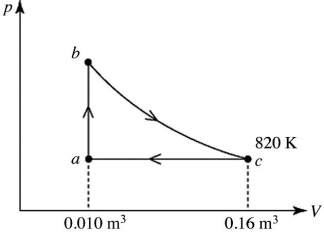
,and the ideal gas constant is .The thermal efficiency of the engine is closest to (Multiple Choice)
4.8/5 (87)
(87) A hot piece of iron is thrown into the ocean and its temperature eventually stabilizes.Which of the following statements concerning this process is correct? (There may be more than one correct choice.)
(Multiple Choice)
4.8/5 (82)
(82) During each cycle of operation,a refrigerator absorbs 230 J of heat from the freezer and expels 356 J of heat to the room.How much work input is required in each cycle?
(Multiple Choice)
4.8/5 (75)
(75) A Carnot cycle engine operates between a low temperature reservoir at 20°C and a high temperature reservoir at 800°C.If the engine is required to output  of work per cycle,how much heat must the high temperature reservoir transfer to the engine during each cycle?
 (Multiple Choice)
4.8/5 (90)
(90) A 610-g quantity of an ideal gas undergoes a reversible isothermal compression at a temperature of  The compression reduces the volume of the gas from
 initially,to
 finally.The molecular mass of the gas is
 and the ideal gas constant is
 .The entropy change for the gas is closest to
The compression reduces the volume of the gas from initially,to finally.The molecular mass of the gas is and the ideal gas constant is .The entropy change for the gas is closest to (Multiple Choice)
4.9/5 (76)
(76) A heat engine with an efficiency of 30.0% performs 2500 J of work.How much heat is discharged to the lower temperature reservoir?
(Multiple Choice)
4.8/5 (87)
(87) 
Filters
- Essay(0)
- Multiple Choice(0)
- Short Answer(0)
- True False(0)
- Matching(0)