



 Chat with AI
Exam 11: Liquids, solids, and Intermolecular Forces

Exam 1: Units of Measurement for Physical and Chemical Change173 Questions
Exam 2: Atoms and Elements161 Questions
Exam 3: Molecules,compounds,and Nomenclature172 Questions
Exam 4: Chemical Reactions and Stoichiometry247 Questions
Exam 5: Gases146 Questions
Exam 6: Thermochemistry145 Questions
Exam 7: The Quantum-Mechanical Model of the Atom164 Questions
Exam 8: Periodic Properties of the Elements129 Questions
Exam 9: Chemical Bonding I: Lewis Theory136 Questions
Exam 10: Chemical Bonding II: Molecular Shapes, valence Bond Theory, and Molecular Orbital Theory158 Questions
Exam 11: Liquids, solids, and Intermolecular Forces127 Questions
Exam 12: Solutions153 Questions
Exam 13: Chemical Kinetics156 Questions
Exam 14: Chemical Equilibrium124 Questions
Exam 15: Acids and Bases141 Questions
Exam 16: Aqueous Ionic Equilibrium159 Questions
Exam 17: Gibbs Energy and Thermodynamics119 Questions
Exam 18: Electrochemistry107 Questions
Exam 19: Radioactivity and Nuclear Chemistry108 Questions
Exam 20: Organic Chemistry I: Structures103 Questions
Exam 21: Organic Chemistry II: Reactions93 Questions
Exam 22: Biochemistry49 Questions
Exam 23: Chemistry of the Nonmetals45 Questions
Exam 24: Metals and Metallurgy42 Questions
Exam 25: Transition Metals and Coordination Compounds50 Questions
Select questions type


Ethyl chloride,C2H5Cl,is used as a local anesthetic.It works by cooling tissue as it vaporizes; its heat of vaporization is 26.4 kJ mol-1.How much heat could be removed by 20.0 g of ethyl chloride?
(Multiple Choice)
4.9/5  (71)
(71) Place the following substances in order of decreasing vapour pressure at a given temperature.
PF5 BrF3 CF4
(Multiple Choice)
4.9/5 (63)
(63) 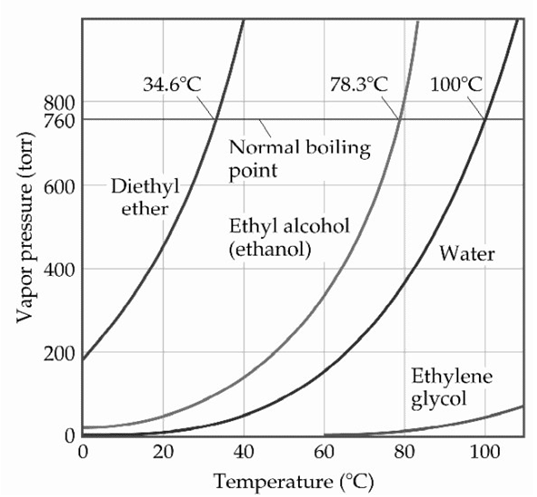 -Based on the figure above,the boiling point of water under an external pressure of 0.316 is _________
 (Multiple Choice)
4.8/5 (67)
(67) What type of intermolecular force causes the dissolution of NaCl in water?
(Multiple Choice)
4.8/5 (73)
(73) The energy required to increase the surface area of a liquid by a unit amount is called ________.
(Multiple Choice)
4.9/5 (78)
(78) Place the following substances in order of increasing vapour pressure at a given temperature.
NF3 NH3 BCl3
(Multiple Choice)
4.9/5 (70)
(70) Which of the following compounds has the highest boiling point?
(Multiple Choice)
4.8/5 (72)
(72) The heat of vaporization of water at 100 °C is 40.66 kJ mol-1.Calculate the quantity of heat that is absorbed/released when 9.00 g of steam condenses to liquid water at 100 °C.
(Multiple Choice)
5.0/5 (84)
(84) Consider the phase diagram shown.Choose the statement below that is TRUE. 
(Multiple Choice)
4.8/5 (76)
(76) Why does the temperature of a substance stay constant during a phase change such as vaporization?
(Essay)
5.0/5 (66)
(66) Which of the following substances should have the highest melting point?
(Multiple Choice)
4.8/5 (68)
(68) The enthalpy change for converting 1.00 mol of ice at -60.0°C to water at 80.0°C is ___________ The specific heats of ice,water,and steam are and respectively.For O, = 6.01 kJ mol-1,and .
(Multiple Choice)
4.9/5 (74)
(74) Determine the vapour pressure (in mbar)of a substance at 29 °C,whose normal boiling point is 76 °C and has a ΔvapH of 38.7 kJ mol-1.
(Multiple Choice)
4.9/5 (81)
(81) 
Filters
- Essay(0)
- Multiple Choice(0)
- Short Answer(0)
- True False(0)
- Matching(0)