



 Chat with AI
Exam 16: The Distribution of Income and Social Policy

Exam 1: Economics Foundations and Models160 Questions
Exam 2: Choices and Trade - Offs in the Market192 Questions
Exam 3: Where Prices Come Frome : The Interaction of Demand and Supply202 Questions
Exam 4: Elasticity: The Responsiveness of Demand and Supply226 Questions
Exam 5: Economic Efficiency , Government Price Setting and Taxes187 Questions
Exam 6: Concumer Choice and Behavioural Economics254 Questions
Exam 7: Technology , Production and Costs300 Questions
Exam 8: Firms in Perfectly Compitive Markets270 Questions
Exam 9: Monopoly Markets281 Questions
Exam 10: Monopolistic Competition : The Competitive Model in More Realistic Setting255 Questions
Exam 11: Oligopoly : Firms in Less Competitve Markets186 Questions
Exam 12: The Market for Labour and Other Factors of Production253 Questions
Exam 13: International Trade111 Questions
Exam 14: Government Intervention in the Market122 Questions
Exam 15: Externalities , Environmental Policy and Public Goods212 Questions
Exam 16: The Distribution of Income and Social Policy120 Questions
Select questions type


 -Refer to Figure 16-2. If the government imposes an excise tax of $1.00 on every unit sold, the producer's burden of the tax
 (Multiple Choice)
4.8/5  (96)
(96) 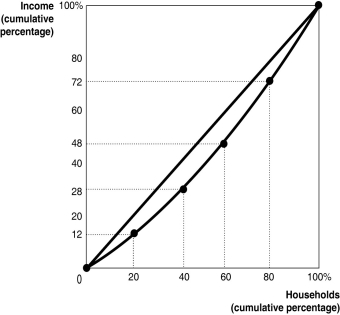 -Refer to Figure 16-5. The middle 20 per cent of households
 (Multiple Choice)
4.9/5 (79)
(79) 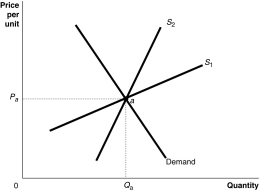 -Refer to Figure 16-3. The figure above shows a demand curve and two supply curves, one more elastic than the other. Use Figure 16-3 to answer the following questions.
a. Suppose the government imposes an excise tax of $1.00 on every unit sold. Use the graph to illustrate the impact of this tax.
b. If the government imposes an excise tax of $1.00 on every unit sold, will the consumer pay more of the tax if the supply curve is S1 or S2? Refer to the graphs in your answer.
c. If an excise tax of $1.00 on every unit sold is imposed, will the revenue collected by the government be greater if the supply curve is S1 or S2?
d. If the government imposes an excise tax of $1.00 on every unit sold, will the deadweight loss be greater if the supply curve is S1 or S2?
-Refer to Figure 16-3. The figure above shows a demand curve and two supply curves, one more elastic than the other. Use Figure 16-3 to answer the following questions.
a. Suppose the government imposes an excise tax of $1.00 on every unit sold. Use the graph to illustrate the impact of this tax.
b. If the government imposes an excise tax of $1.00 on every unit sold, will the consumer pay more of the tax if the supply curve is S1 or S2? Refer to the graphs in your answer.
c. If an excise tax of $1.00 on every unit sold is imposed, will the revenue collected by the government be greater if the supply curve is S1 or S2?
d. If the government imposes an excise tax of $1.00 on every unit sold, will the deadweight loss be greater if the supply curve is S1 or S2? (Essay)
4.9/5 (86)
(86)
-Refer to Figure 16-5. The highest 20 per cent of households
-Refer to Figure 16-5. The highest 20 per cent of households (Multiple Choice)
4.9/5 (81)
(81)  -Refer to Figure 16-6. If area X = 2060, area Y = 240, and area Z = 2700, calculate the Gini coefficient for Islandia.
 (Multiple Choice)
4.9/5 (82)
(82) According to the benefits-received principle, those who receive the benefits from a government program should pay the taxes that support the program.
(True/False)
4.9/5 (82)
(82) When considering changes in tax policy, economists usually focus on
(Multiple Choice)
4.9/5 (87)
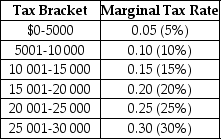
(87) Last year, Anthony Millanti earned exactly $30 000 of taxable income. Assume that the income tax system used to determine Anthony's tax liability is progressive. The table below lists the tax brackets and the marginal tax rates that apply to each bracket.
a. Draw a new table that lists the amounts of income tax that Anthony is obligated to pay for each tax bracket, and the total tax he owes the government. (Assume that there are no allowable tax deductions, tax credits, personal exemptions or any other deductions that Anthony can use to reduce his tax liability).
b. Determine Anthony's average tax rate.
(Essay)
4.9/5 (88)
(88) If your income is $40 000 and you pay taxes of $4650, what is your average tax rate? Show your work.
(Essay)
5.0/5 (67)
(67)
-Refer to Figure 16-2. If the government imposes an excise tax of $1.00 on every unit sold, the producer's burden of the tax
-Refer to Figure 16-2. If the government imposes an excise tax of $1.00 on every unit sold, the producer's burden of the tax (Multiple Choice)
4.9/5 (72)
(72)
-Refer to Figure 16-2. If the government imposes an excise tax of $1.00 on every unit sold,
-Refer to Figure 16-2. If the government imposes an excise tax of $1.00 on every unit sold, (Multiple Choice)
4.9/5 (83)
(83) The idea that two taxpayers in the same economic circumstances should pay the same level of taxes is known as the
(Multiple Choice)
4.8/5 (78)
(78) How would the elimination of a sales tax affect the market for a product that had been subject to the tax?
(Multiple Choice)
4.9/5 (84)
(84) 'Sin taxes,' such as taxes on alcoholic beverages, are intended to
(Multiple Choice)
4.9/5 (76)
(76) Income inequality increases as the Gini coefficient approaches 1.
(True/False)
5.0/5 (91)
(91)
-Refer to Figure 16-2. If the government imposes an excise tax of $1.00 on every unit sold, the consumer's burden of the tax
-Refer to Figure 16-2. If the government imposes an excise tax of $1.00 on every unit sold, the consumer's burden of the tax (Multiple Choice)
4.9/5 (85)
(85) Consider a public good such as fire protection services. Rich people may benefit more than the poor from such a service because rich people stand to lose more from a fire that destroys property. In this case
(Multiple Choice)
4.7/5 (86)
(86) 
Filters
- Essay(0)
- Multiple Choice(0)
- Short Answer(0)
- True False(0)
- Matching(0)