



 Chat with AI
Exam 7: Technology , Production and Costs

Exam 1: Economics Foundations and Models160 Questions
Exam 2: Choices and Trade - Offs in the Market192 Questions
Exam 3: Where Prices Come Frome : The Interaction of Demand and Supply202 Questions
Exam 4: Elasticity: The Responsiveness of Demand and Supply226 Questions
Exam 5: Economic Efficiency , Government Price Setting and Taxes187 Questions
Exam 6: Concumer Choice and Behavioural Economics254 Questions
Exam 7: Technology , Production and Costs300 Questions
Exam 8: Firms in Perfectly Compitive Markets270 Questions
Exam 9: Monopoly Markets281 Questions
Exam 10: Monopolistic Competition : The Competitive Model in More Realistic Setting255 Questions
Exam 11: Oligopoly : Firms in Less Competitve Markets186 Questions
Exam 12: The Market for Labour and Other Factors of Production253 Questions
Exam 13: International Trade111 Questions
Exam 14: Government Intervention in the Market122 Questions
Exam 15: Externalities , Environmental Policy and Public Goods212 Questions
Exam 16: The Distribution of Income and Social Policy120 Questions
Select questions type


An important reason why diseconomies of scale arise is because firms may have to hire lower-skilled workers as firms expand.
(True/False)
4.9/5  (76)
(76) The marginal product of labour is calculated using the formula
(Multiple Choice)
4.9/5 (81)
(81) Consider a manufacturing operation that uses specialised machinery and labour to produce its output. In this case, the input that is not fixed in the short run is labour.
(True/False)
4.9/5 (86)
(86) In the short run, changes in output can only be brought about by a change in the quantity of variable inputs.
(True/False)
4.9/5 (83)
(83)  -Refer to Figure 7-11. In the short run, if the firm sells fewer than 5000 picture frames per month,
 (Multiple Choice)
4.9/5 (92)
(92) In the short run, if marginal product is at its maximum, then
(Multiple Choice)
4.9/5 (75)
(75) Diminishing marginal product of labour occurs when adding another unit of labour
(Multiple Choice)
4.9/5 (63)
(63) Which of the following is true at the output level where average total cost is at its minimum?
(Multiple Choice)
4.8/5 (81)
(81) Average fixed cost can be calculated using any of the formulas below except
(Multiple Choice)
4.9/5 (76)
(76)
-Refer to Table 7-5. Suzette's Fancy Packaging subcontracts with Sunshineland Pecans to box dried fruit and nuts for Suzette's mail order business. Suzette rents space for her factory for $400 a week in a nearby strip mall. She can hire temporary workers for $200 a week. Table 7-5 above shows her output and cost data. Use the table to answer questions a-e.
a. Complete the table.
b. In the last week of summer Suzette closes her business to go on a family vacation. What are her costs during that week?
c. In one week Suzette exactly breaks even. If her revenue for the week is $1200, how many boxes of fruit and nuts did she produce?
d. Judging from the marginal product of labour data, would you say that Suzette had to settle for increasingly unproductive workers? Explain your answer.
e. Suzette has received an order for 1500 boxes of nuts per week for the next 3 months. If she expects the trend in the marginal product of labour will continue in the same direction, what do you think she should do? Should she not commit until she can move to a larger space or should she just hire more workers? Explain your answer.
(Essay)
4.7/5 (78)
(78) 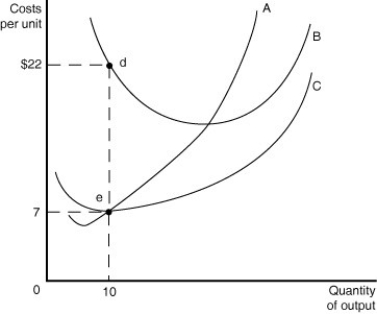 -Refer to Figure 7-8 above to answer the following questions.
a. Identify the curves in the diagram.
A ________
B ________
C ________
b. What is the numerical value of fixed cost when the quantity of output = 10?
c. What is the numerical value of variable cost when the quantity of output = 10?
d. What is the numerical value of total cost when the quantity of output = 10?
e. What is the numerical value of average fixed cost when the quantity of output = 10?
f. What is the numerical value of average total cost when the quantity of output = 10?
g. On the graph identify the area that represents the total variable cost of production when the quantity of output = 10.
h. On the graph identify the area that represents the fixed cost of production when the quantity of output = 10.
-Refer to Figure 7-8 above to answer the following questions.
a. Identify the curves in the diagram.
A ________
B ________
C ________
b. What is the numerical value of fixed cost when the quantity of output = 10?
c. What is the numerical value of variable cost when the quantity of output = 10?
d. What is the numerical value of total cost when the quantity of output = 10?
e. What is the numerical value of average fixed cost when the quantity of output = 10?
f. What is the numerical value of average total cost when the quantity of output = 10?
g. On the graph identify the area that represents the total variable cost of production when the quantity of output = 10.
h. On the graph identify the area that represents the fixed cost of production when the quantity of output = 10. (Essay)
4.8/5 (79)
(79)
-Refer to Table 7-7. What is the marginal cost per unit of production when the firm produces 100 lanterns?
(Multiple Choice)
4.9/5 (66)
(66) When a firm produces 50 000 units of output, its total cost equals $6.5 million. When it increases its production to 70 000 units of output, its total cost increases to $9.4 million. Within this range, the marginal cost of an additional unit of output is
(Multiple Choice)
4.9/5 (69)
(69) Marginal cost is calculated for a particular increase in output by
(Multiple Choice)
5.0/5 (81)
(81) Is it possible for technological change to be negative? If so, give an example.
(Essay)
4.7/5 (78)
(78) The absolute value of the slope of an isocost line equals the ratio of
(Multiple Choice)
4.8/5 (76)
(76) Consider a firm that uses two inputs, labour and capital, to produce its output. Assume labour is measured on the horizontal axis and capital on the vertical axis. Which of the following best explains why the marginal rate of technical substitution decreases in absolute value as we move down an isoquant?
(Multiple Choice)
4.9/5 (88)
(88)  -Refer to Figure 7-1. In a diagram that shows the marginal product of labour on the vertical axis and labour on the horizontal axis, the marginal product curve
 (Multiple Choice)
4.8/5 (72)
(72) Which of the following can a firm do in the long run but not in the short run?
(Multiple Choice)
4.8/5 (91)
(91) 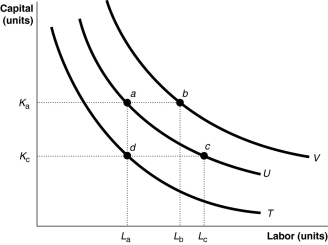 -Refer to Figure 7-12. Which of the following statements about the input combinations shown in the diagram is false?
 (Multiple Choice)
4.7/5 (81)
(81) 
Filters
- Essay(0)
- Multiple Choice(0)
- Short Answer(0)
- True False(0)
- Matching(0)