



 Chat with AI
Exam 19: Organic Compounds

Exam 1: Patterns of Motion and Equilibrium94 Questions
Exam 2: Newtons Laws of Motion109 Questions
Exam 3: Momentum and Energy128 Questions
Exam 4: Gravity, Projectiles, and Satellites114 Questions
Exam 5: Fluid Mechanics120 Questions
Exam 6: Thermal Energy and Thermodynamics100 Questions
Exam 7: Heat Transfer and Change of Phase115 Questions
Exam 8: Static and Current Electricity144 Questions
Exam 9: Magnetism and Electromagnetic Induction105 Questions
Exam 10: Waves and Sound120 Questions
Exam 11: Light146 Questions
Exam 12: Atoms and the Periodic Table128 Questions
Exam 13: The Atomic Nucleus and Radioactivity124 Questions
Exam 14: Elements of Chemistry49 Questions
Exam 15: How Atoms Bond and Molecules Attract150 Questions
Exam 16: Mixtures141 Questions
Exam 17: How Chemicals React118 Questions
Exam 18: Two Classes of Chemical Reactions182 Questions
Exam 19: Organic Compounds98 Questions
Exam 20: Rocks and Minerals170 Questions
Exam 21: Plate Tectonics and Earths Interior175 Questions
Exam 22: Shaping Earths Surface175 Questions
Exam 23: Geologic Timereading the Rock Record145 Questions
Exam 24: The Oceans, Atmosphere, and Climatic Effects172 Questions
Exam 25: Driving Forces of Weather145 Questions
Exam 26: The Solar System87 Questions
Exam 27: Stars and Galaxies84 Questions
Exam 28: The Structure of Space and Time55 Questions
Exam 29: Prologue: the Nature of Science22 Questions
Select questions type


Which of the following ethers has the highest boiling point?
(Multiple Choice)
4.8/5  (86)
(86) What property of carbon allows for the formation of so many different organic molecules?
(Multiple Choice)
4.8/5 (74)
(74) The following reaction is used to make the polymer described below. What is the other starting material? 
(Multiple Choice)
4.8/5 (98)
(98) Which of the following two stick structures are different conformations of the same molecule? 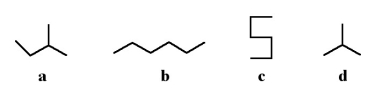
(Multiple Choice)
4.9/5 (86)
(86) What is one thing that all monomers of addition polymers have in common?
(Multiple Choice)
4.9/5 (85)
(85) Explain why caprylic acid, CH3 (CH2)6COOH, dissolves in a 5 percent aqueous solution of sodium hydroxide but caprylaldehyde, CH3 (CH2)6CHO, does not.
(Multiple Choice)
4.9/5 (81)
(81) Which of the following molecules could be a different conformation of the underlined molecule below? 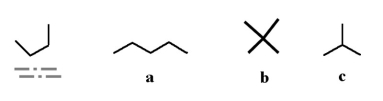
(Multiple Choice)
4.8/5 (77)
(77) Carbon-carbon single bonds can rotate while carbon-carbon double bonds cannot rotate. How many different structures are shown below. 
(Multiple Choice)
4.7/5 (80)
(80) One of the skin-irritating components of poison oak is tetrahydrourushiol: 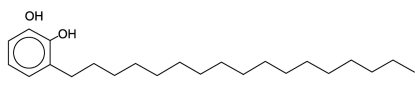 The long, nonpolar hydrocarbon tail embeds itself in a person's oily skin, where the molecule initiates an allergic response. Scratching the itch spreads tetrahydrourushiol molecules over a greater surface area, causing the zone of irritation to grow. Is this compound an alcohol or a phenol?
 (Multiple Choice)
4.9/5 (71)
(71) Which of the following commonly acts as a base in chemical reactions?
(Multiple Choice)
4.8/5 (73)
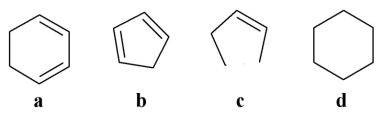
(73) 
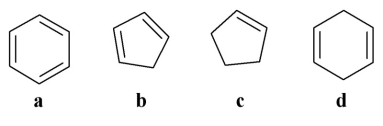
How many structural isomers are there for a compound having the molecular formula C3H9N?
(Multiple Choice)
4.9/5 (88)
(88) The copolymer styrene-butadiene rubber (SBR), shown below, is used for making tires as well as bubble gum. Is it an addition polymer or a condensation polymer? 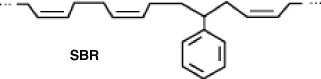
(Multiple Choice)
4.9/5 (85)
(85) Alkaloid salts are not very soluble in the organic solvent diethyl ether. What might happen to the free-base form of caffeine dissolved in diethyl ether if gaseous hydrogen chloride, HCl, were bubbled into the solution? 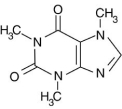
(Multiple Choice)
4.8/5 (78)
(78) Which of the following molecules is not a straight-chain hydrocarbon? 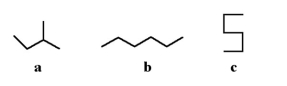
(Multiple Choice)
4.8/5 (82)
(82) 
Filters
- Essay(0)
- Multiple Choice(0)
- Short Answer(0)
- True False(0)
- Matching(0)