



 Chat with AI
Exam 15: How Atoms Bond and Molecules Attract

Exam 1: Patterns of Motion and Equilibrium94 Questions
Exam 2: Newtons Laws of Motion109 Questions
Exam 3: Momentum and Energy128 Questions
Exam 4: Gravity, Projectiles, and Satellites114 Questions
Exam 5: Fluid Mechanics120 Questions
Exam 6: Thermal Energy and Thermodynamics100 Questions
Exam 7: Heat Transfer and Change of Phase115 Questions
Exam 8: Static and Current Electricity144 Questions
Exam 9: Magnetism and Electromagnetic Induction105 Questions
Exam 10: Waves and Sound120 Questions
Exam 11: Light146 Questions
Exam 12: Atoms and the Periodic Table128 Questions
Exam 13: The Atomic Nucleus and Radioactivity124 Questions
Exam 14: Elements of Chemistry49 Questions
Exam 15: How Atoms Bond and Molecules Attract150 Questions
Exam 16: Mixtures141 Questions
Exam 17: How Chemicals React118 Questions
Exam 18: Two Classes of Chemical Reactions182 Questions
Exam 19: Organic Compounds98 Questions
Exam 20: Rocks and Minerals170 Questions
Exam 21: Plate Tectonics and Earths Interior175 Questions
Exam 22: Shaping Earths Surface175 Questions
Exam 23: Geologic Timereading the Rock Record145 Questions
Exam 24: The Oceans, Atmosphere, and Climatic Effects172 Questions
Exam 25: Driving Forces of Weather145 Questions
Exam 26: The Solar System87 Questions
Exam 27: Stars and Galaxies84 Questions
Exam 28: The Structure of Space and Time55 Questions
Exam 29: Prologue: the Nature of Science22 Questions
Select questions type


An individual carbon-oxygen bond is polar. Yet carbon dioxide, CO2, which has two carbon-oxygen bonds, is nonpolar because
(Multiple Choice)
4.7/5  (80)
(80) Chlorine, Cl2, is a gas at room temperature, but bromine, Br2, is a liquid. Explain.
(Multiple Choice)
4.8/5 (58)
(58) How many more electrons can fit within the valence shell of a hydrogen atom?
(Multiple Choice)
4.9/5 (76)
(76) Which would you expect to have a higher melting point: sodium chloride, NaCl, or cesium chloride, CsCl? Why?
(Multiple Choice)
4.8/5 (82)
(82) What molecule loses a proton to form the hydroxide ion, OH⁻?
(Multiple Choice)
4.8/5 (72)
(72) If the concentration of gold in seawater is 2.0 milligram per ton of sea water and the mass of the ocean is 1.5 × 10¹⁸ tons, how much gold is in the ocean?
(Multiple Choice)
4.8/5 (82)
(82) Which of the following molecules would you expect to be the most strongly attracted to a Cl- ion?
(Multiple Choice)
4.9/5 (89)
(89) Which of the following has the greatest number of nonbonding pairs of electrons ?
(Multiple Choice)
4.9/5 (75)
(75) The charges with sodium chloride are all balanced-for every positive sodium ion there is a corresponding negative chloride ion. Since its charges are balanced, how can sodium chloride be attracted to water, and vice versa?
(Multiple Choice)
4.8/5 (80)
(80) If you mix a typical aluminum ion (Al, atomic no. = 13)with a typical oxygen ion (O, atomic no. = 8), what compound is formed?
(Multiple Choice)
4.9/5 (87)
(87) Metals are often used for making designer jewelry because they
(Multiple Choice)
4.9/5 (69)
(69) A substance consisting of which molecule shown below should have a higher boiling point? 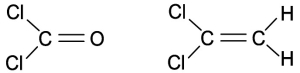
(Multiple Choice)
4.9/5 (76)
(76) Why is calcium fluoride, CaF2, a high melting point crystalline solid while stannic chloride, SnCl4, is a volatile liquid?
(Multiple Choice)
4.9/5 (85)
(85) How many covalent bonds would the following atom usually form? 
(Multiple Choice)
4.8/5 (76)
(76) What does the line in the following example actually represent? H-H
(Multiple Choice)
5.0/5 (91)
(91) 
Filters
- Essay(0)
- Multiple Choice(0)
- Short Answer(0)
- True False(0)
- Matching(0)