



 Chat with AI
Exam 15: How Atoms Bond and Molecules Attract

Exam 1: Patterns of Motion and Equilibrium94 Questions
Exam 2: Newtons Laws of Motion109 Questions
Exam 3: Momentum and Energy128 Questions
Exam 4: Gravity, Projectiles, and Satellites114 Questions
Exam 5: Fluid Mechanics120 Questions
Exam 6: Thermal Energy and Thermodynamics100 Questions
Exam 7: Heat Transfer and Change of Phase115 Questions
Exam 8: Static and Current Electricity144 Questions
Exam 9: Magnetism and Electromagnetic Induction105 Questions
Exam 10: Waves and Sound120 Questions
Exam 11: Light146 Questions
Exam 12: Atoms and the Periodic Table128 Questions
Exam 13: The Atomic Nucleus and Radioactivity124 Questions
Exam 14: Elements of Chemistry49 Questions
Exam 15: How Atoms Bond and Molecules Attract150 Questions
Exam 16: Mixtures141 Questions
Exam 17: How Chemicals React118 Questions
Exam 18: Two Classes of Chemical Reactions182 Questions
Exam 19: Organic Compounds98 Questions
Exam 20: Rocks and Minerals170 Questions
Exam 21: Plate Tectonics and Earths Interior175 Questions
Exam 22: Shaping Earths Surface175 Questions
Exam 23: Geologic Timereading the Rock Record145 Questions
Exam 24: The Oceans, Atmosphere, and Climatic Effects172 Questions
Exam 25: Driving Forces of Weather145 Questions
Exam 26: The Solar System87 Questions
Exam 27: Stars and Galaxies84 Questions
Exam 28: The Structure of Space and Time55 Questions
Exam 29: Prologue: the Nature of Science22 Questions
Select questions type


Given the above diagram, describe what happens electronically between these two molecules.
(Multiple Choice)
4.9/5  (79)
(79) Which of the following molecules would you expect to be the least attracted to a Na+ ion?
(Multiple Choice)
4.9/5 (79)
(79) Which of the following intermolecular forces best describes why molecules like sucrose (which has many OH groups)are very water soluble?
(Multiple Choice)
4.8/5 (76)
(76) Given that the total number of atoms on our planet remains fairly constant, how is it ever possible to deplete a natural resource such as a metal?
(Multiple Choice)
4.7/5 (81)
(81) What property of metal atoms account for many of the observed bulk phenomena seen in metal samples?
(Multiple Choice)
5.0/5 (95)
(95) Water, H2O, and methane, CH4, have about the same mass and differ by only one type of atom. Why is the boiling point of water so much higher than that of methane?
(Multiple Choice)
4.9/5 (77)
(77) If the following generic atom were to undergo ionization, what would be the charge of most likely product? 
(Multiple Choice)
4.9/5 (71)
(71) How is it possible for a neutral molecule, such as water, to form an ion?
(Multiple Choice)
4.8/5 (86)
(86) 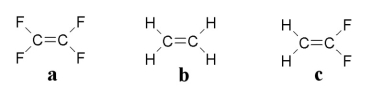
Dipole-induced dipole forces of attraction exist between water and gasoline, and yet these two substances do not mix because water has such a strong attraction for itself. Which of the following compounds might best help to make these two substances mix into a single liquid phase? 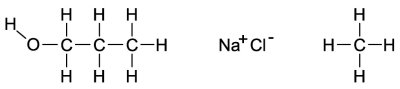
(Multiple Choice)
4.8/5 (89)
(89) The boiling point of 1,4-butanediol is 230°C. Would you expect this compound to be soluble or insoluble in room-temperature water? 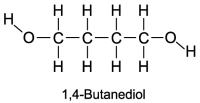
(Multiple Choice)
4.8/5 (95)
(95) Plastic wrap is made of nonpolar molecules and is able to stick well to polar surfaces, such as glass, by way of dipole/induced dipole molecular attractions. How is it that plastic wrap also sticks to itself so well?
(Multiple Choice)
4.8/5 (70)
(70) What is the name for the following polyatomic ion? CH3CO2-1
(Multiple Choice)
4.7/5 (71)
(71) Which of the following is most likely to have the weakest induced dipole-induced dipole interaction?
(Multiple Choice)
4.8/5 (79)
(79) 
Filters
- Essay(0)
- Multiple Choice(0)
- Short Answer(0)
- True False(0)
- Matching(0)