



 Chat with AI
Exam 45: Applications of Nuclear Physics

Exam 1: Physics and Measurement25 Questions
Exam 2: Motion in One Dimension66 Questions
Exam 3: Vectors47 Questions
Exam 4: Motion in Two Dimensions79 Questions
Exam 5: The Laws of Motion113 Questions
Exam 6: Circular Motion and Other Applications of Newtons Laws55 Questions
Exam 7: Energy of a System74 Questions
Exam 8: Conservation of Energy84 Questions
Exam 9: Linear Momentum and Collisions89 Questions
Exam 10: Rotation of a Rigid Object About a Fixed Axis82 Questions
Exam 11: Angular Momentum46 Questions
Exam 12: Static Equilibrium and Elasticity34 Questions
Exam 13: Universal Gravitation47 Questions
Exam 14: Fluid Mechanics53 Questions
Exam 15: Oscillatory Motion41 Questions
Exam 16: Wave Motion46 Questions
Exam 17: Sound Waves48 Questions
Exam 18: Superposition and Standing Waves60 Questions
Exam 19: Temperature47 Questions
Exam 20: The First Law of Thermodynamics61 Questions
Exam 21: The Kinetic Theory of Gases38 Questions
Exam 22: Heat Engines, entropy, and the Second Law of Thermodynamics55 Questions
Exam 23: Electric Fields83 Questions
Exam 24: Gausss Law80 Questions
Exam 25: Electric Potential97 Questions
Exam 26: Capacitance and Dielectrics63 Questions
Exam 27: Current and Resistance34 Questions
Exam 28: Direct-Current Circuits84 Questions
Exam 29: Magnetic Fields80 Questions
Exam 30: Sources of the Magnetic Field105 Questions
Exam 31: Faradays Law62 Questions
Exam 32: Inductance23 Questions
Exam 33: Alternating-Current Circuits65 Questions
Exam 34: Electromagnetic Waves40 Questions
Exam 35: The Nature of Light and the Principles of Ray Optics38 Questions
Exam 36: Image Formation46 Questions
Exam 37: Wave Optics48 Questions
Exam 38: Diffraction Patterns and Polarization47 Questions
Exam 39: Relativity34 Questions
Exam 40: Introduction to Quantum Physics48 Questions
Exam 41: Quantum Mechanics33 Questions
Exam 42: Atomic Physics59 Questions
Exam 43: Molecules and Solids46 Questions
Exam 44: Nuclear Structure50 Questions
Exam 45: Applications of Nuclear Physics40 Questions
Exam 46: Particle Physics and Cosmology34 Questions
Select questions type


A rem (roentgen equivalent in man)is defined as (the product of)
(Multiple Choice)
4.9/5  (86)
(86) Find the number of nuclei per unit volume (n = nuclei/cm3)for lead.
Atomic weight = 202.7
Density = 11.5 g/cm3
Avogadro's number = 6.02 × 10²³
(Multiple Choice)
4.8/5 (81)
(81) In neutron capture by an atomic nucleus,the atomic number changes by
(Multiple Choice)
4.9/5 (64)
(64) A beam of 1-MeV gamma rays incident on a piece of 0.50-cm thick lead is reduced by 50% of its initial value.How thick must the lead be to reduce the beam to one percent of its initial value?
(Multiple Choice)
4.8/5 (73)
(73) A radioactive sample with decay rate R and decay energy Q has power output
(Multiple Choice)
4.8/5 (90)
(90) When a fast neutron collides with a hydrogen or deuterium nucleus,the most likely result is that
(Multiple Choice)
4.8/5 (80)
(80) How fast must two deuterium atoms be moving so they can overcome the Coulomb force of repulsion,and attain the necessary 10−14 m for fusion? (m(  )= 2.014 1 u)
 (Multiple Choice)
4.9/5 (83)
(83) The theory of nuclear astrophysics is that all the heavy elements like uranium are formed in the interior of massive stars.These stars eventually explode,releasing these elements into space.If we assume that at the time of the explosion there were equal amount of U-235 and U-238,how long ago did the star(s)explode that released the elements that formed our Earth? The present U-235/U-238 ratio is 0.0070.[The half-lives of U-235 and U-238 are 0.7 × 10⁹ yr and 4.47 × 10⁹ yr.]
(Short Answer)
4.9/5 (70)
(70)  Stand for?
When a nucleus at rest spontaneously splits into fragments of mass m1 and m2,the ratio of the momentum of m1 to the momentum of m2 is
(Multiple Choice)
4.9/5 (74)
(74) Find the unknown atomic number and mass number respectively,for the following reaction 
(Multiple Choice)
4.8/5 (82)
(82) 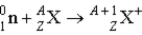 Is known as a ____ reaction.
A principal mechanism for energy loss during nuclear fusion is bremsstrahlung.This loss is associated with
(Multiple Choice)
4.8/5 (93)
(93) When a nucleus at rest spontaneously splits into fragments of mass m1 and m2,the ratio of the velocity of m1 to the velocity of m2 is
(Multiple Choice)
4.9/5 (74)
(74) A nuclear reactor is said to be critical when the average number of neutrons from each fission event that cause(s)another fission event is
(Multiple Choice)
4.8/5 (68)
(68) Approximately how fast is an ion of helium moving if it is in a plasma with a temperature of 108 K? m(He)= 4.002 603 u and u = 1.66 × 10⁻²⁷ kg.
(Multiple Choice)
4.9/5 (83)
(83) A neutron is characterized by the term "thermal neutron" when
(Multiple Choice)
4.9/5 (76)
(76) Calculate the half-value thickness (in mm)of lead if it reduces the intensity of a beam of x-rays whose wavelength is 10 pm by a factor of two.(Assume the linear absorption coefficient of lead is 43 cm−1 for x-rays of wavelength 10 × 10−12 m. )
(Multiple Choice)
4.9/5 (86)
(86) 
Filters
- Essay(0)
- Multiple Choice(0)
- Short Answer(0)
- True False(0)
- Matching(0)