



 Chat with AI
Exam 44: Nuclear Structure

Exam 1: Physics and Measurement25 Questions
Exam 2: Motion in One Dimension66 Questions
Exam 3: Vectors47 Questions
Exam 4: Motion in Two Dimensions79 Questions
Exam 5: The Laws of Motion113 Questions
Exam 6: Circular Motion and Other Applications of Newtons Laws55 Questions
Exam 7: Energy of a System74 Questions
Exam 8: Conservation of Energy84 Questions
Exam 9: Linear Momentum and Collisions89 Questions
Exam 10: Rotation of a Rigid Object About a Fixed Axis82 Questions
Exam 11: Angular Momentum46 Questions
Exam 12: Static Equilibrium and Elasticity34 Questions
Exam 13: Universal Gravitation47 Questions
Exam 14: Fluid Mechanics53 Questions
Exam 15: Oscillatory Motion41 Questions
Exam 16: Wave Motion46 Questions
Exam 17: Sound Waves48 Questions
Exam 18: Superposition and Standing Waves60 Questions
Exam 19: Temperature47 Questions
Exam 20: The First Law of Thermodynamics61 Questions
Exam 21: The Kinetic Theory of Gases38 Questions
Exam 22: Heat Engines, entropy, and the Second Law of Thermodynamics55 Questions
Exam 23: Electric Fields83 Questions
Exam 24: Gausss Law80 Questions
Exam 25: Electric Potential97 Questions
Exam 26: Capacitance and Dielectrics63 Questions
Exam 27: Current and Resistance34 Questions
Exam 28: Direct-Current Circuits84 Questions
Exam 29: Magnetic Fields80 Questions
Exam 30: Sources of the Magnetic Field105 Questions
Exam 31: Faradays Law62 Questions
Exam 32: Inductance23 Questions
Exam 33: Alternating-Current Circuits65 Questions
Exam 34: Electromagnetic Waves40 Questions
Exam 35: The Nature of Light and the Principles of Ray Optics38 Questions
Exam 36: Image Formation46 Questions
Exam 37: Wave Optics48 Questions
Exam 38: Diffraction Patterns and Polarization47 Questions
Exam 39: Relativity34 Questions
Exam 40: Introduction to Quantum Physics48 Questions
Exam 41: Quantum Mechanics33 Questions
Exam 42: Atomic Physics59 Questions
Exam 43: Molecules and Solids46 Questions
Exam 44: Nuclear Structure50 Questions
Exam 45: Applications of Nuclear Physics40 Questions
Exam 46: Particle Physics and Cosmology34 Questions
Select questions type


What is the disintegration energy (in MeV)associated with this spontaneous decay? 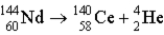 MNd = 143.910 083 u
MCe = 139.905 434 u
MHe = 4.002 603 u
1 u = 1.66 × 10⁻²⁷ kg
MNd = 143.910 083 u
MCe = 139.905 434 u
MHe = 4.002 603 u
1 u = 1.66 × 10⁻²⁷ kg (Multiple Choice)
4.9/5  (80)
(80) It is often possible to use atomic masses when calculating the binding energy of a nucleus.This is not true for calculating the Q value for the e+ decay process since
(Multiple Choice)
4.7/5 (83)
(83) How can a nucleus be described by particular values of A,Z and N when the mass of the nucleus is not equal to Zmp + Nmn,where mp and mn are the masses of free protons and neutrons?
(Multiple Choice)
4.8/5 (65)
(65) The chart below shows part of the radioactive series beginning with the isotope  )The isotope marked with an X is
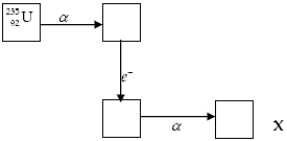
)The isotope marked with an X is (Multiple Choice)
4.8/5 (87)
(87)  (in fm)is
The half-life of 131I is 8 days.On a certain day,the activity of an 131I sample is 6.4 mCi.What is its activity 40 days later?
(Short Answer)
5.0/5 (88)
(88) In nuclear magnetic resonance,nuclei absorb energy when flipping between nuclear
(Multiple Choice)
4.8/5 (74)
(74) The radius of an approximately spherical nucleus is given by r =
(Multiple Choice)
4.9/5 (90)
(90) According to the shell model,binding energy per nucleon is greater when N or Z is equal to one of the numbers below except for
(Multiple Choice)
4.9/5 (95)
(95) Which of the effects listed below is not a major effect influencing the binding energy of the nucleus in the liquid-drop model?
(Multiple Choice)
5.0/5 (78)
(78) The isotope,tritium,has a half-life of 12.3 years.Assume we have 10 kg of the substance.What will be the initial decay rate,at t = 0 (in decays/s)?
(Multiple Choice)
4.8/5 (82)
(82) How many radioactive atoms are present in a sample that has an activity of 0.5 μCi and a half-life of 10 years? (1 curie = 3.7 × 10¹⁰ decays/s)
(Multiple Choice)
4.9/5 (77)
(77) The isotope,tritium,has a half-life of 12.3 years.Assume we have 10 kg of the substance.How much tritium will be left after 30 years?
(Multiple Choice)
4.9/5 (78)
(78) The ratio of the density of a neutron (r = r0A1/3)to the density of a classical electron (re = ke2/mec2 = 2.8 × 10⁻¹⁵ m)is
(Multiple Choice)
4.9/5 (89)
(89) One of the naturally occurring radioactive series begins with  )Which of the following isotopes is the stable isotope at the end of this series?
 (Multiple Choice)
4.8/5 (76)
(76) The Q value for the following reaction, 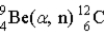 ,is (in MeV)
M(alpha)= 4.002 603 u
M(Be)= 9.012 182 u
m(n.= 1.008 665 u
M(C)= 12.000 00 u
1 u = 1.66 × 10⁻²⁷ kg
,is (in MeV)
M(alpha)= 4.002 603 u
M(Be)= 9.012 182 u
m(n.= 1.008 665 u
M(C)= 12.000 00 u
1 u = 1.66 × 10⁻²⁷ kg (Multiple Choice)
4.8/5 (82)
(82) An alpha particle is emitted from a radioactive source with an energy of 5 MeV.How fast is it moving (in m/s)? (m = 4.002 603 u,1 u = 1.66 × 10⁻²⁷ kg. )
(Multiple Choice)
4.9/5 (78)
(78) Linus claims that the added gravitational force of neutrons holds the particles in a nucleus together.Linnea says that they stick together because they lose their electric charge when they form a nucleus.Which one,if either,is correct,and why?
(Multiple Choice)
4.9/5 (79)
(79) It is often possible to use the atomic masses when calculating the binding energy of a nucleus.The reason for this is
(Multiple Choice)
4.9/5 (84)
(84) 
Filters
- Essay(0)
- Multiple Choice(0)
- Short Answer(0)
- True False(0)
- Matching(0)