



 Chat with AI
Exam 43: Molecules and Solids

Exam 1: Physics and Measurement25 Questions
Exam 2: Motion in One Dimension66 Questions
Exam 3: Vectors47 Questions
Exam 4: Motion in Two Dimensions79 Questions
Exam 5: The Laws of Motion113 Questions
Exam 6: Circular Motion and Other Applications of Newtons Laws55 Questions
Exam 7: Energy of a System74 Questions
Exam 8: Conservation of Energy84 Questions
Exam 9: Linear Momentum and Collisions89 Questions
Exam 10: Rotation of a Rigid Object About a Fixed Axis82 Questions
Exam 11: Angular Momentum46 Questions
Exam 12: Static Equilibrium and Elasticity34 Questions
Exam 13: Universal Gravitation47 Questions
Exam 14: Fluid Mechanics53 Questions
Exam 15: Oscillatory Motion41 Questions
Exam 16: Wave Motion46 Questions
Exam 17: Sound Waves48 Questions
Exam 18: Superposition and Standing Waves60 Questions
Exam 19: Temperature47 Questions
Exam 20: The First Law of Thermodynamics61 Questions
Exam 21: The Kinetic Theory of Gases38 Questions
Exam 22: Heat Engines, entropy, and the Second Law of Thermodynamics55 Questions
Exam 23: Electric Fields83 Questions
Exam 24: Gausss Law80 Questions
Exam 25: Electric Potential97 Questions
Exam 26: Capacitance and Dielectrics63 Questions
Exam 27: Current and Resistance34 Questions
Exam 28: Direct-Current Circuits84 Questions
Exam 29: Magnetic Fields80 Questions
Exam 30: Sources of the Magnetic Field105 Questions
Exam 31: Faradays Law62 Questions
Exam 32: Inductance23 Questions
Exam 33: Alternating-Current Circuits65 Questions
Exam 34: Electromagnetic Waves40 Questions
Exam 35: The Nature of Light and the Principles of Ray Optics38 Questions
Exam 36: Image Formation46 Questions
Exam 37: Wave Optics48 Questions
Exam 38: Diffraction Patterns and Polarization47 Questions
Exam 39: Relativity34 Questions
Exam 40: Introduction to Quantum Physics48 Questions
Exam 41: Quantum Mechanics33 Questions
Exam 42: Atomic Physics59 Questions
Exam 43: Molecules and Solids46 Questions
Exam 44: Nuclear Structure50 Questions
Exam 45: Applications of Nuclear Physics40 Questions
Exam 46: Particle Physics and Cosmology34 Questions
Select questions type


The energy of a molecule can normally be divided into the following categories:
(Multiple Choice)
4.8/5  (83)
(83) The wave functions of some molecules are a combination of wave functions with different values of the orbital quantum number  )The wave function of PF5 combines s,p and d states in an sp3d hybrid orbital.We would expect such an overlap of wave functions in individual molecules to represent
 (Multiple Choice)
4.8/5 (60)
(60) The moment of inertia of a CO molecule is 1.46 × 10−46 kg ⋅ m2.What is the wavelength of the photon emitted if a rotational transition occurs from the J = 3 to the J = 2 state?
(Multiple Choice)
4.9/5 (81)
(81) In the Lennard-Jones model of the hydrogen molecule,the potential is given by 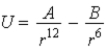 )In this model,the minimum internuclear separation,r0,is
 (Multiple Choice)
4.9/5 (82)
(82) The smallest object one can distinguish using the electron microscope is on the order of one nanometer (1 nm = 10−9 m).How many atoms of gold are contained in a cube whose edge is 1 nm long? The atomic mass of gold is 197 and its density is 19.3 g/cm3.
(Short Answer)
4.9/5 (81)
(81) An oxygen molecule has a moment of inertia of 5 × 10−46 kg ⋅ m2.Calculate the bond length (in nm).Recall that the atomic mass of oxygen is 16 u (1 u = 1.66 × 10⁻²⁷ kg).
(Multiple Choice)
4.9/5 (92)
(92) Because HF,hydrogen fluoride,is a covalent gaseous molecule at room temperature,we might reasonably expect that at room temperature HCl,hydrogen chloride,is
(Multiple Choice)
4.8/5 (81)
(81) A molecule makes a transition from the J = 1 to the J = 0 rotational energy state.The wavelength of the emitted photon is 2.6 × 10⁻³ m.What is the moment of inertia of the molecule (in kg ⋅ m2)?
(Multiple Choice)
4.8/5 (89)
(89) In comparing vibrational and rotational levels in molecules,we find that the energy separation between adjacent energy levels is
(Multiple Choice)
4.8/5 (78)
(78) The dissociation energy of the hydrogen molecule is approximately 5 eV.What is the temperature of a monatomic molecule whose kinetic energy is equal to 5.000 eV?
(Multiple Choice)
4.9/5 (78)
(78) The rotation spectrum of the HCl molecule has been observed in the far infrared,around 50 × 10−6 m.The spacing between successive lines in the spectrum corresponds to radiation of wavelength equal to 5 microns (1 μm = 10−6 m).Determine the frequency of the photon associated with this transition.
(Multiple Choice)
4.8/5 (75)
(75) When calculating the rotational kinetic energy of a diatomic molecule,with atoms of mass m1 and m2,the moment of inertia about an axis passing through the molecule's center of mass,with r the atomic separation,is
(Multiple Choice)
4.8/5 (94)
(94) The energy gap for a semiconductor is 1.25 eV.Of the frequencies given below,what is the minimum frequency photon than can move an electron from the valence band to the conduction band?
(Multiple Choice)
5.0/5 (72)
(72) A diatomic molecule consists of two point masses,m1 and m2,separated by a distance r.If x is the distance from m1 to the center of mass,find the moment of inertia in terms of x about an axis perpendicular to the molecular axis through the center of mass.
(Multiple Choice)
4.9/5 (78)
(78) The Fermi energy of a metal at a temperature T is 7.0 eV.What is the average energy (in eV)of a conduction electron at that temperature?
(Multiple Choice)
4.8/5 (75)
(75) The force constant of HCl is 480 N/m.If the atomic masses are 1 u and 35 u (1 u = 1.66 × 10⁻²⁷ kg),find the fundamental frequency (in Hz).
(Multiple Choice)
4.8/5 (93)
(93) The rotational kinetic energy of a diatomic molecule can take the form
(Multiple Choice)
4.8/5 (94)
(94) 
Filters
- Essay(0)
- Multiple Choice(0)
- Short Answer(0)
- True False(0)
- Matching(0)