



 Chat with AI
Exam 37: Wave Optics

Exam 1: Physics and Measurement25 Questions
Exam 2: Motion in One Dimension66 Questions
Exam 3: Vectors47 Questions
Exam 4: Motion in Two Dimensions79 Questions
Exam 5: The Laws of Motion113 Questions
Exam 6: Circular Motion and Other Applications of Newtons Laws55 Questions
Exam 7: Energy of a System74 Questions
Exam 8: Conservation of Energy84 Questions
Exam 9: Linear Momentum and Collisions89 Questions
Exam 10: Rotation of a Rigid Object About a Fixed Axis82 Questions
Exam 11: Angular Momentum46 Questions
Exam 12: Static Equilibrium and Elasticity34 Questions
Exam 13: Universal Gravitation47 Questions
Exam 14: Fluid Mechanics53 Questions
Exam 15: Oscillatory Motion41 Questions
Exam 16: Wave Motion46 Questions
Exam 17: Sound Waves48 Questions
Exam 18: Superposition and Standing Waves60 Questions
Exam 19: Temperature47 Questions
Exam 20: The First Law of Thermodynamics61 Questions
Exam 21: The Kinetic Theory of Gases38 Questions
Exam 22: Heat Engines, entropy, and the Second Law of Thermodynamics55 Questions
Exam 23: Electric Fields83 Questions
Exam 24: Gausss Law80 Questions
Exam 25: Electric Potential97 Questions
Exam 26: Capacitance and Dielectrics63 Questions
Exam 27: Current and Resistance34 Questions
Exam 28: Direct-Current Circuits84 Questions
Exam 29: Magnetic Fields80 Questions
Exam 30: Sources of the Magnetic Field105 Questions
Exam 31: Faradays Law62 Questions
Exam 32: Inductance23 Questions
Exam 33: Alternating-Current Circuits65 Questions
Exam 34: Electromagnetic Waves40 Questions
Exam 35: The Nature of Light and the Principles of Ray Optics38 Questions
Exam 36: Image Formation46 Questions
Exam 37: Wave Optics48 Questions
Exam 38: Diffraction Patterns and Polarization47 Questions
Exam 39: Relativity34 Questions
Exam 40: Introduction to Quantum Physics48 Questions
Exam 41: Quantum Mechanics33 Questions
Exam 42: Atomic Physics59 Questions
Exam 43: Molecules and Solids46 Questions
Exam 44: Nuclear Structure50 Questions
Exam 45: Applications of Nuclear Physics40 Questions
Exam 46: Particle Physics and Cosmology34 Questions
Select questions type


The figure shows two point sources of light,A and B.B emits light waves that are +π radians out of phase with the waves from A.A is 3λ from P.B is 5λ from P.(λ is the wavelength. )The phase difference between waves arriving at P from A and B is 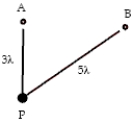
(Multiple Choice)
4.8/5  (82)
(82) When a central dark fringe is observed in reflection in a circular interference pattern,waves reflected from the upper and lower surfaces of the medium must have a phase difference,in radians,of
(Multiple Choice)
4.8/5 (77)
(77) A laser beam (λ = 694 nm)is incident on two slits 0.100 mm apart.Approximately how far apart (in m)will the bright interference fringes be on the screen 5.00 m from the double slits?
(Multiple Choice)
4.8/5 (74)
(74) Monochromatic light (λ = 500 nm)is incident on a soap bubble (n = 1.4)that is 500-nm thick.Calculate the change of phase of the light that penetrates the front surface,reflects from the second surface,and emerges through the first surface as an angle between 0° and 360°?
(Multiple Choice)
4.9/5 (65)
(65) A planar cross section through two spherical waves emanating from the sources S1 and S2 in the plane is shown in the figure.S1 and S2 are in phase.The black circles are one and two wavelengths from their respective sources.The lighter circles are one half and one and a half wavelengths distant from their respective sources.If the waves shown arriving at P2 both arrive with amplitude A,the resultant amplitude at point P2 is 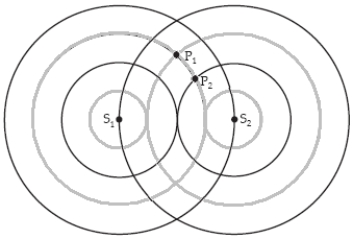
(Multiple Choice)
4.9/5 (78)
(78) Two slits are illuminated with red light (λ = 650 nm).The slits are 0.25 mm apart and the distance to the screen is 1.25 m.What fraction of the maximum intensity on the screen is the intensity measured at a distance 3.0 mm from the central maximum?
(Multiple Choice)
4.8/5 (76)
(76) A film of index of refraction n1 coats a surface with index of refraction n2.When n1 > n2,the condition for destructive interference for reflected monochromatic light of wavelength λ in air is
(Multiple Choice)
4.9/5 (79)
(79) Nonreflective coatings for camera lenses reduce the loss of light at various surfaces of multi-lens systems,as well as preventing internal reflections that might mar the image.Find the minimum thickness of a layer of magnesium fluoride (n = 1.38)on flint glass (n = 1.66)that will cause destructive interference of reflected light of wavelength λ = 550 nm,a wavelength which is near the middle of the visual spectrum.
(Short Answer)
4.9/5 (88)
(88) Two slits separated by 0.10 mm are illuminated with green light (λ = 540 nm).Calculate the distance (in cm)from the central bright-region to the fifth bright band if the screen is 1.0 m away.
(Multiple Choice)
4.9/5 (73)
(73) Ray says that interference effects cannot be observed with visible light because random phase changes occur in time intervals less than a nanosecond.Stacy says that doesn't matter if collimated light from a single source reaches multiple openings.(They are arguing about a light source 50.0 cm away from two 0.010 0 mm-wide slits,2.00 mm apart,with a screen 1.00 m away from the slits. )Which one,if either,is correct,and why?
(Multiple Choice)
4.9/5 (87)
(87) In a double slit experiment,the distance between the slits is 0.2 mm and the distance to the screen is 150 cm.What is the phase difference (in degrees)between the waves from the two slits arriving at a point P when the angular distance of P is 10° relative to the central peak,and the wavelength is 500 nm? (Convert your result so the angle is between 0 and 360°. )
(Multiple Choice)
4.8/5 (77)
(77) Light is incident on a double-slit.The fourth bright band has an angular distance of 7.0° from the central maximum.What is the distance between the slits (in μm)? (Assume the frequency of the light is 5.4 × 10¹⁴ Hz. )
(Multiple Choice)
4.8/5 (69)
(69) A uniform film of oil (n = 1.31)is floating on water.When sunlight in air is incident normally on the film,an observer finds that the reflected light has a brightness maximum at λ = 450 nm and a brightness minimum at λ = 600 nm.What is the thickness of the oil film?
(Short Answer)
4.8/5 (97)
(97) Two slits are illuminated with green light (λ = 540 nm).The slits are 0.05 mm apart and the distance to the screen is 1.5 m.At what distance (in mm)from the central maximum on the screen is the average intensity 50% of the intensity of the central maximum?
(Multiple Choice)
4.8/5 (84)
(84) Monochromatic light (λ = 500 nm)is incident on a soap bubble (n = 1.40).How thick is the bubble (in nm)if destructive interference occurs in the reflected light?
(Multiple Choice)
4.7/5 (67)
(67) Bright and dark fringes are seen on a screen when light from a single source reaches two narrow slits a short distance apart.The locations of bright and dark fringes can be interchanged if a thin film is placed in front of one of the slits.The minimum thickness of this film must be
(Multiple Choice)
4.8/5 (73)
(73) Bright and dark fringes are seen on a screen when light from a single source reaches two narrow slits a short distance apart.The number of fringes per unit length on the screen can be doubled
(Multiple Choice)
4.8/5 (75)
(75) The superposition of two waves E1 = E0 sin(ωt)and E2 = E0 sin(ωt + φ)arriving at the same point in space at the same time is E =
(Multiple Choice)
4.9/5 (83)
(83) A film of index of refraction n1 coats a surface with index of refraction n2.When n1 < n2,the condition for constructive interference for reflected monochromatic light of wavelength λ in air is
(Multiple Choice)
5.0/5 (73)
(73) The electric fields arriving at a point P from three coherent sources are described by E1 = E0 sin ωt,E2 = E0 sin (ωt + π/4)and E3 = E0 sin (ωt + π/2).Assume the resultant field is represented by Ep = ER sin (ωt + α).The amplitude of the resultant wave at P is
(Multiple Choice)
4.9/5 (62)
(62) 
Filters
- Essay(0)
- Multiple Choice(0)
- Short Answer(0)
- True False(0)
- Matching(0)