



 Chat with AI
Exam 30: Sources of the Magnetic Field

Exam 1: Physics and Measurement25 Questions
Exam 2: Motion in One Dimension66 Questions
Exam 3: Vectors47 Questions
Exam 4: Motion in Two Dimensions79 Questions
Exam 5: The Laws of Motion113 Questions
Exam 6: Circular Motion and Other Applications of Newtons Laws55 Questions
Exam 7: Energy of a System74 Questions
Exam 8: Conservation of Energy84 Questions
Exam 9: Linear Momentum and Collisions89 Questions
Exam 10: Rotation of a Rigid Object About a Fixed Axis82 Questions
Exam 11: Angular Momentum46 Questions
Exam 12: Static Equilibrium and Elasticity34 Questions
Exam 13: Universal Gravitation47 Questions
Exam 14: Fluid Mechanics53 Questions
Exam 15: Oscillatory Motion41 Questions
Exam 16: Wave Motion46 Questions
Exam 17: Sound Waves48 Questions
Exam 18: Superposition and Standing Waves60 Questions
Exam 19: Temperature47 Questions
Exam 20: The First Law of Thermodynamics61 Questions
Exam 21: The Kinetic Theory of Gases38 Questions
Exam 22: Heat Engines, entropy, and the Second Law of Thermodynamics55 Questions
Exam 23: Electric Fields83 Questions
Exam 24: Gausss Law80 Questions
Exam 25: Electric Potential97 Questions
Exam 26: Capacitance and Dielectrics63 Questions
Exam 27: Current and Resistance34 Questions
Exam 28: Direct-Current Circuits84 Questions
Exam 29: Magnetic Fields80 Questions
Exam 30: Sources of the Magnetic Field105 Questions
Exam 31: Faradays Law62 Questions
Exam 32: Inductance23 Questions
Exam 33: Alternating-Current Circuits65 Questions
Exam 34: Electromagnetic Waves40 Questions
Exam 35: The Nature of Light and the Principles of Ray Optics38 Questions
Exam 36: Image Formation46 Questions
Exam 37: Wave Optics48 Questions
Exam 38: Diffraction Patterns and Polarization47 Questions
Exam 39: Relativity34 Questions
Exam 40: Introduction to Quantum Physics48 Questions
Exam 41: Quantum Mechanics33 Questions
Exam 42: Atomic Physics59 Questions
Exam 43: Molecules and Solids46 Questions
Exam 44: Nuclear Structure50 Questions
Exam 45: Applications of Nuclear Physics40 Questions
Exam 46: Particle Physics and Cosmology34 Questions
Select questions type


A current element (length = 1.0 cm)lies along the x axis with its center at x = 0 and carries a 20-A current in the positive x direction.Consider only the field of this current element and decide which combination of the following statements is correct.
(Short Answer)
4.7/5  (79)
(79) A long solenoid (1500 turns/m)carries a current of 20 mA and has an inside diameter of 4.0 cm.A long wire carries a current of 2.0 A along the axis of the solenoid.What is the magnitude of the magnetic field at a point that is inside the solenoid and 1.0 cm from the wire?
(Multiple Choice)
4.9/5 (74)
(74) Two long parallel wires carry unequal currents in opposite directions.The ratio of the currents is 3 to 1.The magnitude of the magnetic field at a point in the plane of the wires and 10 cm from each wire is 4.0 μT.What is the larger of the two currents?
(Multiple Choice)
4.8/5 (70)
(70) When a ferromagnetic material that has been magnetized is brought to a temperature greater than the Curie temperature,what happens to its residual magnetism.
(Multiple Choice)
4.8/5 (75)
(75) A long wire is known to have a radius greater than 4.0 mm and to carry a current uniformly distributed over its cross section.If the magnitude of the magnetic field is 0.285 mT at a point 4.0 mm from the axis of the wire and 0.200 mT at a point 10 mm from the axis,what is the radius of the wire?
(Multiple Choice)
4.9/5 (73)
(73) Two wires,each having a weight per unit length of 1.0 × 10⁻⁴ N/m,are strung parallel,one 0.10 m above the other.If the wires carry the same current,though in opposite directions,how great must the current in each wire be for the magnetic field of the lower conductor to balance the weight of the upper conductor?
(Short Answer)
4.8/5 (87)
(87) Each of two long straight parallel wires separated by a distance of 16 cm carries a current of 20 A in the same direction.What is the magnitude of the resulting magnetic field at a point that is 10 cm from each wire?
(Multiple Choice)
4.7/5 (73)
(73) A current-carrying 2.0-cm long segment of wire is inside a long solenoid (radius = 4.0 cm,n = 800 turns/m,current = 50 mA).The wire segment is oriented perpendicularly to the axis of the solenoid.If the current in the wire segment is 12 A,what is the magnitude of the magnetic force on this segment?
(Multiple Choice)
4.8/5 (90)
(90) Two very long parallel wires carry currents in the positive x direction.One wire (current = 15 A)is coincident with the x axis.The other wire (current = 50 A)passes through the point (0,4.0 mm,0).What is the magnitude of the magnetic field at the point (0,0,3.0 mm)?
(Multiple Choice)
4.8/5 (67)
(67) Each of two parallel wires separated by 8.0 mm carries a 20-A current.These two currents are oppositely directed.Determine the magnitude of the magnetic field at a point that is 5.0 mm from each of the wires.
(Multiple Choice)
4.8/5 (75)
(75) If you were to travel parallel to an infinitely long straight wire with current I at the same velocity as the electrons in the wire at a distance a from the wire,the magnitude of the magnetic field (according to your measuring instruments)would be
(Multiple Choice)
4.9/5 (80)
(80) Which of the following type(s)of materials is(are)repelled when a magnet is brought near by?
(Multiple Choice)
4.9/5 (78)
(78) A 0.50-m long solenoid consists of 1 000 turns of copper wire wound with a 4.0 cm radius.When the current in the solenoid is 18 A,the magnetic field at a point 1.0 cm from the central axis of the solenoid is
(Multiple Choice)
4.7/5 (83)
(83) A long straight wire (diameter = 2.0 mm)carries a current of 30 A.What is the magnitude of the magnetic field 2.5 mm from the axis of the wire?
(Multiple Choice)
4.8/5 (66)
(66) Two long parallel wires are separated by 4.0 cm.One of the wires carries a current of 20 A and the other carries a 30-A current.Determine the magnitude of the magnetic force on a 2.0-m length of the wire carrying the greater current.
(Multiple Choice)
4.7/5 (68)
(68) Two long parallel wires carry unequal currents in the same direction.The ratio of the currents is 3 to 1.The magnitude of the magnetic field at a point in the plane of the wires and 10 cm from each wire is 4.0 μT.What is the larger of the two currents?
(Multiple Choice)
4.8/5 (82)
(82) By using a compass to measure the magnetic field direction at various points adjacent to a long straight wire,you can show that the wire's magnetic field lines are
(Multiple Choice)
4.8/5 (87)
(87) The segment of wire (total length including portions of incoming and outgoing wire = 6R)is formed into the shape shown and carries a current I.What is the magnitude of the resulting magnetic field at the point P? 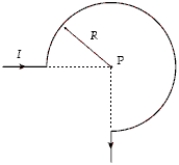
(Multiple Choice)
4.9/5 (85)
(85) What is the magnitude of the magnetic field at point P if a = R and b = 2R? 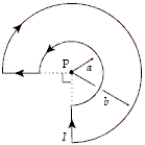
(Multiple Choice)
4.8/5 (85)
(85) The segment of wire (total length = 6R,including the incoming and outgoing portions of the wire)is formed into the shape shown and carries a current I.What is the magnitude of the resulting magnetic field at the point P? 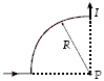
(Multiple Choice)
4.8/5 (79)
(79) 
Filters
- Essay(0)
- Multiple Choice(0)
- Short Answer(0)
- True False(0)
- Matching(0)