



 Chat with AI
Exam 29: Magnetic Fields

Exam 1: Physics and Measurement25 Questions
Exam 2: Motion in One Dimension66 Questions
Exam 3: Vectors47 Questions
Exam 4: Motion in Two Dimensions79 Questions
Exam 5: The Laws of Motion113 Questions
Exam 6: Circular Motion and Other Applications of Newtons Laws55 Questions
Exam 7: Energy of a System74 Questions
Exam 8: Conservation of Energy84 Questions
Exam 9: Linear Momentum and Collisions89 Questions
Exam 10: Rotation of a Rigid Object About a Fixed Axis82 Questions
Exam 11: Angular Momentum46 Questions
Exam 12: Static Equilibrium and Elasticity34 Questions
Exam 13: Universal Gravitation47 Questions
Exam 14: Fluid Mechanics53 Questions
Exam 15: Oscillatory Motion41 Questions
Exam 16: Wave Motion46 Questions
Exam 17: Sound Waves48 Questions
Exam 18: Superposition and Standing Waves60 Questions
Exam 19: Temperature47 Questions
Exam 20: The First Law of Thermodynamics61 Questions
Exam 21: The Kinetic Theory of Gases38 Questions
Exam 22: Heat Engines, entropy, and the Second Law of Thermodynamics55 Questions
Exam 23: Electric Fields83 Questions
Exam 24: Gausss Law80 Questions
Exam 25: Electric Potential97 Questions
Exam 26: Capacitance and Dielectrics63 Questions
Exam 27: Current and Resistance34 Questions
Exam 28: Direct-Current Circuits84 Questions
Exam 29: Magnetic Fields80 Questions
Exam 30: Sources of the Magnetic Field105 Questions
Exam 31: Faradays Law62 Questions
Exam 32: Inductance23 Questions
Exam 33: Alternating-Current Circuits65 Questions
Exam 34: Electromagnetic Waves40 Questions
Exam 35: The Nature of Light and the Principles of Ray Optics38 Questions
Exam 36: Image Formation46 Questions
Exam 37: Wave Optics48 Questions
Exam 38: Diffraction Patterns and Polarization47 Questions
Exam 39: Relativity34 Questions
Exam 40: Introduction to Quantum Physics48 Questions
Exam 41: Quantum Mechanics33 Questions
Exam 42: Atomic Physics59 Questions
Exam 43: Molecules and Solids46 Questions
Exam 44: Nuclear Structure50 Questions
Exam 45: Applications of Nuclear Physics40 Questions
Exam 46: Particle Physics and Cosmology34 Questions
Select questions type


A current loop is oriented in three different positions relative to a uniform magnetic field.In position 1 the plane of the loop is perpendicular to the field lines.In position 2 and 3 the plane of the loop is parallel to the field as shown.The torque on the loop is maximum in 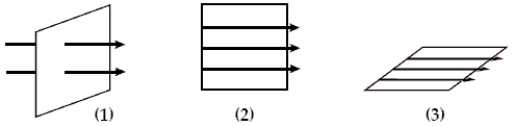
(Multiple Choice)
4.9/5  (66)
(66) The diagram below shows the position of a long straight wire perpendicular to the page and a set of directions labeled A through H. 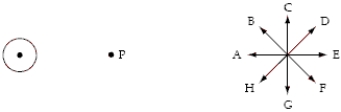 When the current in the wire is directed up out of the page,the direction of the magnetic field at point P is
 (Multiple Choice)
4.8/5 (78)
(78) A charged particle (m = 2.0 g,q = −50 μC)moves in a region of uniform field along a helical path (radius = 4.0 cm,pitch = 8.0 cm)as shown.What is the angle between the velocity of the particle and the magnetic field? 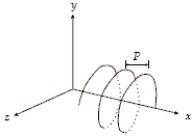
(Multiple Choice)
4.9/5 (91)
(91) A proton is accelerated from rest through a potential difference of 150 V.It then enters a region of uniform magnetic field and moves in a circular path (radius = 12 cm).What is the magnitude of the magnetic field in this region?
(Multiple Choice)
4.8/5 (70)
(70) A magnetic field of 2.00 T is applied to a bubble chamber to make the tracks of protons and other charged particles identifiable by the radius of the circles they move in.If a high-energy proton moves along an arc of a 3.30-m circle,what is the momentum of the proton? [q = 1.60 × 10⁻¹⁹ C,m = 1.67 × 10⁻²⁷ kg]
(Short Answer)
4.9/5 (77)
(77) A 2.0-C charge moves with a velocity of ( 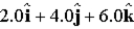 )m/s and experiences a magnetic force of (
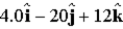 )N)The x component of the magnetic field is equal to zero.Determine the y component of the magnetic field.
)m/s and experiences a magnetic force of (
)N)The x component of the magnetic field is equal to zero.Determine the y component of the magnetic field. (Multiple Choice)
4.8/5 (78)
(78) What is the radius of curvature of the path of a 3.0-keV proton in a perpendicular magnetic field of magnitude 0.80 T?
(Multiple Choice)
4.8/5 (84)
(84) A 2.0-m wire carries a current of 15 A directed along the positive x axis in a region where the magnetic field is uniform and given by B = (30  − 40
 )mT)What is the resulting magnetic force on the wire?
− 40
)mT)What is the resulting magnetic force on the wire? (Multiple Choice)
4.8/5 (87)
(87) A particle (m = 3.0 μg,q = 5.0 μC)moves in a uniform magnetic field given by (  )mT)At t = 0 the velocity of the particle is equal to (
 )m/s.The subsequent path of the particle is
)mT)At t = 0 the velocity of the particle is equal to (
)m/s.The subsequent path of the particle is (Multiple Choice)
4.9/5 (78)
(78) A charged particle (mass = M,charge = Q > 0)moves in a region of space where the magnetic field has a constant magnitude of B and a downward direction.What is the magnetic force on the particle at an instant when it is moving horizontally toward the north with a speed V?
(Multiple Choice)
4.9/5 (79)
(79) A rectangular coil (0.20 m × 0.80 m)has 200 turns and is in a uniform magnetic field of 0.30 T.When the orientation of the coil is varied through all possible positions,the maximum torque on the coil by magnetic forces is 0.080 N ⋅ m.What is the current in the coil?
(Multiple Choice)
4.8/5 (78)
(78) At what speed would a proton need to circle the Earth at a height of 1 000 km above the equator if the Earth's magnetic field is horizontal and directed north-south,with an intensity of 4.00 × 10⁻⁸ T? (The radius of the Earth is 6 400 km and the charge and mass of the proton are q = 1.60 × 10⁻¹⁹ C and mp = 1.67 × 10⁻²⁷ kg.Ignore relativistic corrections. )
(Short Answer)
4.8/5 (79)
(79) A charged particle (mass = M,charge = Q > 0)moves in a region of space where the magnetic field has a constant magnitude of B and a downward direction.What is the magnetic force on the particle at an instant when it is moving horizontally toward the north with speed V?
(Multiple Choice)
4.8/5 (72)
(72) The boundary shown is that of a uniform magnetic field directed in the positive z direction.An electron enters the magnetic field with a velocity pointing along the x axis and exits 0.63 μs later at point A.What is the magnitude of the magnetic field? 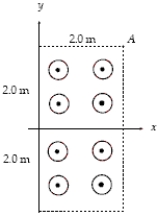
(Multiple Choice)
4.8/5 (64)
(64) A charged particle (m = 5.0 g,q = −70 μC)moves horizontally at a constant speed of 30 km/s in a region where the free fall gravitational acceleration is 9.8 m/s2 downward,the electric field is 700 N/C upward,and the magnetic field is perpendicular to the velocity of the particle.What is the magnitude of the magnetic field in this region?
(Multiple Choice)
4.9/5 (86)
(86) A straight 10-cm wire bent at its midpoint so as to form an angle of 90° carries a current of 10 A.It lies in the xy plane in a region where the magnetic field is in the positive z direction and has a constant magnitude of 3.0 mT.What is the magnitude of the magnetic force on this wire?
(Multiple Choice)
4.8/5 (86)
(86) A proton with a kinetic energy of 0.20 keV follows a circular path in a region where the magnetic field is uniform and has a magnitude of 60 mT.What is the radius of this path?
(Multiple Choice)
4.9/5 (77)
(77) A segment of wire carries a current of 25 A along the x axis from x = −2.0 m to x = 0 and then along the z axis from z = 0 to z = 3.0m.In this region of space,the magnetic field is equal to 40 mT in the positive z direction.What is the magnitude of the force on this segment of wire?
(Multiple Choice)
4.9/5 (80)
(80) The magnetic field in a region of space is parallel to the surface of a long flat table.Imagine that this page is lying flat on the table.When current is present in the coil,which is lying on the table,the coil tends to rotate so that the left side moves up and the right side moves down.The magnetic field is 
(Multiple Choice)
4.9/5 (78)
(78) A charged particle (mass = 4.0 μg,charge = 5.0 μC)moves in a region where the only force on it is magnetic.What is the magnitude of the acceleration of the particle at a point where the speed of the particle is 5.0 km/s,the magnitude of the magnetic field is 8.0 mT,and the angle between the direction of the magnetic field and the velocity of the particle is 60°?
(Multiple Choice)
4.8/5 (74)
(74) 
Filters
- Essay(0)
- Multiple Choice(0)
- Short Answer(0)
- True False(0)
- Matching(0)