



 Chat with AI
Exam 24: Gausss Law

Exam 1: Physics and Measurement25 Questions
Exam 2: Motion in One Dimension66 Questions
Exam 3: Vectors47 Questions
Exam 4: Motion in Two Dimensions79 Questions
Exam 5: The Laws of Motion113 Questions
Exam 6: Circular Motion and Other Applications of Newtons Laws55 Questions
Exam 7: Energy of a System74 Questions
Exam 8: Conservation of Energy84 Questions
Exam 9: Linear Momentum and Collisions89 Questions
Exam 10: Rotation of a Rigid Object About a Fixed Axis82 Questions
Exam 11: Angular Momentum46 Questions
Exam 12: Static Equilibrium and Elasticity34 Questions
Exam 13: Universal Gravitation47 Questions
Exam 14: Fluid Mechanics53 Questions
Exam 15: Oscillatory Motion41 Questions
Exam 16: Wave Motion46 Questions
Exam 17: Sound Waves48 Questions
Exam 18: Superposition and Standing Waves60 Questions
Exam 19: Temperature47 Questions
Exam 20: The First Law of Thermodynamics61 Questions
Exam 21: The Kinetic Theory of Gases38 Questions
Exam 22: Heat Engines, entropy, and the Second Law of Thermodynamics55 Questions
Exam 23: Electric Fields83 Questions
Exam 24: Gausss Law80 Questions
Exam 25: Electric Potential97 Questions
Exam 26: Capacitance and Dielectrics63 Questions
Exam 27: Current and Resistance34 Questions
Exam 28: Direct-Current Circuits84 Questions
Exam 29: Magnetic Fields80 Questions
Exam 30: Sources of the Magnetic Field105 Questions
Exam 31: Faradays Law62 Questions
Exam 32: Inductance23 Questions
Exam 33: Alternating-Current Circuits65 Questions
Exam 34: Electromagnetic Waves40 Questions
Exam 35: The Nature of Light and the Principles of Ray Optics38 Questions
Exam 36: Image Formation46 Questions
Exam 37: Wave Optics48 Questions
Exam 38: Diffraction Patterns and Polarization47 Questions
Exam 39: Relativity34 Questions
Exam 40: Introduction to Quantum Physics48 Questions
Exam 41: Quantum Mechanics33 Questions
Exam 42: Atomic Physics59 Questions
Exam 43: Molecules and Solids46 Questions
Exam 44: Nuclear Structure50 Questions
Exam 45: Applications of Nuclear Physics40 Questions
Exam 46: Particle Physics and Cosmology34 Questions
Select questions type


A charge of 5.0 pC is distributed uniformly on a spherical surface (radius = 2.0 cm),and a second charge of −2.0 pC is distributed uniformly on a concentric spherical surface (radius = 4.0 cm).Determine the magnitude of the electric field 3.0 cm from the center of the two surfaces.
(Multiple Choice)
4.8/5  (82)
(82) A positive point charge q is placed off center inside an uncharged metal sphere insulated from the ground as shown.Where is the induced charge density greatest in magnitude and what is its sign? 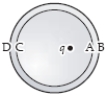
(Multiple Choice)
4.9/5 (76)
(76) If the electric field just outside a thin conducting sheet is equal to 1.5 N/C,determine the surface charge density on the conductor.
(Multiple Choice)
4.8/5 (85)
(85) A long cylinder (radius = 3.0 cm)is filled with a nonconducting material which carries a uniform charge density of 1.3 μC/m3.Determine the electric flux through a spherical surface (radius = 2.0 cm)which has a point on the axis of the cylinder as its center.
(Multiple Choice)
4.8/5 (83)
(83) The axis of a long hollow metallic cylinder (inner radius = 1.0 cm,outer radius = 2.0 cm)coincides with a long wire.The wire has a linear charge density of −8.0 pC/m,and the cylinder has a net charge per unit length of −4.0 pC/m.Determine the magnitude of the electric field 3.0 cm from the axis.
(Multiple Choice)
4.9/5 (87)
(87) Charge of uniform surface density (4.0 nC/m2)is distributed on a spherical surface (radius = 2.0 cm).What is the total electric flux through a concentric spherical surface with a radius of 4.0 cm?
(Multiple Choice)
4.7/5 (76)
(76) Whitney says that Gauss's Law can be used to find the electric field of a sufficiently symmetrical distribution of charge as long as  Over the whole Gaussian surface.Algie says that the electric field must be a constant vector over the entire Gaussian surface.Which one,if either,is correct?
 (Multiple Choice)
4.9/5 (77)
(77) A long straight metal rod has a radius of 2.0 mm and a surface charge of density 0.40 nC/m2.Determine the magnitude of the electric field 3.0 mm from the axis.
(Multiple Choice)
5.0/5 (95)
(95) A long cylindrical conductor (radius = 1.0 mm)carries a charge density of 4.0 pC/m and is inside a coaxial,hollow,cylindrical conductor (inner radius = 3.0 mm,outer radius = 4.0 mm)that has a total charge of −8.0 pC/m.What is the magnitude of the electric field 2.0 mm from the axis of these conductors?
(Multiple Choice)
4.8/5 (81)
(81) A point charge +Q is located on the x axis at x = a,and a second point charge −Q is located on the x axis at x = −a.A Gaussian surface with radius r = 2a is centered at the origin.The flux through this Gaussian surface is
(Multiple Choice)
5.0/5 (77)
(77) An constant electric field,  N/C,goes through a surface with area
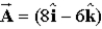 M2.(This surface can also be expressed as an area of 10 m2 with the direction of the unit vector (
 ))What is the magnitude of the electric flux through this area?
N/C,goes through a surface with area
M2.(This surface can also be expressed as an area of 10 m2 with the direction of the unit vector (
))What is the magnitude of the electric flux through this area? (Multiple Choice)
4.9/5 (72)
(72) A small metal sphere is suspended from the conducting cover of a conducting metal ice bucket by a non-conducting thread.The sphere is given a negative charge before the cover is placed on the bucket.The bucket is tilted by means of a non-conducting material so that the charged sphere touches the inside of the bucket.Which statement is correct?
(Multiple Choice)
4.8/5 (75)
(75) A student has made the statement that the electric flux through one half of a Gaussian surface is always equal to the flux through the other half of the Gaussian surface.This is
(Multiple Choice)
4.8/5 (79)
(79) Charge of a uniform density (8.0 nC/m2)is distributed over the entire xy plane.A charge of uniform density (3.0 nC/m2)is distributed over the parallel plane defined by z = 2.0 m.Determine the magnitude of the electric field for any point with z = 3.0 m.
(Multiple Choice)
4.9/5 (78)
(78) Charge of uniform linear density (4.0 nC/m)is distributed along the entire x axis.Determine the magnitude of the electric field on the y axis at y = 2.5 m.
(Multiple Choice)
4.9/5 (80)
(80) A hemispherical surface (half of a spherical surface)of radius R is located in a uniform electric field of magnitude E that is parallel to the axis of the hemisphere.What is the magnitude of the electric flux through the hemisphere surface?
(Multiple Choice)
4.8/5 (73)
(73) A Geiger counter is like an electroscope that discharges whenever ions formed by a radioactive particle produce a conducting path.A typical Geiger counter consists of a thin conducting wire of radius 0.002 cm stretched along the axis of a conducting cylinder of radius 2.0 cm.The wire and the cylinder carry equal and opposites charges of 8.0 × 10⁻¹⁰ C all along their length of 10.0 cm.What is the magnitude of the electric field at the surface of the wire?
(Short Answer)
4.8/5 (94)
(94) Charge of uniform density (20 nC/m2)is distributed over a cylindrical surface (radius = 1.0 cm),and a second coaxial surface (radius = 3.0 cm)carries a uniform charge density of −12 nC/m2.Determine the magnitude of the electric field at a point 4.0 cm from the symmetry axis of the two surfaces.
(Multiple Choice)
4.7/5 (83)
(83) Two planes of charge with no thickness,A and B,are parallel and vertical.The electric field in the region between the two planes has magnitude  )The electric field in the region to the left of A and the electric field in the region to the right of B may have the magnitudes
 (Multiple Choice)
4.8/5 (74)
(74) A long cylindrical shell (radius = 2.0 cm)has a charge uniformly distributed on its surface.If the magnitude of the electric field at a point 8.0 cm radially outward from the axis of the shell is 85 N/C,how much charge is distributed on a 2.0-m length of the charged cylindrical surface?
(Multiple Choice)
4.8/5 (82)
(82) 
Filters
- Essay(0)
- Multiple Choice(0)
- Short Answer(0)
- True False(0)
- Matching(0)