



 Chat with AI
Exam 19: Temperature

Exam 1: Physics and Measurement25 Questions
Exam 2: Motion in One Dimension66 Questions
Exam 3: Vectors47 Questions
Exam 4: Motion in Two Dimensions79 Questions
Exam 5: The Laws of Motion113 Questions
Exam 6: Circular Motion and Other Applications of Newtons Laws55 Questions
Exam 7: Energy of a System74 Questions
Exam 8: Conservation of Energy84 Questions
Exam 9: Linear Momentum and Collisions89 Questions
Exam 10: Rotation of a Rigid Object About a Fixed Axis82 Questions
Exam 11: Angular Momentum46 Questions
Exam 12: Static Equilibrium and Elasticity34 Questions
Exam 13: Universal Gravitation47 Questions
Exam 14: Fluid Mechanics53 Questions
Exam 15: Oscillatory Motion41 Questions
Exam 16: Wave Motion46 Questions
Exam 17: Sound Waves48 Questions
Exam 18: Superposition and Standing Waves60 Questions
Exam 19: Temperature47 Questions
Exam 20: The First Law of Thermodynamics61 Questions
Exam 21: The Kinetic Theory of Gases38 Questions
Exam 22: Heat Engines, entropy, and the Second Law of Thermodynamics55 Questions
Exam 23: Electric Fields83 Questions
Exam 24: Gausss Law80 Questions
Exam 25: Electric Potential97 Questions
Exam 26: Capacitance and Dielectrics63 Questions
Exam 27: Current and Resistance34 Questions
Exam 28: Direct-Current Circuits84 Questions
Exam 29: Magnetic Fields80 Questions
Exam 30: Sources of the Magnetic Field105 Questions
Exam 31: Faradays Law62 Questions
Exam 32: Inductance23 Questions
Exam 33: Alternating-Current Circuits65 Questions
Exam 34: Electromagnetic Waves40 Questions
Exam 35: The Nature of Light and the Principles of Ray Optics38 Questions
Exam 36: Image Formation46 Questions
Exam 37: Wave Optics48 Questions
Exam 38: Diffraction Patterns and Polarization47 Questions
Exam 39: Relativity34 Questions
Exam 40: Introduction to Quantum Physics48 Questions
Exam 41: Quantum Mechanics33 Questions
Exam 42: Atomic Physics59 Questions
Exam 43: Molecules and Solids46 Questions
Exam 44: Nuclear Structure50 Questions
Exam 45: Applications of Nuclear Physics40 Questions
Exam 46: Particle Physics and Cosmology34 Questions
Select questions type


A child has a temperature of 104°F.What is the temperature in degrees kelvin?
(Multiple Choice)
4.9/5  (67)
(67) A student has written the equation below to convert a temperature in degrees Fahrenheit into Kelvins.What is wrong with this equation? 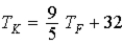
(Multiple Choice)
4.8/5 (84)
(84) Equal masses of hydrogen and helium gas are at the same temperature in vessels of equal volume.The atomic mass of helium is four times that of hydrogen.If the total mass of both gases is the same,the ratio of the pressure of helium (He)to that of hydrogen (H2)is
(Multiple Choice)
4.8/5 (87)
(87) A beaker is filled to the 500 ml mark with alcohol.What increase in volume (in ml)does the beaker contain when the temperature changes from 5° C to 30° C? (Neglect the expansion of the beaker,evaporation of alcohol and absorption of water vapor by alcohol. )βalcohol = 1.12 × 10⁻⁴/°C
(Multiple Choice)
4.8/5 (80)
(80) A thermometer registers a change in temperature of 100°F.What change in temperature does this correspond to on the Kelvin Scale?
(Multiple Choice)
4.8/5 (74)
(74) When the coefficient of linear expansion,α,and the temperature change,Tf − Ti,are large,a length Li of a solid substance expands in length to
(Multiple Choice)
4.9/5 (78)
(78) Two thermometers are calibrated,one in degrees Celsius and the other in degrees Fahrenheit.At what temperature (in kelvins)do their readings measure the same temperature?
(Multiple Choice)
4.8/5 (76)
(76) 
Filters
- Essay(0)
- Multiple Choice(0)
- Short Answer(0)
- True False(0)
- Matching(0)