



 Chat with AI
Exam 18: Superposition and Standing Waves

Exam 1: Physics and Measurement25 Questions
Exam 2: Motion in One Dimension66 Questions
Exam 3: Vectors47 Questions
Exam 4: Motion in Two Dimensions79 Questions
Exam 5: The Laws of Motion113 Questions
Exam 6: Circular Motion and Other Applications of Newtons Laws55 Questions
Exam 7: Energy of a System74 Questions
Exam 8: Conservation of Energy84 Questions
Exam 9: Linear Momentum and Collisions89 Questions
Exam 10: Rotation of a Rigid Object About a Fixed Axis82 Questions
Exam 11: Angular Momentum46 Questions
Exam 12: Static Equilibrium and Elasticity34 Questions
Exam 13: Universal Gravitation47 Questions
Exam 14: Fluid Mechanics53 Questions
Exam 15: Oscillatory Motion41 Questions
Exam 16: Wave Motion46 Questions
Exam 17: Sound Waves48 Questions
Exam 18: Superposition and Standing Waves60 Questions
Exam 19: Temperature47 Questions
Exam 20: The First Law of Thermodynamics61 Questions
Exam 21: The Kinetic Theory of Gases38 Questions
Exam 22: Heat Engines, entropy, and the Second Law of Thermodynamics55 Questions
Exam 23: Electric Fields83 Questions
Exam 24: Gausss Law80 Questions
Exam 25: Electric Potential97 Questions
Exam 26: Capacitance and Dielectrics63 Questions
Exam 27: Current and Resistance34 Questions
Exam 28: Direct-Current Circuits84 Questions
Exam 29: Magnetic Fields80 Questions
Exam 30: Sources of the Magnetic Field105 Questions
Exam 31: Faradays Law62 Questions
Exam 32: Inductance23 Questions
Exam 33: Alternating-Current Circuits65 Questions
Exam 34: Electromagnetic Waves40 Questions
Exam 35: The Nature of Light and the Principles of Ray Optics38 Questions
Exam 36: Image Formation46 Questions
Exam 37: Wave Optics48 Questions
Exam 38: Diffraction Patterns and Polarization47 Questions
Exam 39: Relativity34 Questions
Exam 40: Introduction to Quantum Physics48 Questions
Exam 41: Quantum Mechanics33 Questions
Exam 42: Atomic Physics59 Questions
Exam 43: Molecules and Solids46 Questions
Exam 44: Nuclear Structure50 Questions
Exam 45: Applications of Nuclear Physics40 Questions
Exam 46: Particle Physics and Cosmology34 Questions
Select questions type


Which of the following wavelengths could NOT be present as a standing wave in a 2 m long organ pipe open at both ends?
(Multiple Choice)
4.8/5  (81)
(81) Transverse waves y1 = A1 sin(k1x − ω1t)and y2 = A2 sin(k2x − ω2t),with A2 > A1,start at opposite ends of a long rope when t = 0.The magnitude of the maximum displacement,y,of the rope at any point is
(Multiple Choice)
4.9/5 (75)
(75) Two harmonic waves are described by 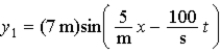
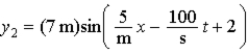 What is the phase (in rad)of the resultant wave when x = t = 0?
 (Multiple Choice)
4.8/5 (81)
(81) Two ropes are spliced together as shown.  A short time after the incident pulse shown in the diagram reaches the splice,the rope's appearance will be that in
 (Multiple Choice)
4.9/5 (83)
(83) The superposition of two waves, 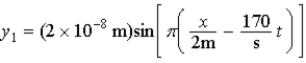 And
 ,
Results in a wave with a frequency of
And
,
Results in a wave with a frequency of (Multiple Choice)
4.8/5 (84)
(84) A steel wire in a piano has a length of 0.700 m and a mass of 4.30 grams.To what tension must this wire be stretched to make the fundamental frequency correspond to middle C, (fc = 261.6 Hz)?
(Short Answer)
4.8/5 (69)
(69) The figure below shows the positions of particles in a longitudinal standing wave.One quarter period later the particle distribution is shown in 
(Multiple Choice)
4.7/5 (84)
(84) Two harmonic waves are described by 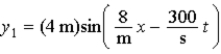
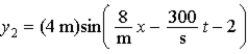 What is the frequency (in Hz)of the resultant wave?
 (Multiple Choice)
4.8/5 (83)
(83) Two strings are respectively 1.00 m and 2.00 m long.Which of the following wavelengths,in meters,could represent harmonics present on both strings?
(Multiple Choice)
4.7/5 (85)
(85) A fire engine approaches a wall at 5 m/s while the siren emits a tone of 500 Hz frequency.At the time,the speed of sound in air is 340 m/s.How many beats per second do the people on the fire engine hear?
(Multiple Choice)
4.8/5 (83)
(83) Two harmonic waves traveling in opposite directions interfere to produce a standing wave described by y = 2 sin (4x)cos (3t)where x is in m and t is in s.What is the speed (in m/s)of the interfering waves?
(Multiple Choice)
4.9/5 (82)
(82) Two harmonic waves are described by 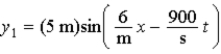
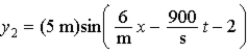 What is the wavelength of the resultant wave?
 (Multiple Choice)
4.9/5 (78)
(78) Two speakers in an automobile emit sound waves that are in phase at the speakers.One speaker is 40 cm ahead of and 30 cm to the left of the driver's left ear.The other speaker is 50 cm ahead of and 120 cm to the right of the driver's right ear.Which of the following wavelengths is(are)in phase at the left ear for the speaker on the left and the right ear for the speaker on the right?
(Multiple Choice)
4.8/5 (81)
(81) Find the frequencies of the first three harmonics of a 1.0-m long string which has a mass per unit length of 2.0 × 10⁻³ kg/m and a tension of 80 N when both ends are fixed in place.
(Short Answer)
4.8/5 (76)
(76) A string is stretched and fixed at both ends,200 cm apart.If the density of the string is 0.015 g/cm,and its tension is 600 N,what is the wavelength (in cm)of the first harmonic?
(Multiple Choice)
4.9/5 (80)
(80) Two harmonic waves are described by 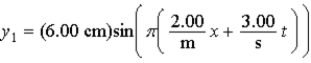
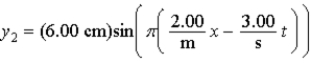 What is the magnitude of the displacement (in cm)of this wave at x = 3 cm and t = 5 sec?
 (Multiple Choice)
4.8/5 (71)
(71) Two identical strings have the same length and same mass per unit length.String B is stretched with four times as great a tension as that applied to string A.Which statement is correct for all n harmonics on the two strings,n = 1,2,3...?
(Multiple Choice)
4.8/5 (80)
(80) A length of organ pipe is closed at one end.If the speed of sound is 344 m/s,what length of pipe (in cm)is needed to obtain a fundamental frequency of 50 Hz?
(Multiple Choice)
4.9/5 (86)
(86) The superposition of two waves, 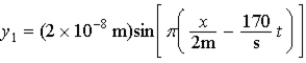 And
 ,
Results in a wave with a phase angle of
And
,
Results in a wave with a phase angle of (Multiple Choice)
4.7/5 (71)
(71) A string with a fixed frequency vibrator at one end is subjected to varying tensions.When the tension is 20 N,a resonance with 3 antinodes results.What tension would cause a resonance with 2 antinodes in this string?
(Multiple Choice)
4.9/5 (83)
(83) 
Filters
- Essay(0)
- Multiple Choice(0)
- Short Answer(0)
- True False(0)
- Matching(0)