



 Chat with AI
Exam 15: Oscillatory Motion

Exam 1: Physics and Measurement25 Questions
Exam 2: Motion in One Dimension66 Questions
Exam 3: Vectors47 Questions
Exam 4: Motion in Two Dimensions79 Questions
Exam 5: The Laws of Motion113 Questions
Exam 6: Circular Motion and Other Applications of Newtons Laws55 Questions
Exam 7: Energy of a System74 Questions
Exam 8: Conservation of Energy84 Questions
Exam 9: Linear Momentum and Collisions89 Questions
Exam 10: Rotation of a Rigid Object About a Fixed Axis82 Questions
Exam 11: Angular Momentum46 Questions
Exam 12: Static Equilibrium and Elasticity34 Questions
Exam 13: Universal Gravitation47 Questions
Exam 14: Fluid Mechanics53 Questions
Exam 15: Oscillatory Motion41 Questions
Exam 16: Wave Motion46 Questions
Exam 17: Sound Waves48 Questions
Exam 18: Superposition and Standing Waves60 Questions
Exam 19: Temperature47 Questions
Exam 20: The First Law of Thermodynamics61 Questions
Exam 21: The Kinetic Theory of Gases38 Questions
Exam 22: Heat Engines, entropy, and the Second Law of Thermodynamics55 Questions
Exam 23: Electric Fields83 Questions
Exam 24: Gausss Law80 Questions
Exam 25: Electric Potential97 Questions
Exam 26: Capacitance and Dielectrics63 Questions
Exam 27: Current and Resistance34 Questions
Exam 28: Direct-Current Circuits84 Questions
Exam 29: Magnetic Fields80 Questions
Exam 30: Sources of the Magnetic Field105 Questions
Exam 31: Faradays Law62 Questions
Exam 32: Inductance23 Questions
Exam 33: Alternating-Current Circuits65 Questions
Exam 34: Electromagnetic Waves40 Questions
Exam 35: The Nature of Light and the Principles of Ray Optics38 Questions
Exam 36: Image Formation46 Questions
Exam 37: Wave Optics48 Questions
Exam 38: Diffraction Patterns and Polarization47 Questions
Exam 39: Relativity34 Questions
Exam 40: Introduction to Quantum Physics48 Questions
Exam 41: Quantum Mechanics33 Questions
Exam 42: Atomic Physics59 Questions
Exam 43: Molecules and Solids46 Questions
Exam 44: Nuclear Structure50 Questions
Exam 45: Applications of Nuclear Physics40 Questions
Exam 46: Particle Physics and Cosmology34 Questions
Select questions type


To double the total energy of a mass oscillating at the end of a spring with amplitude A,we need to
(Multiple Choice)
4.7/5  (74)
(74) Simple harmonic oscillations can be modeled by the projection of circular motion at constant angular velocity onto a diameter of the circle.When this is done,the analog along the diameter of the acceleration of the particle executing simple harmonic motion is
(Multiple Choice)
4.9/5 (77)
(77) An archer pulls her bow string back 0.40 m by exerting a force that increases uniformly from zero to 240 N.What is the equivalent spring constant of the bow,and how much work is done in pulling the bow?
(Short Answer)
4.9/5 (74)
(74) A mass m = 2.0 kg is attached to a spring having a force constant k = 290 N/m as in the figure.The mass is displaced from its equilibrium position and released.Its frequency of oscillation (in Hz)is approximately 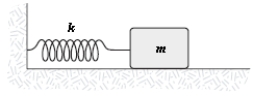
(Multiple Choice)
4.8/5 (69)
(69) An object of mass m is attached to string of length L.When it is released from point A,the object oscillates between points A and B.Which statement about the system consisting of the pendulum and the Earth is correct? 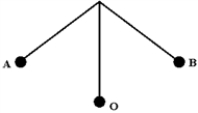
(Multiple Choice)
4.9/5 (74)
(74) The oscillation of the 2.0-kg mass on a spring is described by  Where x is in centimeters and t is in seconds.What is the force constant of the spring?
 (Multiple Choice)
4.8/5 (89)
(89) A body oscillates with simple harmonic motion along the x axis.Its displacement varies with time according to the equation x = 5 sin (πt + π/3).The phase (in rad)of the motion at t = 2 s is
(Multiple Choice)
5.0/5 (71)
(71) A body oscillates with simple harmonic motion along the x axis.Its displacement varies with time according to the equation x = 5.0 sin (πt + π/3).The velocity (in m/s)of the body at t = 1.0 s is
(Multiple Choice)
4.8/5 (95)
(95) In the figure below,a disk (radius R = 1.0 m,mass = 2.0 kg)is suspended from a pivot a distance d = 0.25 m above its center of mass.For a circular disk,  )The angular frequency (in rad/s)for small oscillations is approximately

)The angular frequency (in rad/s)for small oscillations is approximately (Multiple Choice)
4.9/5 (71)
(71) The mat of a trampoline is held by 32 springs,each having a spring constant of 5 000 N/m.A person with a mass of 40.0 kg jumps from a platform 1.93 m high onto the trampoline.Determine the stretch of each of the springs.
(Short Answer)
4.9/5 (76)
(76) A torsional pendulum consists of a solid disk (mass = 2.0 kg,radius = 1.0 m)suspended by a wire attached to a rigid support.The body oscillates about the support wire.If the torsion constant is 16 N⋅m/rad.What is the angular frequency (in rad/s)? 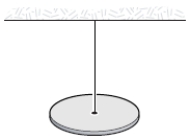
(Multiple Choice)
4.7/5 (89)
(89) At sea level,at a latitude where  ,a pendulum that takes 2.00 s for a complete swing back and forth has a length of 0.993 m.What is the value of g in m/s2 at a location where the length of such a pendulum is 0.970 m?
 (Multiple Choice)
4.9/5 (82)
(82) Exhibit 15-1
A graph of position versus time for an object oscillating at the free end of a horizontal spring is shown below.A point or points at which the object has positive velocity and zero acceleration is(are) 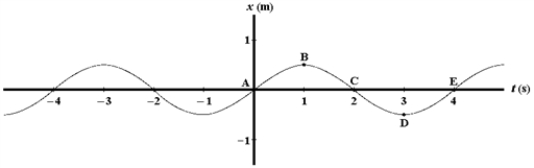 Use this exhibit to answer the following question(s).
-Refer to Exhibit 15-1.The point at which the object has zero velocity and positive acceleration is
Use this exhibit to answer the following question(s).
-Refer to Exhibit 15-1.The point at which the object has zero velocity and positive acceleration is (Multiple Choice)
4.7/5 (82)
(82) Which of the following combinations of variables results in the greatest period for a pendulum?
(Multiple Choice)
4.7/5 (86)
(86) The figure shows a uniform rod (length L = 1.0 m,mass = 2.0 kg)suspended from a pivot a distance d = 0.25 m above its center of mass.The angular frequency (in rad/s)for small oscillations is approximately 
(Multiple Choice)
4.9/5 (69)
(69) An ore car of mass 4 000 kg starts from rest and rolls downhill on tracks from a mine.A spring with k = 400 000 N/m is located at the end of the tracks.At the spring's maximum compression,the car is at an elevation 10 m lower than its elevation at the starting point.How much is the spring compressed in stopping the ore car? Ignore friction.
(Short Answer)
4.9/5 (72)
(72) A weight of mass m is at rest at O when suspended from a spring,as shown.When it is pulled down and released,it oscillates between positions A and B.Which statement about the system consisting of the spring and the mass is correct? 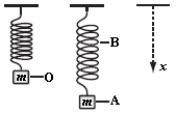
(Multiple Choice)
4.9/5 (86)
(86) When a damping force is applied to a simple harmonic oscillator which has angular frequency ω0 in the absence of damping,the new angular frequency ω is such that
(Multiple Choice)
4.8/5 (89)
(89) The mass in the figure below slides on a frictionless surface.When the mass is pulled out,spring 1 is stretched a distance x1 from its equilibrium position and spring 2 is stretched a distance x2.The spring constants are k1 and k2 respectively.The force pulling back on the mass is: 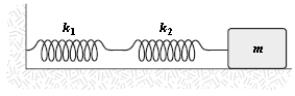
(Multiple Choice)
4.8/5 (71)
(71) In the figure below,a hoop (radius R = 1.0 m,mass = 2.0 kg)having four spokes of negligible mass is suspended from a pivot a distance d = .25 m above its center of mass.The angular frequency (in rad/s)for small oscillations is approximately 
(Multiple Choice)
4.9/5 (79)
(79) 
Filters
- Essay(0)
- Multiple Choice(0)
- Short Answer(0)
- True False(0)
- Matching(0)