



 Chat with AI
Exam 2: The Chemical Level of Organization

Exam 1: An Introduction to the Human Body74 Questions
Exam 2: The Chemical Level of Organization75 Questions
Exam 3: The Cellular Level of Organization76 Questions
Exam 4: The Tissue Level of Organization75 Questions
Exam 5: The Integumentary System Unit Ii: Principles of Support and Movement74 Questions
Exam 6: The Skeletal System: Bone Tissue75 Questions
Exam 7: The Skeletal System: the Axial Skeleton75 Questions
Exam 8: The Skeletal System: the Appendicular Skeleton75 Questions
Exam 9: Joints75 Questions
Exam 10: Muscle Tissue75 Questions
Exam 11: The Muscular System Unit Iii: Control Systems of the Human Body75 Questions
Exam 12: Nervous Tissue75 Questions
Exam 13: The Spinal Cord and Spinal Nerves75 Questions
Exam 14: The Brain and Cranial Nerves75 Questions
Exam 15: The Autonomic Nervous System75 Questions
Exam 16: Sensory, Motor and Integrative Systems75 Questions
Exam 17: The Special Senses75 Questions
Exam 18: The Endocrine System Unit Iv: Maintenance of the Human Body75 Questions
Exam 19: The Cardiovascular System: the Blood74 Questions
Exam 20: The Cardiovascular System: the Heart74 Questions
Exam 21: The Cardiovascular System: Blood Vessels and Hemodynamics75 Questions
Exam 22: The Lymphatic System, Nonspecific Resistance to Disease, and Immunity75 Questions
Exam 23: The Respiratory System75 Questions
Exam 24: The Digestive System75 Questions
Exam 25: Metabolism73 Questions
Exam 26: The Urinary System73 Questions
Exam 27: Fluid, Electrolyte, and Acid-Base Homeostasis Unit V: Continuity48 Questions
Exam 28: The Reproductive Systems74 Questions
Exam 29: Development and Inheritance75 Questions
Select questions type


What type of molecule is shown in the diagram? Where in a eukaryotic cell would this type of molecule be commonly found? What special chemical properties does this molecule possess that allows it to accomplish its functions?
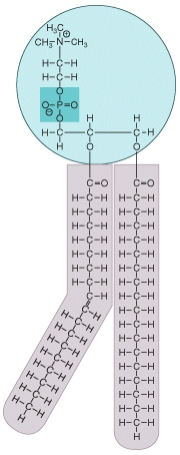
(Essay)
5.0/5  (69)
(69) In a polar covalent bond,the atom that has the most electronegativity will have a
(Multiple Choice)
4.7/5 (81)
(81) Which of the following is a monosaccharide that is used by cells to produce energy?
(Multiple Choice)
4.9/5 (79)
(79) The energy stored in the bonds of the molecules in the foods that humans eat is
1)a form of kinetic energy.
2)a form of potential energy.
3)referred to as chemical energy.
(Multiple Choice)
5.0/5 (67)
(67) Which type of chemical reaction breaks larger reactants into smaller products?
(Multiple Choice)
4.8/5 (82)
(82) Which of the labeled structures are found in DNA but not RNA?
1 A
2 B
3 C
4 E
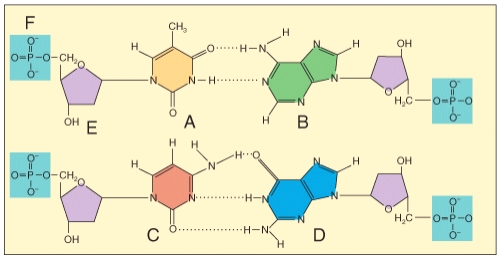
(Multiple Choice)
5.0/5 (87)
(87) Which type of chemical bond involves the sharing of valence electrons between two atoms?
(Multiple Choice)
4.8/5 (75)
(75) Which type of chemical reaction combines reactants to produce larger products?
(Multiple Choice)
4.8/5 (76)
(76) The number of protons in an atom is represented by an element's
(Multiple Choice)
4.8/5 (82)
(82) AB + CD → AD + BC is a general example of a(n)_____ reaction.
(Multiple Choice)
4.9/5 (86)
(86) All of the following are characteristics of anabolism EXCEPT:
(Multiple Choice)
4.8/5 (87)
(87) 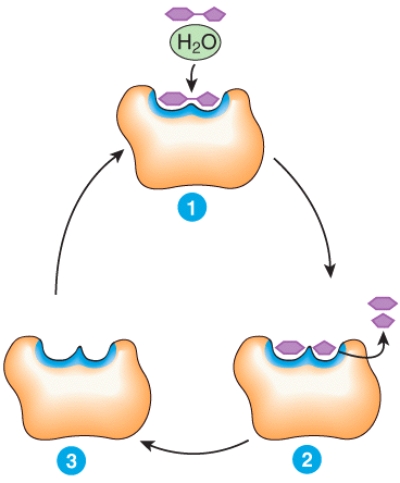
The nucleus of unstable _____ of an element will decay leading to emission of radiation.
(Multiple Choice)
4.9/5 (76)
(76) A chemical compound that helps control the pH of a solution by adding or removing hydrogen ions is a(n)
(Multiple Choice)
4.9/5 (98)
(98) 
Filters
- Essay(0)
- Multiple Choice(0)
- Short Answer(0)
- True False(0)
- Matching(0)