



 Chat with AI
Exam 2: The Chemical Level of Organization

Exam 1: An Introduction to the Human Body74 Questions
Exam 2: The Chemical Level of Organization75 Questions
Exam 3: The Cellular Level of Organization76 Questions
Exam 4: The Tissue Level of Organization75 Questions
Exam 5: The Integumentary System Unit Ii: Principles of Support and Movement74 Questions
Exam 6: The Skeletal System: Bone Tissue75 Questions
Exam 7: The Skeletal System: the Axial Skeleton75 Questions
Exam 8: The Skeletal System: the Appendicular Skeleton75 Questions
Exam 9: Joints75 Questions
Exam 10: Muscle Tissue75 Questions
Exam 11: The Muscular System Unit Iii: Control Systems of the Human Body75 Questions
Exam 12: Nervous Tissue75 Questions
Exam 13: The Spinal Cord and Spinal Nerves75 Questions
Exam 14: The Brain and Cranial Nerves75 Questions
Exam 15: The Autonomic Nervous System75 Questions
Exam 16: Sensory, Motor and Integrative Systems75 Questions
Exam 17: The Special Senses75 Questions
Exam 18: The Endocrine System Unit Iv: Maintenance of the Human Body75 Questions
Exam 19: The Cardiovascular System: the Blood74 Questions
Exam 20: The Cardiovascular System: the Heart74 Questions
Exam 21: The Cardiovascular System: Blood Vessels and Hemodynamics75 Questions
Exam 22: The Lymphatic System, Nonspecific Resistance to Disease, and Immunity75 Questions
Exam 23: The Respiratory System75 Questions
Exam 24: The Digestive System75 Questions
Exam 25: Metabolism73 Questions
Exam 26: The Urinary System73 Questions
Exam 27: Fluid, Electrolyte, and Acid-Base Homeostasis Unit V: Continuity48 Questions
Exam 28: The Reproductive Systems74 Questions
Exam 29: Development and Inheritance75 Questions
Select questions type


This type of lipid is the body's primary long-term energy storage molecule.
(Multiple Choice)
4.9/5  (77)
(77) Specific arrangements of atoms within an organic molecule that confer characteristic chemical properties upon that molecule are called
(Multiple Choice)
4.7/5 (89)
(89) Define mixture and then distinguish between the three types of mixtures called solutions,colloids and suspensions.
(Essay)
4.7/5 (79)
(79) Describe what happens to a protein's structure and function when it is denatured.
(Essay)
4.8/5 (65)
(65) The three types of subatomic particles that are important for understanding chemical reactions in the human body are
(Multiple Choice)
4.8/5 (85)
(85) In the diagram,what would happen to the concentration of C if the concentration of A increases?
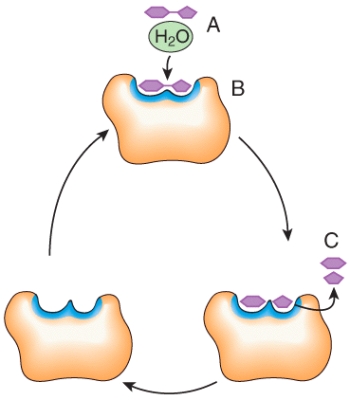
(Multiple Choice)
4.9/5 (77)
(77) Which of the following is a polysaccharide that serves as a storage form of energy in muscle and liver cells?
(Multiple Choice)
5.0/5 (79)
(79) In the body fluid compartments found in the human body,the solvent is
(Multiple Choice)
4.8/5 (68)
(68) What is the difference between atomic mass,mass number and atomic number?
(Essay)
4.9/5 (93)
(93) This lipid is used by the body as a precursor for the production of steroid hormones.
(Multiple Choice)
4.9/5 (68)
(68) A chemical reaction involves interactions between the _____ of two different atoms.
(Multiple Choice)
5.0/5 (71)
(71) In the diagram,removal of one or more of this type of subatomic particle would result in the formation of a cation?

(Multiple Choice)
4.9/5 (83)
(83) 
Filters
- Essay(0)
- Multiple Choice(0)
- Short Answer(0)
- True False(0)
- Matching(0)