



 Chat with AI
Exam 17: The Special Senses

Exam 1: An Introduction to the Human Body78 Questions
Exam 2: The Chemical Level of Organization81 Questions
Exam 3: The Cellular Level of Organization84 Questions
Exam 4: The Tissue Level of Organization64 Questions
Exam 5: The Integumentary System78 Questions
Exam 6: The Skeletal System: Bone Tissue77 Questions
Exam 7: The Skeletal System: the Axial Skeleton80 Questions
Exam 8: The Skeletal System: The Appendicular Skeleton82 Questions
Exam 9: Joints41 Questions
Exam 10: Muscular Tissue85 Questions
Exam 11: The Muscular System70 Questions
Exam 12: Nervous Tissue17 Questions
Exam 13: The Spinal Cord and Spinal Nerves74 Questions
Exam 14: The Brain and Cranial Nerves72 Questions
Exam 15: The Autonomic Nervous System64 Questions
Exam 16: Sensory, Motor, and Integrative Systems76 Questions
Exam 17: The Special Senses73 Questions
Exam 18: The Endocrine System84 Questions
Exam 19: The Cardiovascular System: the Blood83 Questions
Exam 20: The Cardiovascular System: the Heart82 Questions
Exam 21: The Cardiovascular System: Blood Vessels and Hemodynamics81 Questions
Exam 22: The Lymphatic System and Immunity80 Questions
Exam 23: The Respiratory System85 Questions
Exam 24: The Digestive System85 Questions
Exam 25: Metabolism and Nutrition85 Questions
Exam 26: The Urinary System84 Questions
Exam 27: Fluid, Electrolyte, and Acidbase Homeostasis57 Questions
Exam 28: The Reproductive Systems84 Questions
Exam 29: Development and Inheritance83 Questions
Select questions type


How many extrinsic eye muscles are responsible for moving each eye?
(Multiple Choice)
4.8/5  (77)
(77) Choose the sequence of events in order for how gustation is conveyed from beginning to end.
1)Taste bud detects tastant on anterior two third of tongue
2)Information travels to limbic system and hypothalamus,and to the thalamus
3)Gustatory nucleus in medulla receives information
4)First order neuron from facial nerve carries impulse
5)First order neuron from vagus nerve carries impulse
6)First order neuron from glossopharyngeal nerve carries impulse
7)Conscious perception of taste
8)Information is sent to the insula of the cerebral cortex
(Multiple Choice)
4.7/5 (81)
(81) The first step in the visual transduction process that occurs in the retina is
(Multiple Choice)
4.9/5 (88)
(88) 
In the diagram G represents the [dropdown 1] which is filled with [dropdown 2] that is made by the [dropdown 3]
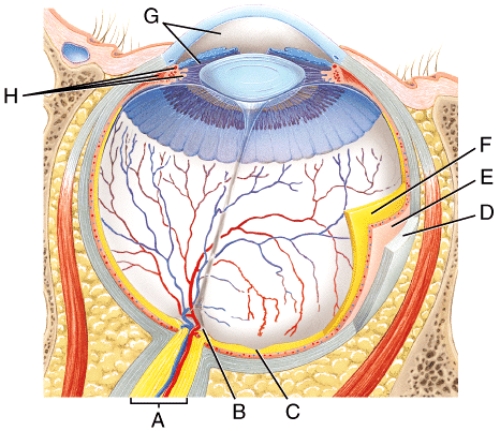 *Dropdown 1 choices:
-anterior cavity
-anterior chamber
-posterior chamber
-vitrios chamber
*Dropdown 2 choices:
-aqueous humor
-endolymph
-vitreous humor
-perilymph
*Dropdown 3 choices:
-ciliary processes
-crystallins lens
-zonular fibers
*Dropdown 1 choices:
-anterior cavity
-anterior chamber
-posterior chamber
-vitrios chamber
*Dropdown 2 choices:
-aqueous humor
-endolymph
-vitreous humor
-perilymph
*Dropdown 3 choices:
-ciliary processes
-crystallins lens
-zonular fibers (Short Answer)
4.9/5 (69)
(69) ___________are the thin protective mucous membranes composed of stratified squamous epithelium with numerous goblet cells.
(Multiple Choice)
4.8/5 (78)
(78) What ear structure vibrates back and forth when sound waves strike?
(Multiple Choice)
4.9/5 (67)
(67) Circular muscles of the iris are controlled by the [dropdown 1] nervous system and cause the pupil to [dropdown 2].Radial muscles of the iris are controlled by the [dropdown 3] nervous system and cause the pupil to [dropdown 4].The circular muscles are controlled specifically by the [dropdown 5] cranial nerve.
*Dropodwn 1&3 choices:
-central
-enteric
-parasympathetic
-sympathetic
*Dropodwn 2&4 choices:
-constrict
-dilate
*Dropodwn 5 choices: Optic
-abducens oculomotor
-trochlear
(Short Answer)
4.7/5 (86)
(86) ______are proteins that make up the refractive portion of the lens.
(Multiple Choice)
5.0/5 (86)
(86) Which is the transparent layer on the anterior of the eyeball through which the iris can be observed?
(Multiple Choice)
4.8/5 (79)
(79) 
Filters
- Essay(0)
- Multiple Choice(0)
- Short Answer(0)
- True False(0)
- Matching(0)