



 Chat with AI
Exam 2: The Chemical Level of Organization

Exam 1: An Introduction to the Human Body78 Questions
Exam 2: The Chemical Level of Organization81 Questions
Exam 3: The Cellular Level of Organization84 Questions
Exam 4: The Tissue Level of Organization64 Questions
Exam 5: The Integumentary System78 Questions
Exam 6: The Skeletal System: Bone Tissue77 Questions
Exam 7: The Skeletal System: the Axial Skeleton80 Questions
Exam 8: The Skeletal System: The Appendicular Skeleton82 Questions
Exam 9: Joints41 Questions
Exam 10: Muscular Tissue85 Questions
Exam 11: The Muscular System70 Questions
Exam 12: Nervous Tissue17 Questions
Exam 13: The Spinal Cord and Spinal Nerves74 Questions
Exam 14: The Brain and Cranial Nerves72 Questions
Exam 15: The Autonomic Nervous System64 Questions
Exam 16: Sensory, Motor, and Integrative Systems76 Questions
Exam 17: The Special Senses73 Questions
Exam 18: The Endocrine System84 Questions
Exam 19: The Cardiovascular System: the Blood83 Questions
Exam 20: The Cardiovascular System: the Heart82 Questions
Exam 21: The Cardiovascular System: Blood Vessels and Hemodynamics81 Questions
Exam 22: The Lymphatic System and Immunity80 Questions
Exam 23: The Respiratory System85 Questions
Exam 24: The Digestive System85 Questions
Exam 25: Metabolism and Nutrition85 Questions
Exam 26: The Urinary System84 Questions
Exam 27: Fluid, Electrolyte, and Acidbase Homeostasis57 Questions
Exam 28: The Reproductive Systems84 Questions
Exam 29: Development and Inheritance83 Questions
Select questions type


This lipid is used by the body as a precursor for the production of steroid hormones.
(Multiple Choice)
4.8/5  (72)
(72) Which of the following is a monosaccharide that is used by cells to produce energy?
(Multiple Choice)
4.9/5 (67)
(67) Which type of chemical bond involves the sharing of valence electron pairs between two atoms?
(Multiple Choice)
5.0/5 (88)
(88) Which relatively weak type of bond helps stabilize the three dimensional structure of large molecules like proteins and DNA?
(Multiple Choice)
4.9/5 (81)
(81) What type of molecule is shown in the diagram? Where in a human body cell would this type of molecule be commonly found? What special chemical properties does this molecule possess that allows it to accomplish its functions?
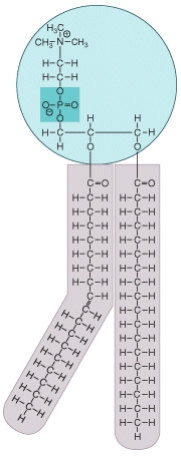
(Essay)
4.9/5 (78)
(78) Which of the following describes the major significance of the element chlorine in the human body?
(Multiple Choice)
4.9/5 (75)
(75) The three types of subatomic particles that are important for understanding chemical reactions in the human body are
(Multiple Choice)
4.8/5 (71)
(71) This type of fatty acid contains more than one double bond in its hydrocarbon chain.
(Multiple Choice)
4.8/5 (76)
(76) 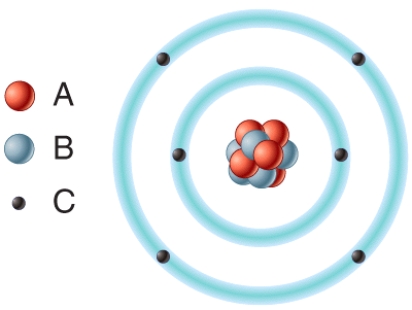
What organic compound is lacking the human digestive system that makes it unable to digest cellulose?
(Essay)
4.8/5 (73)
(73) In the diagram,what would happen to the concentration of C if the concentration of A increases?
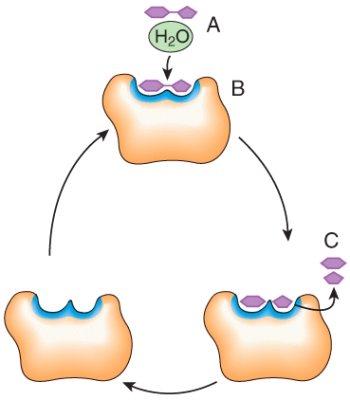
(Multiple Choice)
4.8/5 (89)
(89) Which of the following subatomic particles are shared by two atoms to form covalent bonds?
1)neutron
2)electron
3)proton
(Multiple Choice)
4.9/5 (82)
(82) The number of protons in an atom is represented by an element's
(Multiple Choice)
4.7/5 (76)
(76) 
Filters
- Essay(0)
- Multiple Choice(0)
- Short Answer(0)
- True False(0)
- Matching(0)