



 Chat with AI
Exam 12: Risk and Refinements in Capital Budgeting

Exam 1: The Role of Managerial Finance134 Questions
Exam 2: The Financial Market Environment91 Questions
Exam 3: Financial Statements and Ratio Analysis208 Questions
Exam 4: Cash Flow and Financial Planning185 Questions
Exam 5: Time Value of Money173 Questions
Exam 6: Interest Rates and Bond Valuation224 Questions
Exam 7: Stock Valuation188 Questions
Exam 8: Risk and Return188 Questions
Exam 9: The Cost of Capital137 Questions
Exam 10: Capital Budgeting Techniques167 Questions
Exam 11: Capital Budgeting Cash Flows117 Questions
Exam 12: Risk and Refinements in Capital Budgeting106 Questions
Exam 13: Leverage and Capital Structure217 Questions
Exam 14: Payout Policy130 Questions
Exam 15: Working Capital and Current Assets Management336 Questions
Exam 16: Current Liabilities Management171 Questions
Exam 17: Hybrid and Derivative Securities185 Questions
Exam 18: Mergers, Lbos, Divestitures, and Business Failure191 Questions
Exam 19: International Managerial Finance108 Questions
Select questions type


The option to develop follow-on projects, expand markets, expand or retool plants, and so on that would not be possible without implementation of the project that is being evaluated is called ________.
(Multiple Choice)
4.9/5  (92)
(92) The danger that an unexpected change in the exchange rate between the dollar and the currency in which a project's cash flows are denominated will reduce the market value of that project's cash flow is called exchange rate risk.
(True/False)
4.9/5 (81)
(81) Foreign direct investment is the transfer of capital, managerial, and technical assets to a foreign country.
(True/False)
4.9/5 (82)
(82) Table 12.1
A corporation is assessing the risk of two capital budgeting proposals. The financial analysts have developed pessimistic, most likely, and optimistic estimates of the annual cash inflows which are given in the following table. The firm's cost of capital is 10 percent. 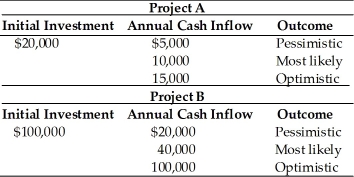 -The expected net present value of Project A if the outcomes are equally probable and the project has five-year life is ________. (See Table 12.1)
 (Multiple Choice)
4.8/5 (87)
(87) In CAPM, the total risk is defined as the sum of nondiversifiable and diversifiable risk.
(True/False)
4.9/5 (72)
(72) Futures and options are opportunities that are embedded in capital budgeting projects that enable managers to alter their cash flows and risks in a way that affects project acceptability.
(True/False)
4.9/5 (72)
(72) The acceptance of a particular project usually has no impact on a firm's overall risk.
(True/False)
4.7/5 (74)
(74) Table 12.1
A corporation is assessing the risk of two capital budgeting proposals. The financial analysts have developed pessimistic, most likely, and optimistic estimates of the annual cash inflows which are given in the following table. The firm's cost of capital is 10 percent.
-The range of the annual cash inflows for Project A is ________. (See Table 12.1)
-The range of the annual cash inflows for Project A is ________. (See Table 12.1) (Multiple Choice)
4.8/5 (74)
(74) In case of international capital budgeting, a U.S. company can minimize its political risk by creating a joint venture with a competent and well-connected local partner.
(True/False)
4.9/5 (81)
(81) The theoretical basis from which the concept of risk-adjusted discount rates is derived is ________.
(Multiple Choice)
4.8/5 (83)
(83) In capital budgeting, risk is generally thought of as the chance that NPV and IRR will provide conflicting recommendations to management.
(True/False)
4.9/5 (80)
(80) In capital budgeting, risk is the degree of variability of cash flows.
(True/False)
4.9/5 (74)
(74) The two basic types of risk associated with international cash flows are inflation and foreign exchange risks and political risks.
(True/False)
4.9/5 (77)
(77) Table 12.2
A firm is considering investment in a capital project which is described below. The firm's cost of capital is 18 percent and the risk-free rate is 6 percent. The project has a risk index of 1.5. The firm uses the following equation to determine the risk adjusted discount rate, RADR, for each project: RADR = Rf + Risk Index (Cost of capital - Rf) 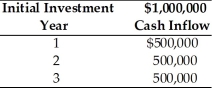 -The discount rate that should be used in the net present value calculation to compensate for risk is ________. (See Table 12.2)
 (Multiple Choice)
4.9/5 (78)
(78) Table 12.5
Nico Manufacturing is considering investment in one of two mutually exclusive projects X and Y which are described below. Nico Manufacturing's overall cost of capital is 15 percent, the market return is 15 percent and the risk-free rate is 5 percent. Nico estimates that the beta for project X is 1.20 and the beta for project Y is 1.40. 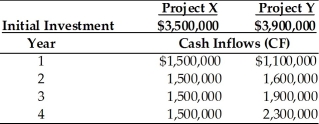 -Calculate the NPV of projects X and Y assuming that the firm did not employ the RADR method and instead used the firm's overall cost of capital to evaluate projects X and Y. (See Table 12.5)
 (Essay)
4.9/5 (93)
(93) A market risk-return function is a graphical presentation of the discount rates associated with each level of project risk.
(True/False)
4.9/5 (88)
(88) In case of international capital budgeting, long-term exchange rate risk can be minimized by financing the project, in whole or in part, in local currency.
(True/False)
4.9/5 (86)
(86) The difference by which the required discount rate exceeds the risk-free rate is called the ________.
(Multiple Choice)
4.8/5 (86)
(86) The risk-adjusted discount rate can be computed as the risk free rate plus the product of a project's beta and the credit risk premium.
(True/False)
4.9/5 (75)
(75) 
Filters
- Essay(0)
- Multiple Choice(0)
- Short Answer(0)
- True False(0)
- Matching(0)