



 Chat with AI
Exam 14: Payout Policy

Exam 1: The Role of Managerial Finance134 Questions
Exam 2: The Financial Market Environment91 Questions
Exam 3: Financial Statements and Ratio Analysis208 Questions
Exam 4: Cash Flow and Financial Planning185 Questions
Exam 5: Time Value of Money173 Questions
Exam 6: Interest Rates and Bond Valuation224 Questions
Exam 7: Stock Valuation188 Questions
Exam 8: Risk and Return188 Questions
Exam 9: The Cost of Capital137 Questions
Exam 10: Capital Budgeting Techniques167 Questions
Exam 11: Capital Budgeting Cash Flows117 Questions
Exam 12: Risk and Refinements in Capital Budgeting106 Questions
Exam 13: Leverage and Capital Structure217 Questions
Exam 14: Payout Policy130 Questions
Exam 15: Working Capital and Current Assets Management336 Questions
Exam 16: Current Liabilities Management171 Questions
Exam 17: Hybrid and Derivative Securities185 Questions
Exam 18: Mergers, Lbos, Divestitures, and Business Failure191 Questions
Exam 19: International Managerial Finance108 Questions
Select questions type


In a 2-for-1 stock split, the number of shares outstanding decreases by fifty percent and the stock's per share par value will double.
(True/False)
4.9/5  (88)
(88) Informational content of dividends throws light with respect to future earnings. In other words, investors view a change in dividends, up or down, as a signal that management expects future earnings to change in the same direction.
(True/False)
4.8/5 (78)
(78) The payment of a stock dividend is a shifting of funds between stockholders' equity accounts rather than an outflow of funds.
(True/False)
4.9/5 (87)
(87) A stock split is usually taxable to a firm as it restructures the capital.
(True/False)
4.8/5 (81)
(81) According to Modigliani and Miller, a firm's value is determined solely by the earning power and risk of its assets and that the manner in which it splits its earnings stream between dividends and internally retained funds does not affect this value.
(True/False)
4.8/5 (82)
(82) A firm has had the indicated earnings per share over the last three years: 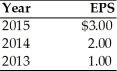 (a) If the firm's dividend policy was based on a constant payout ratio of 50 percent, determine the annual dividend for each year.
(b) If the firm's dividend policy was based on a fixed dollar payout policy of 50 cents per share plus an extra dividend equal to 75 percent of earnings per share above $1.00, determine the annual dividend for each year.
(a) If the firm's dividend policy was based on a constant payout ratio of 50 percent, determine the annual dividend for each year.
(b) If the firm's dividend policy was based on a fixed dollar payout policy of 50 cents per share plus an extra dividend equal to 75 percent of earnings per share above $1.00, determine the annual dividend for each year. (Essay)
4.8/5 (78)
(78) An excess earnings accumulation tax is levied when ________.
(Multiple Choice)
4.9/5 (74)
(74) According to the bird-in-the-hand argument, current dividend payments reduce investor uncertainty and result in a higher value for a firm's stock.
(True/False)
4.8/5 (84)
(84) 
Filters
- Essay(0)
- Multiple Choice(0)
- Short Answer(0)
- True False(0)
- Matching(0)