



 Chat with AI
Exam 14: Payout Policy

Exam 1: The Role of Managerial Finance134 Questions
Exam 2: The Financial Market Environment91 Questions
Exam 3: Financial Statements and Ratio Analysis208 Questions
Exam 4: Cash Flow and Financial Planning185 Questions
Exam 5: Time Value of Money173 Questions
Exam 6: Interest Rates and Bond Valuation224 Questions
Exam 7: Stock Valuation188 Questions
Exam 8: Risk and Return188 Questions
Exam 9: The Cost of Capital137 Questions
Exam 10: Capital Budgeting Techniques167 Questions
Exam 11: Capital Budgeting Cash Flows117 Questions
Exam 12: Risk and Refinements in Capital Budgeting106 Questions
Exam 13: Leverage and Capital Structure217 Questions
Exam 14: Payout Policy130 Questions
Exam 15: Working Capital and Current Assets Management336 Questions
Exam 16: Current Liabilities Management171 Questions
Exam 17: Hybrid and Derivative Securities185 Questions
Exam 18: Mergers, Lbos, Divestitures, and Business Failure191 Questions
Exam 19: International Managerial Finance108 Questions
Select questions type


Regular dividend policy is a dividend policy based on the payment of a certain fixed percentage of earnings to owners in each dividend period.
(True/False)
4.9/5  (76)
(76) By purchasing shares through a firm's dividend reinvestment plan (or DRIP), shareholders typically can acquire shares at a value that is above the prevailing market price.
(True/False)
4.7/5 (88)
(88) A stock split commonly increases the stock's per share par value.
(True/False)
4.9/5 (88)
(88) As per dividend relevance theory, current dividend payments are believed to reduce investor's uncertainty, thereby-all else being equal-placing a lower value on a firm's stock after its payment.
(True/False)
4.9/5 (84)
(84) Which of the following is true of arguments for dividend relevance?
(Multiple Choice)
4.9/5 (76)
(76) A firm has the following stockholders' equity balances: 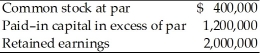 In states where the firm's legal capital is defined as the par value of its common stock, the maximum cash dividend the firm could pay is ________.
 (Multiple Choice)
4.7/5 (78)
(78) In a(n) ________, a firm announces the price it is willing to pay to buy back shares and the quantity of shares it wishes to repurchase.
(Multiple Choice)
4.8/5 (84)
(84) The motive to pay stock dividend to retain cash to satisfy past-due bills, may result in a decline in market value.
(True/False)
4.8/5 (84)
(84) If a firm has overdue liabilities or is legally insolvent or bankrupt, most states prohibit its payment of cash dividends.
(True/False)
4.8/5 (89)
(89) Mr. R. owns 20,000 shares of ABC Corporation stock. The company is planning to issue a stock dividend. Before the dividend Mr. R. owned 10 percent of the outstanding stock, which had a market value of $200,000, or $10 per share. Upon receiving the 10 percent stock dividend the value of his shares is ________.
(Multiple Choice)
4.8/5 (90)
(90) Legal constraints prohibit the payment of cash dividends until a certain level of earnings has been achieved or limit the amount of dividends paid to a certain dollar amount or percentage of earnings.
(True/False)
5.0/5 (84)
(84) The Jobs and Growth Tax Relief Reconciliation Act of 2003 significantly changed the tax treatment of corporate dividends for most taxpayers by dropping the tax rate to the rate applicable on capital gains, which is a maximum rate of 15%.
(True/False)
4.8/5 (73)
(73) The level of dividends a firm expects to pay is generally unrelated to how rapidly it expects to grow as well as the level of asset investments required.
(True/False)
4.9/5 (66)
(66) Which type of dividend payment policy has the disadvantage that if a firm's earnings drop or if a loss occurs in a given period, dividends may be low or nonexistent?
(Multiple Choice)
4.8/5 (87)
(87) By purchasing shares through a firm's dividend reinvestment plan (or DRIP), shareholders typically can acquire shares at a value that is below the prevailing market price.
(True/False)
4.8/5 (79)
(79) The problem with the regular dividend policy from a firm's perspective is that ________.
(Multiple Choice)
4.8/5 (91)
(91) 
Filters
- Essay(0)
- Multiple Choice(0)
- Short Answer(0)
- True False(0)
- Matching(0)