



 Chat with AI
Exam 45: Community Ecology

Exam 1: Invitation to Biology79 Questions
Exam 2: Life's Chemical Bases67 Questions
Exam 3: Molecules of Life87 Questions
Exam 4: Cell Structure106 Questions
Exam 5: Ground Rules of Metabolism69 Questions
Exam 6: Where it Starts—Photosynthesis69 Questions
Exam 7: How Cells Release Chemical Energy75 Questions
Exam 8: DNA Structure and Function61 Questions
Exam 9: From DNA to Protein64 Questions
Exam 10: Control of Gene Expression63 Questions
Exam 11: How Cells Reproduce77 Questions
Exam 12: Meiosis and Sexual Reproduction59 Questions
Exam 13: Observing Patterns in Inherited Traits95 Questions
Exam 14: Chromosomes and Human Inheritance76 Questions
Exam 15: Studying and Manipulating Genomes58 Questions
Exam 16: Evidence of Evolution55 Questions
Exam 17: Processes of Evolution74 Questions
Exam 18: Organizing Information about Species46 Questions
Exam 19: Life's Origin and Early Evolution60 Questions
Exam 20: Viruses, Bacteria, and Archaea56 Questions
Exam 21: Protists: The Simplest Eukaryotes61 Questions
Exam 22: The Land Plants66 Questions
Exam 23: Fungi52 Questions
Exam 24: Animal Evolution: The Invertebrates74 Questions
Exam 25: Animal Evolution: The Chordates71 Questions
Exam 26: Human Evolution51 Questions
Exam 27: Plant Tissues96 Questions
Exam 28: Plant Nutrition and Transport69 Questions
Exam 29: Life Cycles of Flowering Plants89 Questions
Exam 30: Communication Strategies in Plants72 Questions
Exam 31: Animal Tissues and Organ Systems79 Questions
Exam 32: Neural Control97 Questions
Exam 33: Sensory Perception69 Questions
Exam 34: Endocrine Control90 Questions
Exam 35: Structural Support and Movement72 Questions
Exam 36: Circulation58 Questions
Exam 37: Immunity73 Questions
Exam 38: Respiration78 Questions
Exam 39: Digestion and Nutrition98 Questions
Exam 40: Maintaining the Internal Environment73 Questions
Exam 41: Animal Reproductive System105 Questions
Exam 42: Animal Development72 Questions
Exam 43: Animal Behavior74 Questions
Exam 44: Population Ecology59 Questions
Exam 45: Community Ecology71 Questions
Exam 46: Ecosystems64 Questions
Exam 47: The Biosphere73 Questions
Exam 48: Human Impacts on the Biosphere67 Questions
Select questions type


Which element is LEAST likely to be an abiotic factor that can affect community structure?
(Multiple Choice)
4.8/5  (90)
(90) Respond to the following statements in reference to the five kinds of species interactions listed below.
-In this interaction,one species is harmed but usually not killed,to the benefit of the other that lives on or in it.
(Multiple Choice)
4.8/5 (92)
(92) 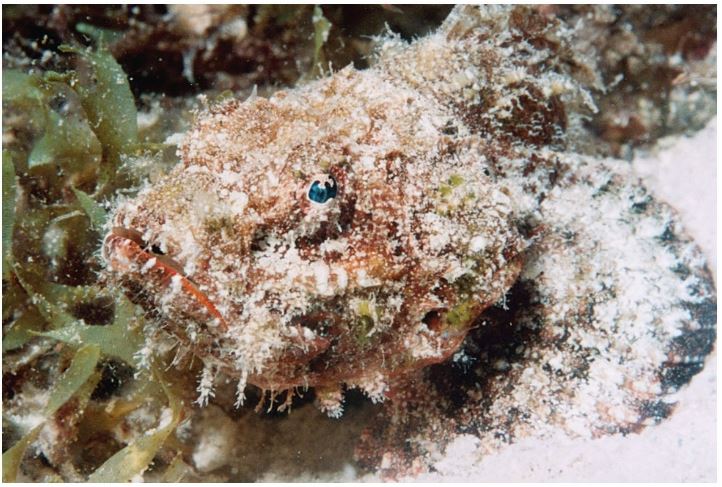 Figure 45.13
-The scorpionfish in the above figure is using ____ for protection.
Figure 45.13
-The scorpionfish in the above figure is using ____ for protection. (Multiple Choice)
4.9/5 (83)
(83) Respond to the following statements in reference to the five kinds of species interactions listed below.
-If a wasp lays its eggs inside the larva of a moth,the interaction is this.
(Multiple Choice)
4.8/5 (79)
(79) A new community that develops in a disturbed site where the soil that supported a previous community remains is known as ________.
(Short Answer)
4.8/5 (87)
(87) Gause's principle of competitive exclusion is based on the idea that ____.
(Multiple Choice)
4.8/5 (71)
(71) Choose the most appropriate answer for each.
-Primary succession
(Multiple Choice)
5.0/5 (79)
(79) Choose the most appropriate answer for each.
-Pioneer species
(Multiple Choice)
5.0/5 (84)
(84) Respond to the following statements in reference to the five kinds of species interactions listed below.
-The interaction between two closely related species of woodpeckers that live in a temperate forest is likely to be this.
(Multiple Choice)
4.7/5 (67)
(67) What is a process that begins when a pioneer species colonizes a barren habitat with no soil?
(Multiple Choice)
4.7/5 (86)
(86) Choose the most appropriate answer for each.
-Competitive exclusion
(Multiple Choice)
4.7/5 (69)
(69) Respond to the following statements in reference to the five kinds of species interactions listed below.
-In this interaction between two species,both species are harmed to some degree.
(Multiple Choice)
4.9/5 (76)
(76) An interaction between two species in which both species benefit is known as ____.
(Multiple Choice)
4.7/5 (80)
(80) ___________ is a body shape,color pattern,or behavior that allows an individual to blend into its surrounding and avoid detection.
(Short Answer)
4.8/5 (84)
(84) In this type of competitive interaction,the competing species reduce the amount of resources available to each other without direct interaction with each other.
(Short Answer)
4.8/5 (74)
(74) Which is the species that is especially intolerant of physical disturbance to their environment?
(Multiple Choice)
4.8/5 (81)
(81) 
Filters
- Essay(0)
- Multiple Choice(0)
- Short Answer(0)
- True False(0)
- Matching(0)