



 Chat with AI
Exam 44: Population Ecology

Exam 1: Invitation to Biology79 Questions
Exam 2: Life's Chemical Bases67 Questions
Exam 3: Molecules of Life87 Questions
Exam 4: Cell Structure106 Questions
Exam 5: Ground Rules of Metabolism69 Questions
Exam 6: Where it Starts—Photosynthesis69 Questions
Exam 7: How Cells Release Chemical Energy75 Questions
Exam 8: DNA Structure and Function61 Questions
Exam 9: From DNA to Protein64 Questions
Exam 10: Control of Gene Expression63 Questions
Exam 11: How Cells Reproduce77 Questions
Exam 12: Meiosis and Sexual Reproduction59 Questions
Exam 13: Observing Patterns in Inherited Traits95 Questions
Exam 14: Chromosomes and Human Inheritance76 Questions
Exam 15: Studying and Manipulating Genomes58 Questions
Exam 16: Evidence of Evolution55 Questions
Exam 17: Processes of Evolution74 Questions
Exam 18: Organizing Information about Species46 Questions
Exam 19: Life's Origin and Early Evolution60 Questions
Exam 20: Viruses, Bacteria, and Archaea56 Questions
Exam 21: Protists: The Simplest Eukaryotes61 Questions
Exam 22: The Land Plants66 Questions
Exam 23: Fungi52 Questions
Exam 24: Animal Evolution: The Invertebrates74 Questions
Exam 25: Animal Evolution: The Chordates71 Questions
Exam 26: Human Evolution51 Questions
Exam 27: Plant Tissues96 Questions
Exam 28: Plant Nutrition and Transport69 Questions
Exam 29: Life Cycles of Flowering Plants89 Questions
Exam 30: Communication Strategies in Plants72 Questions
Exam 31: Animal Tissues and Organ Systems79 Questions
Exam 32: Neural Control97 Questions
Exam 33: Sensory Perception69 Questions
Exam 34: Endocrine Control90 Questions
Exam 35: Structural Support and Movement72 Questions
Exam 36: Circulation58 Questions
Exam 37: Immunity73 Questions
Exam 38: Respiration78 Questions
Exam 39: Digestion and Nutrition98 Questions
Exam 40: Maintaining the Internal Environment73 Questions
Exam 41: Animal Reproductive System105 Questions
Exam 42: Animal Development72 Questions
Exam 43: Animal Behavior74 Questions
Exam 44: Population Ecology59 Questions
Exam 45: Community Ecology71 Questions
Exam 46: Ecosystems64 Questions
Exam 47: The Biosphere73 Questions
Exam 48: Human Impacts on the Biosphere67 Questions
Select questions type


__________ sampling can be used to estimate the population of an area based on direct counts in a small part of the area.
(Short Answer)
4.8/5  (85)
(85) Based on the demographic transition model,which of the following countries is in the industrialization stage,marked by birth rate declines and less rapid population growth compared to the previous period?
(Multiple Choice)
4.9/5 (72)
(72) Which of these is NOT a direct factor that controls biotic potential?
(Multiple Choice)
4.9/5 (91)
(91) Choose the most appropriate response for each.
-Exponential growth
(Multiple Choice)
4.8/5 (68)
(68) The per capita growth rate (r)is ____ per mouse per month in a population of 1,000 mice where 500 mice are born and 400 mice die monthly.
(Multiple Choice)
4.8/5 (84)
(84) The average person in the United States has an ecological footprint nearly _____ times that of an average world citizen.
(Multiple Choice)
4.9/5 (70)
(70) Equilibrial species are shaped by ____,and tend to have a ____.
(Multiple Choice)
4.8/5 (69)
(69) A developing country's replacement fertility rate is most directly affected by which factor?
(Multiple Choice)
4.8/5 (82)
(82) Competition among members of the same species is known as ___________.
(Short Answer)
5.0/5 (81)
(81) The ____ of a human population is the average number of children born to a woman during her reproductive years.
(Multiple Choice)
4.7/5 (81)
(81) There will be approximately ____ mice in four months in a population of 1,000 mice where 500 mice are born and 400 mice die monthly.
(Multiple Choice)
4.9/5 (82)
(82) The number of individuals occupying a unit of habitat (volume or area)is the ___________.
(Multiple Choice)
4.9/5 (82)
(82) What distribution pattern is the most common in the natural world?
(Multiple Choice)
4.8/5 (71)
(71) Choose the most appropriate response for each.
-Broad-based age structure
(Multiple Choice)
4.8/5 (85)
(85) The maximum possible rate of increase is a species' __________ potential.
(Short Answer)
4.9/5 (79)
(79) The size of a population depends on its rates of births,deaths,__________,and __________.
(Short Answer)
4.8/5 (77)
(77) Which of the following is an example of r-selected organism?
(Multiple Choice)
4.8/5 (80)
(80) 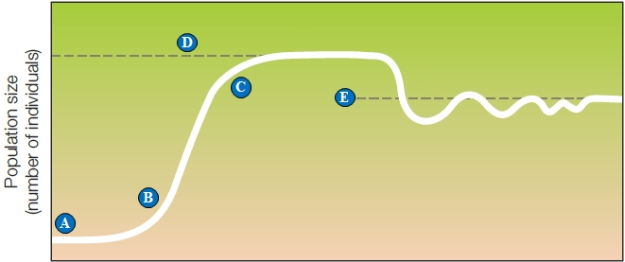 Figure 44.6
The following question refers to the figure above illustrating logistic growth.
-The initial carrying capacity of an environment is indicated by ____.
Figure 44.6
The following question refers to the figure above illustrating logistic growth.
-The initial carrying capacity of an environment is indicated by ____. (Multiple Choice)
4.8/5 (79)
(79) 
Filters
- Essay(0)
- Multiple Choice(0)
- Short Answer(0)
- True False(0)
- Matching(0)