



 Chat with AI
Exam 10: Partnerships: Formation, operation, and Basis

Exam 1: Understanding and Working With the Federal Tax Law72 Questions
Exam 2: Corporations: Introduction and Operating Rules103 Questions
Exam 3: Corporations: Special Situations76 Questions
Exam 4: Corporations: Organization and Capital Structure91 Questions
Exam 5: Corporations: Earnings and Profits and Dividend Distributions82 Questions
Exam 6: Corporations: Redemptions and Liquidations107 Questions
Exam 7: Corporations: Reorganizations138 Questions
Exam 8: Consolidated Tax Returns143 Questions
Exam 9: Taxation of International Transactions142 Questions
Exam 10: Partnerships: Formation, operation, and Basis71 Questions
Exam 11: Partnerships: Distributions, transfer of Interests, and Terminations84 Questions
Exam 12: S Corporations161 Questions
Exam 13: Comparative Forms of Doing Business139 Questions
Exam 14: Exempt Entities159 Questions
Exam 15: Multistate Corporate Taxation169 Questions
Exam 16: Tax Practice and Ethics147 Questions
Exam 17: The Federal Gift and Estate Taxes199 Questions
Exam 18: Family Tax Planning168 Questions
Exam 19: Income Taxation of Trusts and Estates155 Questions
Select questions type


Match each of the following statements with the terms below that provide the best definition.
a.Organizational choice of many large accounting firms.
b.Partner's percentage allocation of current operating results.
c.Might affect any two partners' tax liabilities in different ways.
d.Brokerage and registration fees incurred for promoting and marketing partnership interests.
e.Transfer of asset to partnership followed by immediate distribution of cash to partner.
f.Must have at least one general partner.
g.Theory treating the partner and partnership as separate economic units.
h.Partner's basis in partnership interest after tax-free contribution of asset to partnership.
i.Partnership's basis in asset after tax-free contribution of asset to partnership.
j.Owners are "members."
k.Theory treating the partnership as a collection of taxpayers joined in an agency relationship.
l.Allows many unincorporated entities to select their Federal tax status.
m.No correct match provided.
-Aggregate concept
(Short Answer)
4.7/5  (77)
(77) Match each of the following statements with the terms below that provide the best definition.
a.Organizational choice of many large accounting firms.
b.Partner's percentage allocation of current operating results.
c.Might affect any two partners' tax liabilities in different ways.
d.Brokerage and registration fees incurred for promoting and marketing partnership interests.
e.Transfer of asset to partnership followed by immediate distribution of cash to partner.
f.Must have at least one general partner.
g.Theory treating the partner and partnership as separate economic units.
h.Partner's basis in partnership interest after tax-free contribution of asset to partnership.
i.Partnership's basis in asset after tax-free contribution of asset to partnership.
j.Owners are "members."
k.Theory treating the partnership as a collection of taxpayers joined in an agency relationship.
l.Allows many unincorporated entities to select their Federal tax status.
m.No correct match provided.
-Syndication costs
(Short Answer)
4.7/5 (83)
(83) In the current year,Greg formed an equal partnership with Melvin.Greg contributed land with an adjusted basis of $90,000 and a fair market value of $150,000.Greg also contributed $75,000 cash to the partnership.Melvin contributed land with an adjusted basis of $100,000 and a fair market value of $200,000.The land contributed by Greg was encumbered by a $50,000 nonrecourse debt.The land contributed by Melvin was encumbered by $25,000 of nonrecourse debt.Assume the partners share debt equally.Immediately after the formation,the basis of Melvin's partnership interest is:
(Multiple Choice)
5.0/5 (86)
(86) Roxanne contributes land to the RB Partnership in exchange for a 40% interest.The land has an adjusted basis and fair market value of $75,000 and is subject to a liability of $25,000,which the partnership assumes.None of this liability is repaid at year-end.At the end of the year,the partnership has trade accounts payable of $30,000.Assume all liabilities are allocated proportionately to the partners.Total partnership income for the year is $100,000.Roxanne's basis in her partnership interest at the end of the year is $112,000.
(True/False)
5.0/5 (85)
(85) Formation of a partnership is generally a tax-deferred transaction,provided the contributing partners receive partnership interests representing "control" of the entity (more than 80% of the voting power of the partnership interests).
(True/False)
4.8/5 (77)
(77) Kevin,Chuck,and Greg contributed assets to form the equal KCG Partnership.Kevin contributed cash of $50,000 and land with a basis of $80,000 (fair market value of $50,000).Chuck contributed cash of $30,000 and land with a basis of $40,000 (fair market value of $70,000).Greg contributed cash of $60,000 and a fully depreciated property ($0 basis)valued at $40,000.Which of the following tax treatments is not correct?
(Multiple Choice)
4.8/5 (91)
(91) Match each of the following statements with the terms below that provide the best definition.
a.Organizational choice of many large accounting firms.
b.Partner's percentage allocation of current operating results.
c.Might affect any two partners' tax liabilities in different ways.
d.Brokerage and registration fees incurred for promoting and marketing partnership interests.
e.Transfer of asset to partnership followed by immediate distribution of cash to partner.
f.Must have at least one general partner.
g.Theory treating the partner and partnership as separate economic units.
h.Partner's basis in partnership interest after tax-free contribution of asset to partnership.
i.Partnership's basis in asset after tax-free contribution of asset to partnership.
j.Owners are "members."
k.Theory treating the partnership as a collection of taxpayers joined in an agency relationship.
l.Allows many unincorporated entities to select their Federal tax status.
m.No correct match provided.
-Separately stated item
(Short Answer)
4.9/5 (62)
(62) Nina and Sue form an equal partnership during the current year.Nina contributes cash of $100,000,and Sue contributes property (adjusted basis of $40,000,fair market value of $250,000)subject to a nonrecourse liability of $150,000.As a result of these transactions,Sue has a recognized gain of $35,000 and a basis in her partnership interest of $75,000.
(True/False)
4.9/5 (75)
(75) Richard made a contribution of property to the newly formed QRST Partnership.The property had a $30,000 adjusted basis to Richard and a $100,000 fair market value on the contribution date.The property was also encumbered by a $50,000 nonrecourse debt,which was transferred to the partnership on that date.Another partner,Sylvia,shares 1/3 of the partnership income,gain,loss,deduction,and credit.Under IRS regulations,Sylvia's share of the nonrecourse debt for basis purposes is:
(Multiple Choice)
4.8/5 (81)
(81) Fern,Inc.,Ivy Inc.,and Jason formed a general partnership,each contributing equally.Fern,Inc.files its tax return on a July 1 - June 30 fiscal year; Ivy Inc.files on a September 1 - August 31 fiscal year; and Jason is a calendar year taxpayer.Which of the following statements is true regarding the taxable year the partnership can choose?
(Multiple Choice)
4.9/5 (75)
(75) Meagan is a 40% general partner in the calendar year,cash basis MKK Partnership.The partnership received $100,000 income from services and paid the following other amounts:
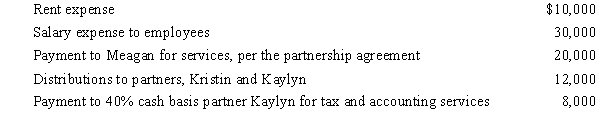 How much is Meagan's adjusted gross income increased as a result of the above items?
 (Multiple Choice)
4.9/5 (81)
(81) 
Filters
- Essay(0)
- Multiple Choice(0)
- Short Answer(0)
- True False(0)
- Matching(0)