



 Chat with AI
Exam 13: Monopolistic Competition and Oligopoly

Exam 1: Nature and Scope of Managerial Economics25 Questions
Exam 2: Economic Optimization45 Questions
Exam 3: Demand and Supply50 Questions
Exam 4: Demand Analysis46 Questions
Exam 5: Demand Estimation49 Questions
Exam 6: Forecasting50 Questions
Exam 7: Production Analysis and Compensation Policy50 Questions
Exam 8: Cost Analysis and Estimation50 Questions
Exam 9: Linear Programming32 Questions
Exam 10: Competitive Markets50 Questions
Exam 11: Performance and Strategy in Competitive Markets50 Questions
Exam 12: Monopoly and Monopsony50 Questions
Exam 13: Monopolistic Competition and Oligopoly48 Questions
Exam 14: Game Theory and Competitive Strategy37 Questions
Exam 15: Pricing Practices47 Questions
Exam 16: Risk Analysis47 Questions
Exam 17: Capital Budgeting50 Questions
Exam 18: Organization Structure and Corporate Governance50 Questions
Exam 19: Government in the Market Economy50 Questions
Select questions type


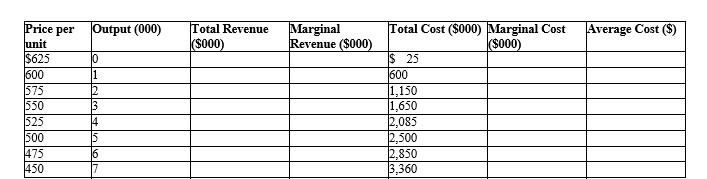
Monopolistic Competition. Paintless Dent Removal, Inc., was an early innovator in the noninvasive removal of dents, dings, and hail damage from cars, trucks and SUVs. Imitation by traditional auto body repair shops and a host of new rivals is poised to eliminate the company's early lead.


(Essay)
4.9/5  (72)
(72) A successfully exploited niche market involves elements of:
(Multiple Choice)
4.7/5 (82)
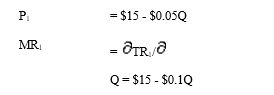
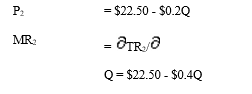
(82) Kinked Demand. Brooklyn Broadband, Inc., is a local provider of broadband access to the Internet in Brooklyn, New York. Brooklyn faces the following segmented demand and marginal revenue curves for its residential service:
Over the range of 0 to 50(000) customers per month:
 When output exceeds 50(000) customers per month:
 The company's total and marginal cost functions are as follows:
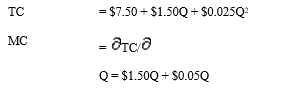 where P is price (in dollars), Q is output (in thousands), and TC is total cost (in thousands of dollars).

When output exceeds 50(000) customers per month:
The company's total and marginal cost functions are as follows:
where P is price (in dollars), Q is output (in thousands), and TC is total cost (in thousands of dollars).
(Essay)
4.9/5 (76)
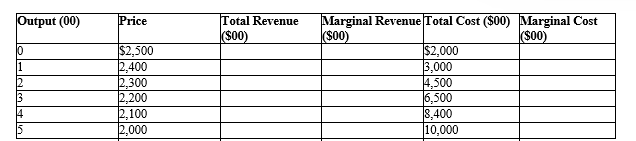
(76) Price/Output Equilibrium. Osteopathic Devices, Inc., makes products used in the surgical replacement of degenerated bone material. During recent years, its unique hip joint replacement product has successfully exploited a small but profitable niche in the market. The company's monopoly position in this market niche is now threatened by a competitor's announcement of a new device with capabilities similar to those of the Osteopathic product.


(Essay)
4.9/5 (71)
(71) A theory used to explain rigid or "sticky" in oligopoly markets is proposed in the:
(Multiple Choice)
5.0/5 (87)
(87) Price Leadership. Biking Magazine is a dominant price leading firm in the popular bicycle magazine market. Wheel Deal and Free Wheel are competing magazines that address the same audience. Total and marginal cost relations for each magazine are:
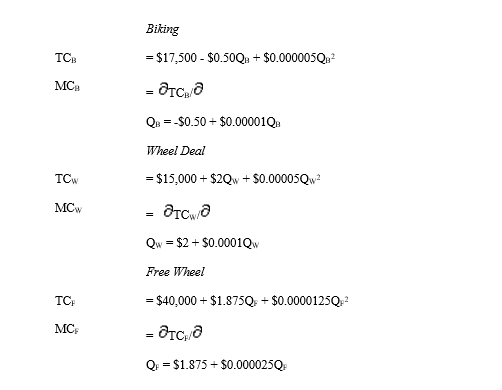 and the industry demand curve is:
 Assume throughout this problem that Wheel Deal and Free Wheel are perfect substitutes for Biking magazine.

and the industry demand curve is:
Assume throughout this problem that Wheel Deal and Free Wheel are perfect substitutes for Biking magazine.
(Essay)
4.8/5 (77)
(77) A perfectly functioning cartel leads to a price/output combination identical to an industry that is:
(Multiple Choice)
5.0/5 (86)
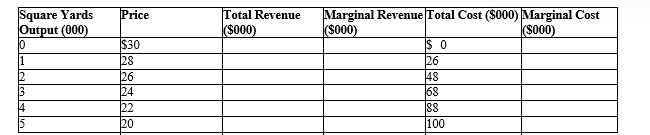
(86) Price/Output Equilibrium. Sears markets an innovative two-step carpet cleaning process. Because leftover carpet cleaning solutions can act as a magnet for dirt, Sears exclusive two-step carpet cleaning system includes a specially formulated pH-balancing fiber rinse that removes carpet cleaning solution residue right along with deep-down dirt. According to Sear's, all that's left behind is cleaner, softer, more beautiful carpet.


(Essay)
4.8/5 (78)
(78) Cartel Pricing. The domestic color separator manufacturing industry is highly concentrated with only three active firms. Color separators are used in the production of high-quality images used to produce glossy color, pamphlets, newspapers, etc. Annual output and the marginal cost of production for production grade models produced by each company are as follows:
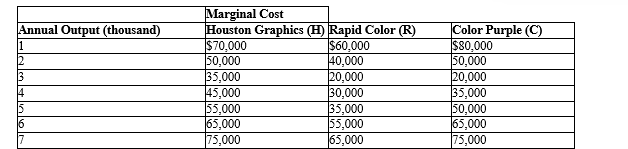 Competition from low-priced imports has been effectively limited by import tariffs (taxes). Given this import protection, domestic firms are able to sell as much output as they wish at the current wholesale market price of $35,000. However, industry prices haven't risen above $35,000 because this price triggers a flood of foreign competition.

Competition from low-priced imports has been effectively limited by import tariffs (taxes). Given this import protection, domestic firms are able to sell as much output as they wish at the current wholesale market price of $35,000. However, industry prices haven't risen above $35,000 because this price triggers a flood of foreign competition.
(Essay)
4.8/5 (77)
(77) In long-run equilibrium, the monopolistically competitive firm will set a price equal to:
(Multiple Choice)
5.0/5 (96)
(96) In monopolistically competitive markets, the firm demand curve is:
(Multiple Choice)
4.8/5 (73)
(73) A firm should increase advertising if the net marginal revenue derived is:
(Multiple Choice)
4.9/5 (77)
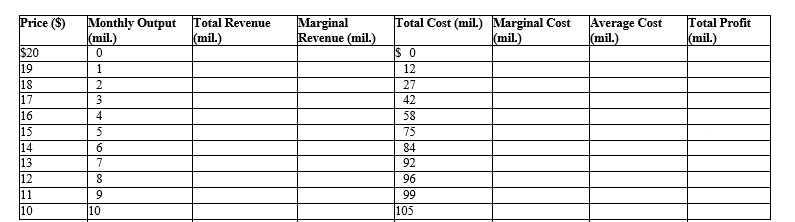
(77) Monopolistic Competition. Soft Lens, Inc., has enjoyed rapid growth in sales and high operating profits on its innovative extended-wear soft contact lenses. However, the company faces potentially fierce competition from a host of new competitors as some important basic patents expire during the coming year. Unless the company is able to thwart such competition, severe downward pressure on prices and profit margins is anticipated.


(Essay)
4.8/5 (76)
(76) Price/Output Equilibrium. The domestic sewing machine manufacturing industry is highly concentrated with only three active firms. Annual output and the marginal cost of production for "free arm" models produced by each company are as follows:
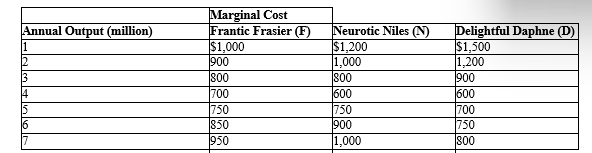 Competition from low-priced imports has been effectively limited by import tariffs (taxes). Given this import protection, domestic firms are able to sell as much output as they wish at the current wholesale market price of $750. However, industry prices haven't risen above $750 because this price triggers a flood of foreign competition.

Competition from low-priced imports has been effectively limited by import tariffs (taxes). Given this import protection, domestic firms are able to sell as much output as they wish at the current wholesale market price of $750. However, industry prices haven't risen above $750 because this price triggers a flood of foreign competition.
(Essay)
4.8/5 (84)
(84) Pricing Discretion. Would the following factors increase or decrease the ability of domestic manufacturers to raise prices and profit margins? Why?
A. Elimination of uniform product safety standards.
B. Increased import tariffs (taxes).
C. Increase import quotas.
D. A rising value of the dollar that has the effect of lowering import prices.
E. A tax on price advertising.
(Essay)
4.8/5 (72)
(72) 
Filters
- Essay(0)
- Multiple Choice(0)
- Short Answer(0)
- True False(0)
- Matching(0)