



 Chat with AI
Exam 17: Capital Budgeting

Exam 1: Nature and Scope of Managerial Economics25 Questions
Exam 2: Economic Optimization45 Questions
Exam 3: Demand and Supply50 Questions
Exam 4: Demand Analysis46 Questions
Exam 5: Demand Estimation49 Questions
Exam 6: Forecasting50 Questions
Exam 7: Production Analysis and Compensation Policy50 Questions
Exam 8: Cost Analysis and Estimation50 Questions
Exam 9: Linear Programming32 Questions
Exam 10: Competitive Markets50 Questions
Exam 11: Performance and Strategy in Competitive Markets50 Questions
Exam 12: Monopoly and Monopsony50 Questions
Exam 13: Monopolistic Competition and Oligopoly48 Questions
Exam 14: Game Theory and Competitive Strategy37 Questions
Exam 15: Pricing Practices47 Questions
Exam 16: Risk Analysis47 Questions
Exam 17: Capital Budgeting50 Questions
Exam 18: Organization Structure and Corporate Governance50 Questions
Exam 19: Government in the Market Economy50 Questions
Select questions type


Incremental Analysis. Grey's Anatomy, Ltd., is contemplating opening a new retail outlet in a suburban shopping mall. Projections for an initial 10-year period for the potential outlet are:
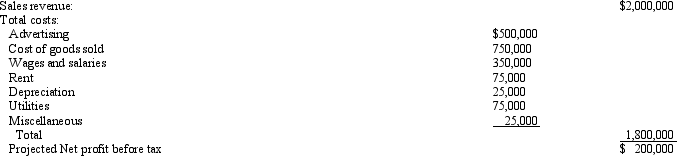 A. Calculate the NPV for the proposed outlet assuming that an initial investment of $750,000 is required and the cost of capital is k=20%.
B. Given the proposed outlet's projected net profit before tax, calculate the maximum initial investment that could be justified when k=20%.
A. Calculate the NPV for the proposed outlet assuming that an initial investment of $750,000 is required and the cost of capital is k=20%.
B. Given the proposed outlet's projected net profit before tax, calculate the maximum initial investment that could be justified when k=20%. (Essay)
4.9/5  (87)
(87) Expected Return. Pediatric Medicine, Ltd., is considering two alternative capital budgeting projects. Project A is an investment of $300,000 to renovate office facilities. Project B is an investment of $600,000 to expand diagnostic capabilities. Relevant cash flow data for the two projects over their expected two-year lives are as follows:
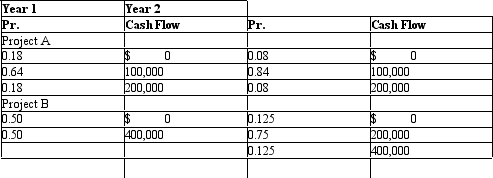 A. Calculate the expected value, standard deviation, and coefficient of variation of cash flows for each project.
B. Calculate the risk-adjusted NPV for each project, using a 12% cost of capital for the more risky project and 10% for the less risky one. Which project is preferred using the NPV criterion?
C. Calculate the PI for each project, and rank them according to their PIs.
D. Calculate the IRR for each project, and rank them according to their IRRs.
E. Compare your answers to parts B, C, and D, and discuss any differences.
A. Calculate the expected value, standard deviation, and coefficient of variation of cash flows for each project.
B. Calculate the risk-adjusted NPV for each project, using a 12% cost of capital for the more risky project and 10% for the less risky one. Which project is preferred using the NPV criterion?
C. Calculate the PI for each project, and rank them according to their PIs.
D. Calculate the IRR for each project, and rank them according to their IRRs.
E. Compare your answers to parts B, C, and D, and discuss any differences. (Essay)
4.8/5 (73)
(73) Cash Flow Analysis. Biometric Devices, Inc., is analyzing the potential profitability of three potential new testing devices:
 Assume that: (1) The company's marginal city-plus-state-plus-federal tax rate is 40%, (2) each product is expected to have a three-year life, (3) the firm uses straight-line depreciation, (4) the average cost of capital is 20%, (5) the products have the same risks as the firm's other business, and (6) the company has already spent $25,000 on research and development (R&D) for these products. This $250,000 has been capitalized and will be amortized over the life of the product chosen, if any.
A. What is the expected net cash flow each year? (Hint: Cash flow equals net profit after taxes plus depreciation and amortization charges.)
B. What is the net present value of each product? Which product, if any, should BDI introduce?
Assume that: (1) The company's marginal city-plus-state-plus-federal tax rate is 40%, (2) each product is expected to have a three-year life, (3) the firm uses straight-line depreciation, (4) the average cost of capital is 20%, (5) the products have the same risks as the firm's other business, and (6) the company has already spent $25,000 on research and development (R&D) for these products. This $250,000 has been capitalized and will be amortized over the life of the product chosen, if any.
A. What is the expected net cash flow each year? (Hint: Cash flow equals net profit after taxes plus depreciation and amortization charges.)
B. What is the net present value of each product? Which product, if any, should BDI introduce? (Essay)
4.7/5 (79)
(79) Cash Flow Analysis. The Printing Press, Inc., (PPI) is analyzing the potential profitability of three printing jobs put up for bid by a national textbook publisher:
 Assume that: (1) The company's marginal city-plus-state-plus-federal tax rate is 35%, (2) each job is expected to have a five-year life, (3) the firm uses straight-line depreciation, (4) the average cost of capital is 15%, (5) the jobs have the same risks as the firm's other business, and (6) the company has already spent $10,000 on developing the preceding data. This $10,000 has been capitalized and will be amortized over the life of the job chosen, if any.
A. What is the expected net cash flow each year? (Hint: Cash flow equals net profit after taxes plus depreciation and amortization charges.)
B. What is the net present value of each job? On which job, if any, should PPI bid?
C. Suppose that PPI's primary business is quite cyclical, improving and declining with the economy, which job B is expected to be counter cyclical. Might this have any bearing on your decision?
Assume that: (1) The company's marginal city-plus-state-plus-federal tax rate is 35%, (2) each job is expected to have a five-year life, (3) the firm uses straight-line depreciation, (4) the average cost of capital is 15%, (5) the jobs have the same risks as the firm's other business, and (6) the company has already spent $10,000 on developing the preceding data. This $10,000 has been capitalized and will be amortized over the life of the job chosen, if any.
A. What is the expected net cash flow each year? (Hint: Cash flow equals net profit after taxes plus depreciation and amortization charges.)
B. What is the net present value of each job? On which job, if any, should PPI bid?
C. Suppose that PPI's primary business is quite cyclical, improving and declining with the economy, which job B is expected to be counter cyclical. Might this have any bearing on your decision? (Essay)
4.9/5 (81)
(81) Incremental Analysis. Warren Buffet is a medium-sized restaurant located in Omaha, Nebraska. Warren Buffet currently offers elegant dining to luncheon and dining customers. The restaurant's most recent annual net income statement is as follows:
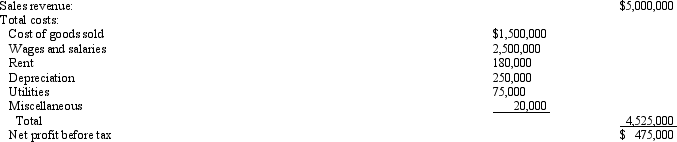 Luncheon and dining customer sales and expenses have remained relatively constant in the past few years and are expected to continue unchanged in the near future. To increase sales, Warren Buffet is considering offering a new Sunday buffet brunch service. Warren Buffet would offer Sunday brunch for an initial two-year period, and then reevaluate its profitability. Offering a Sunday brunch would require an initial outlay of $10,000 to cover new buffet equipment and utensils. This is the only capital investment required during the initial two-year period. At the end of that time, additional capital would be required to continue operation, and no capital would be recovered if the buffet were dropped. Buffet sales of $300,000 are anticipated, and the share of revenues devoted to cost of goods sold expenses are expected to represent the same as previously. Wage and salary expenses are expected to increase by 8% and utility expenses by 5%. No other incremental costs are expected.
A. Calculate net incremental cash flows for the Sunday buffet.
B. Assume that Warren Buffet's has the necessary capital and places a 20% before-tax opportunity cost on those funds. Should the buffet service be offered? Why or why not?
Luncheon and dining customer sales and expenses have remained relatively constant in the past few years and are expected to continue unchanged in the near future. To increase sales, Warren Buffet is considering offering a new Sunday buffet brunch service. Warren Buffet would offer Sunday brunch for an initial two-year period, and then reevaluate its profitability. Offering a Sunday brunch would require an initial outlay of $10,000 to cover new buffet equipment and utensils. This is the only capital investment required during the initial two-year period. At the end of that time, additional capital would be required to continue operation, and no capital would be recovered if the buffet were dropped. Buffet sales of $300,000 are anticipated, and the share of revenues devoted to cost of goods sold expenses are expected to represent the same as previously. Wage and salary expenses are expected to increase by 8% and utility expenses by 5%. No other incremental costs are expected.
A. Calculate net incremental cash flows for the Sunday buffet.
B. Assume that Warren Buffet's has the necessary capital and places a 20% before-tax opportunity cost on those funds. Should the buffet service be offered? Why or why not? (Essay)
4.8/5 (89)
(89) The internal rate of return can be calculated by solving for ki after setting net present value equal to:
(Multiple Choice)
4.8/5 (78)
(78) Examples of mandatory nonrevenue-producing investments are provided by:
(Multiple Choice)
4.8/5 (83)
(83) NPV Analysis. The Health Maintenance Organization, Ltd., is considering offering extended service hours during weekday and weekend periods. The company has the following projections for a two-year planning horizon:
 A. Calculate the net present value for each service. Which is more desirable according to the NPV criterion?
B. Calculate the profitability index for each service. Which is more desirable according to the PI criterion?
C. Under what conditions would either or both of the services be undertaken?
A. Calculate the net present value for each service. Which is more desirable according to the NPV criterion?
B. Calculate the profitability index for each service. Which is more desirable according to the PI criterion?
C. Under what conditions would either or both of the services be undertaken? (Essay)
4.9/5 (70)
(70) The pattern of returns for all potential investment projects is the:
(Multiple Choice)
4.8/5 (83)
(83) The most difficult step in capital expenditure analysis is estimating:
(Multiple Choice)
4.8/5 (68)
(68) Cost of Capital. Indicate whether each of the following statements is true or false. Explain why.
A. In practice, the component costs of debt and equity are independently, determined.
B. The marginal cost of capital will be more elastic for larger as opposed to smaller firms.
C. Information costs both increase the marginal cost of capital and reduce the internal rate of return on investment projects.
D. Investments necessary to replace worn-out or damaged equipment tend to have high levels of risk.
E. Depreciation expenses that involve no direct cash outlay must be incorporated in investment project evaluation.
(Short Answer)
4.8/5 (88)
(88) Holding all else equal, the profitability index will fall following an increase in the:
(Multiple Choice)
4.8/5 (95)
(95) Cash Flow Analysis. Dick Tracy has acquired a franchise to sell one of three designs of a novelty watch in the Gotham City Market:
 Assume that: (1) The company's marginal city-plus-state-plus-federal tax rate is 50%, (2) each product is expected to have a four-year life, (3) the firm uses straight-line depreciation, (4) the average cost of capital is 12%, (5) the products have the same risk as the firm's other business, and (6) the company has already spent $250,000 on franchise acquisition costs. This $250,000 has been capitalized and will be amortized over the life of the design chosen.
A. What is the expected net cash flow each year? (Hint: Cash flow equals net profit after taxes plus depreciation and amortization charges.)
B. What is the net present value of each product? Which design, if any, should Tracy sell?
Assume that: (1) The company's marginal city-plus-state-plus-federal tax rate is 50%, (2) each product is expected to have a four-year life, (3) the firm uses straight-line depreciation, (4) the average cost of capital is 12%, (5) the products have the same risk as the firm's other business, and (6) the company has already spent $250,000 on franchise acquisition costs. This $250,000 has been capitalized and will be amortized over the life of the design chosen.
A. What is the expected net cash flow each year? (Hint: Cash flow equals net profit after taxes plus depreciation and amortization charges.)
B. What is the net present value of each product? Which design, if any, should Tracy sell? (Essay)
4.8/5 (70)
(70) Expected Return. Manhattan Transfer, Inc., is considering two alternative capital budgeting projects. Project A is an investment of $225,000 to renovate warehouse facilities. Project B is an investment of $450,000 to expand distribution facilities. Relevant annual cash flow data for the two projects over their expected five-year lives are as follows:
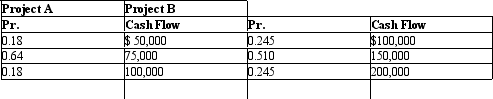 A. Calculate the expected value, standard deviation, and coefficient of variation of cash flows for each project.
B. Calculate the risk-adjusted NPV for each project, using a 15% cost of capital for the more risky project and 12% for the less risky one. Which project is preferred using the NPV criterion?
C. Calculate the PI for each project, and rank them according to their PIs.
D. Calculate the IRR for each project, and rank them according to their IRRs.
E. Compare your answers to parts B, C, and D, and discuss any differences.
A. Calculate the expected value, standard deviation, and coefficient of variation of cash flows for each project.
B. Calculate the risk-adjusted NPV for each project, using a 15% cost of capital for the more risky project and 12% for the less risky one. Which project is preferred using the NPV criterion?
C. Calculate the PI for each project, and rank them according to their PIs.
D. Calculate the IRR for each project, and rank them according to their IRRs.
E. Compare your answers to parts B, C, and D, and discuss any differences. (Essay)
4.8/5 (79)
(79) Cost of Capital. Chock Full O'Coffee, Inc., processes and markets a leading brand of coffee. A security analyst's report issued by a national brokerage firm indicates that debt yielding 9%, comprises 60% of the company's overall capital structure. Furthermore, both earnings and dividends are expected to grow at a rate of 4% per year.
Currently, common stock in the company is priced at $20, and it should pay $1.40 per share in dividends during the coming year. This yield compares favorably with the 8% return currently available on risk-free securities and the 14% average for all common stocks, given the company's estimated beta of 0.5.
A. Calculate the component cost of equity using both the capital asset pricing model and the dividend yield plus expected growth model.
B. Assuming a 50% marginal federal plus state income tax rate, calculate the company's weighted average cost of capital.
(Essay)
5.0/5 (85)
(85) Cost of Capital. Northwest Bankshares, Inc., is a rapidly growing chain of commercial banks in north central states. A security analyst's report issued by a national brokerage firm indicates that debt yielding 15%, comprises 25% of Northwest's overall capital structure. Furthermore, both earnings and dividends are expected to grow at a rate of 25% per year.
Currently, common stock in the company is priced at $25, and is not expected to pay dividends during the coming year. This yield compares favorably with the 10% return currently available on risk-free securities and the 16% average for all common stocks, given the company's estimated beta of 2.5.
A. Calculate Northwest's component cost of equity using both the capital asset pricing model and the dividend yield plus expected growth model.
B. Assuming a 40% marginal federal plus state income tax rate, calculate Northwest's weighted average cost of capital.
(Essay)
4.9/5 (72)
(72) 
Filters
- Essay(0)
- Multiple Choice(0)
- Short Answer(0)
- True False(0)
- Matching(0)