



 Chat with AI
Exam 31: Animal Tissues and Organ Systems

Exam 1: Invitation to Biology79 Questions
Exam 2: Life's Chemical Bases67 Questions
Exam 3: Molecules of Life87 Questions
Exam 4: Cell Structure106 Questions
Exam 5: Ground Rules of Metabolism69 Questions
Exam 6: Where it Starts—Photosynthesis69 Questions
Exam 7: How Cells Release Chemical Energy75 Questions
Exam 8: DNA Structure and Function61 Questions
Exam 9: From DNA to Protein64 Questions
Exam 10: Control of Gene Expression63 Questions
Exam 11: How Cells Reproduce77 Questions
Exam 12: Meiosis and Sexual Reproduction59 Questions
Exam 13: Observing Patterns in Inherited Traits95 Questions
Exam 14: Chromosomes and Human Inheritance76 Questions
Exam 15: Studying and Manipulating Genomes58 Questions
Exam 16: Evidence of Evolution55 Questions
Exam 17: Processes of Evolution74 Questions
Exam 18: Organizing Information about Species46 Questions
Exam 19: Life's Origin and Early Evolution60 Questions
Exam 20: Viruses, Bacteria, and Archaea56 Questions
Exam 21: Protists: The Simplest Eukaryotes61 Questions
Exam 22: The Land Plants66 Questions
Exam 23: Fungi52 Questions
Exam 24: Animal Evolution: The Invertebrates74 Questions
Exam 25: Animal Evolution: The Chordates71 Questions
Exam 26: Human Evolution51 Questions
Exam 27: Plant Tissues96 Questions
Exam 28: Plant Nutrition and Transport69 Questions
Exam 29: Life Cycles of Flowering Plants89 Questions
Exam 30: Communication Strategies in Plants72 Questions
Exam 31: Animal Tissues and Organ Systems79 Questions
Exam 32: Neural Control97 Questions
Exam 33: Sensory Perception69 Questions
Exam 34: Endocrine Control90 Questions
Exam 35: Structural Support and Movement72 Questions
Exam 36: Circulation58 Questions
Exam 37: Immunity73 Questions
Exam 38: Respiration78 Questions
Exam 39: Digestion and Nutrition98 Questions
Exam 40: Maintaining the Internal Environment73 Questions
Exam 41: Animal Reproductive System105 Questions
Exam 42: Animal Development72 Questions
Exam 43: Animal Behavior74 Questions
Exam 44: Population Ecology59 Questions
Exam 45: Community Ecology71 Questions
Exam 46: Ecosystems64 Questions
Exam 47: The Biosphere73 Questions
Exam 48: Human Impacts on the Biosphere67 Questions
Select questions type


Which of the following functions in homeostasis,information processing,and controlling movement?
(Multiple Choice)
4.8/5  (89)
(89) Classification. Respond to the following statements with reference to the types of connective tissue listed below.
-fibrous protein that allows tissues to stretch,then spring back to their original shape
(Multiple Choice)
4.8/5 (87)
(87) Classification. Respond to the following statements with reference to the types of connective tissue listed below.
-This tissue plays a particularly important role in the thermoregulation of many marine mammals.
(Multiple Choice)
4.8/5 (79)
(79)
Figure 31.14
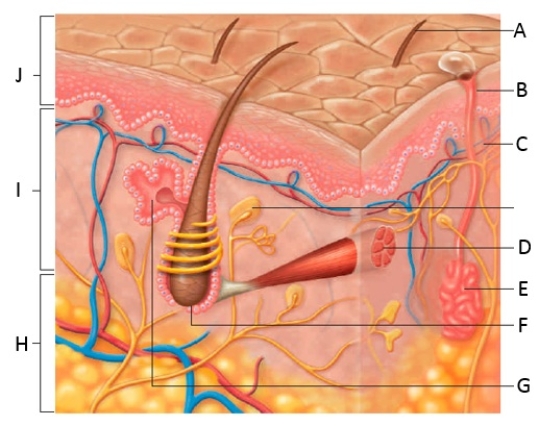 Which part of figure above related to :
-sweat gland
Which part of figure above related to :
-sweat gland (Short Answer)
4.9/5 (80)
(80)
Figure 31.14
Which part of figure above related to :
-hair follicle
Which part of figure above related to :
-hair follicle (Short Answer)
4.9/5 (84)
(84) What is a sheet-like layer of cells with no extracellular matrix in between?
(Multiple Choice)
4.9/5 (85)
(85) A negative feedback system has four steps.Please choose the answer that lists the steps in the correct order.
(Multiple Choice)
4.9/5 (89)
(89) Which type of tissue consists of cells that store fatty acids as triglycerides?
(Multiple Choice)
4.9/5 (73)
(73) Classification. Respond to the following statements with reference to the organ systems listed below.
-secretes substances that change the activity of other organ systems
(Multiple Choice)
4.7/5 (77)
(77) The integration of body functions is controlled by the ____.
(Multiple Choice)
4.8/5 (64)
(64) What is the name of the deep layer of skin that consists of connective tissue,with nerves and blood vessels running through it?
(Multiple Choice)
4.8/5 (82)
(82)
Figure 31.14
Which part of figure above related to :
-smooth muscle
Which part of figure above related to :
-smooth muscle (Short Answer)
4.9/5 (74)
(74) Choose the one most appropriate response for each.
-epidermis
(Multiple Choice)
4.9/5 (77)
(77) Which organ in the human body has the largest surface area?
(Multiple Choice)
4.7/5 (74)
(74) One of the cell types that support and assist neurons is ____________________.
(Multiple Choice)
4.9/5 (81)
(81) What is the term for similar cells that are organized together with a common function?
(Multiple Choice)
4.8/5 (75)
(75) Choose the one most appropriate response for each.
-exocrine gland
(Multiple Choice)
4.7/5 (88)
(88) 
Filters
- Essay(0)
- Multiple Choice(0)
- Short Answer(0)
- True False(0)
- Matching(0)