



 Chat with AI
Exam 11: Organic Chemistry

Exam 1: Atoms202 Questions
Exam 2: Molecules181 Questions
Exam 3: States of Matter287 Questions
Exam 4: Thermodynamics192 Questions
Exam 5: Equilibrium191 Questions
Exam 6: Reactions282 Questions
Exam 7: Kinetics87 Questions
Exam 8: The Main-Group Elements191 Questions
Exam 9: The D-Block Elements95 Questions
Exam 10: Nuclear Chemistry96 Questions
Exam 11: Organic Chemistry193 Questions
Select questions type



How many primary alcohols are there with the formula C4H9OH?
(Multiple Choice)
4.8/5  (72)
(72) What major product(s) is (are)Obtained from the following reaction? 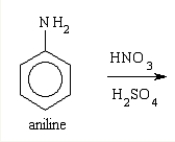
(Multiple Choice)
4.7/5 (78)
(78) What type of bond forms when a carboxylic acid and an amine combine?
(Multiple Choice)
4.9/5 (75)
(75) Which of the following monomers is used to produce Teflon?
(Multiple Choice)
4.7/5 (76)
(76) Which of the following do not function as nucleophiles in nucleophilic substitution reactions?
1.H2O
2.SH-
3.CN-
4.PH3
5.CH3CH2O-
(Multiple Choice)
4.8/5 (81)
(81) True or false: Alkanes undergo substitution by a radical chain mechanism,even though they are very unreactive?
(True/False)
4.7/5 (71)
(71) Consider the compound below. 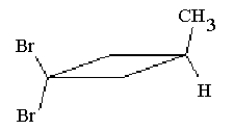 Which of the following is true?
 (Multiple Choice)
4.8/5 (90)
(90) Consider the reaction
CH3(CH2)4CH2CH(Br)CH3 + NaOH CH3(CH2)4CH2CH(OH)CH3
(optically pure enantiomer)
If 2-bromooctane rotates the plane of polarized light to the right while the product rotates the plane of polarized light to the left,
Which of the following statements is true?
(Multiple Choice)
4.9/5 (86)
(86) What major product(s) is (are)Predicted from the following reaction? 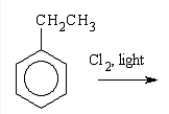
(Multiple Choice)
4.8/5 (75)
(75) Of the following five alkanes, which has the highest boiling point?
(Multiple Choice)
4.9/5 (74)
(74) What is the product of the reaction of 3-hydroxy-3-ethylpentane?
(Multiple Choice)
4.8/5 (75)
(75) How many of the structural isomers of C6H14 have tertiary hydrogens?
(Multiple Choice)
4.8/5 (77)
(77) What is the missing compound in the reaction below?
ethanol,
70 C
CH3CH2CHBrCH3 +____ CH3CH=CHCH3 + Br- + CH3CH2OH
(Essay)
4.9/5 (85)
(85) What type of reaction is that of chlorine and ethylene (the older name for ethene) to form 1,2-dichloroethane?
(Multiple Choice)
5.0/5 (88)
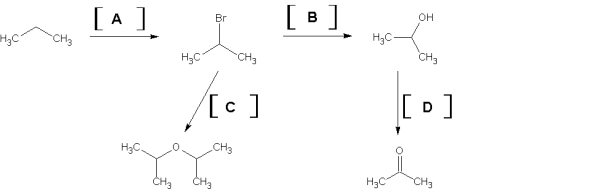
(88) 
Filters
- Essay(0)
- Multiple Choice(0)
- Short Answer(0)
- True False(0)
- Matching(0)