



 Chat with AI
Exam 11: Organic Chemistry

Exam 1: Atoms202 Questions
Exam 2: Molecules181 Questions
Exam 3: States of Matter287 Questions
Exam 4: Thermodynamics192 Questions
Exam 5: Equilibrium191 Questions
Exam 6: Reactions282 Questions
Exam 7: Kinetics87 Questions
Exam 8: The Main-Group Elements191 Questions
Exam 9: The D-Block Elements95 Questions
Exam 10: Nuclear Chemistry96 Questions
Exam 11: Organic Chemistry193 Questions
Select questions type


In the SN1 mechanism for nucleophilic substitution,the carbocation produced is a Lewis acid and the nucleophile is a Lewis base.
(True/False)
4.8/5  (96)
(96) The major product of the reaction of (CH3)2CHCH(Br)CH3 with concentrated KOH in alcohol solvent is
(Multiple Choice)
4.8/5 (59)
(59) A dichlorobenzene reacts with HNO3/H2SO4 and produces one mononitrated product.Identify the initial dichlorobenzene.
(Short Answer)
4.8/5 (85)
(85) When 2-methyl-1-butene reacts with HBr,the reaction occurs in two steps.The attacking agent in the first step is __________.
(Short Answer)
4.7/5 (74)
(74) The formation of an amide from a primary amine and a carboxylic acid is
(Multiple Choice)
4.8/5 (89)
(89) What reactants would be used to synthesize the following compound? 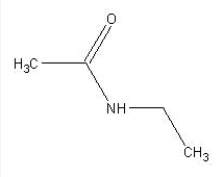
(Short Answer)
4.9/5 (78)
(78) How many of the structural isomers of C6H14 have only primary and tertiary hydrogens?
(Multiple Choice)
4.8/5 (92)
(92) 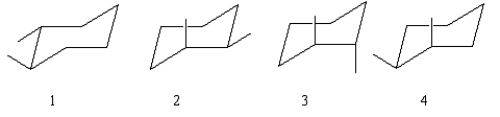
A dichlorobenzene reacts with HNO3/H2SO4 and produces three mononitrated products.Identify the initial dichlorobenzene.
(Short Answer)
4.9/5 (86)
(86) Which of the following forms ortho- and meta-products upon nitration?
(Multiple Choice)
4.8/5 (84)
(84) 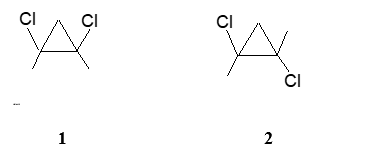
How many secondary alcohols are there with the formula C4H9OH?
(Multiple Choice)
4.9/5 (78)
(78) 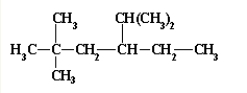
Where is the electrophilic site in the compound 2-bromo-2-methylbutane?
(Essay)
4.8/5 (78)
(78) 
Filters
- Essay(0)
- Multiple Choice(0)
- Short Answer(0)
- True False(0)
- Matching(0)