



 Chat with AI
Exam 4: Thermodynamics

Exam 1: Atoms202 Questions
Exam 2: Molecules181 Questions
Exam 3: States of Matter287 Questions
Exam 4: Thermodynamics192 Questions
Exam 5: Equilibrium191 Questions
Exam 6: Reactions282 Questions
Exam 7: Kinetics87 Questions
Exam 8: The Main-Group Elements191 Questions
Exam 9: The D-Block Elements95 Questions
Exam 10: Nuclear Chemistry96 Questions
Exam 11: Organic Chemistry193 Questions
Select questions type


The standard enthalpy of formation of ammonia gas is -46.11 kJ.mol-1 at 298 K .What is the standard reaction enthalpy for the Haber process at 500 C? The molar heat capacities of nitrogen,Hydrogen,And ammonia are29.12,28.82,And 35.06J.k.mol-1 respectively.
(Multiple Choice)
4.9/5  (66)
(66) The energy levels of two particle in a box systems are given below: 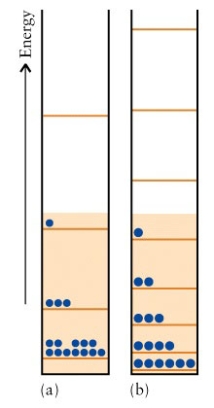 Which molecule,N2,or F2,is better represented by (b)?
 (Short Answer)
5.0/5 (91)
(91) Calculate the change in molar entropy when the pressure of argon is allowed to double isothermally (assume ideal behavior).
(Multiple Choice)
4.8/5 (84)
(84) The heat flow for the reactionC2H6(g)+ 3.5O2(g) 2CO2(g)+ 3H2O(l)Measured in a bomb calorimeter is -1553.5 kJ/mol at 298 K.At this temperature, U is
(Multiple Choice)
4.9/5 (80)
(80) Estimate the minimum temperature at which magnetite can be reduced to iron by graphite.
Fe3O4(s)+ 2C(s) 2CO2(g)+ 3Fe(s)
Sr = +351.44 kJ.mol-1
The standard molar enthalpies of formation of magnetite and CO2(g)
Are -1118.4 and -393.51 kJ.mol-1 ,Respectively.
(Multiple Choice)
4.7/5 (79)
(79) What equation corresponds to the standard enthalpy of formation of gaseous hydrogen atoms,which,at 298 K is +217 kJ.mol-1 ?
(Essay)
4.8/5 (87)
(87) Consider the following compounds and their standard free energies of formation: 1 2 3 4 5 () cyclohexane () methanol () hydrazine () hydrogen peroxide () carbon disulfide +6.4\cdot -166\cdot +149\cdot -120\cdot +65.3\cdot Which of these liquids is (are)Thermodynamically stable?
(Multiple Choice)
4.8/5 (76)
(76) The formation of solid calcium chloride from a gas of its ions is an exothermic process.
(True/False)
4.7/5 (81)
(81) When a solution of 1.691 g of silver nitrate is mixed with an excess of sodium chloride in a calorimeter of heat capacity 216 J.( C)-1, the temperature rises 3.03 C.What is the reaction enthalpy?
(Multiple Choice)
4.8/5 (73)
(73) If the standard reaction enthalpy for the reaction
NO2(g) NO(g)+ O(g)
Is needed,Calculate it from the standard enthalpy of formation of ozone,+142.7kJ.mol-1 ,And from the reactions listed below:
O2(g) 2O(g)
H° = +498.4 kJ.mol-1
NO(g)+ O3(g) NO2(g)+ O2(g)
H° = -200 kJ.mol-1
(Multiple Choice)
4.8/5 (66)
(66) Calculate the average H-S bond enthalpy in H2S(g) given the standard enthalpies of formation for H2S(g),H(g),And S(g):-20.1,218,And 223kJ.mol-1 ,Respectively.
(Multiple Choice)
4.9/5 (77)
(77) Which of the following quantities is not equal to zero at 298 K?
(Multiple Choice)
4.7/5 (76)
(76) A piece of a newly synthesized material of mass 25.0 g at 80.0 C is placed in a calorimeter containing 100.0 g of water at 20.0 C .If the final temperature of the system is 24.0 C,What is the specific heat capacity of this material?
(Multiple Choice)
5.0/5 (77)
(77) Calculate the standard reaction enthalpy for the reaction.
()+()\rightarrow2() Given: ()+()\rightarrow()+2() \Delta=-543\cdot 2()+()\rightarrow2() \Delta=-484\cdot ()+3()\rightarrow2() \Delta=-92.2\cdot
(Multiple Choice)
4.8/5 (78)
(78) For the reaction
2C(s)+ 2H2(g) C2H4(g)
Hr = +52.3 kJ.mol-1 and Sr = -53.07 J.K-1.mol-1 at 298 K.
The reverse reaction will be spontaneous at
(Multiple Choice)
4.9/5 (86)
(86) Use Trouton's constant to estimate the enthalpy of condensation of diethyl ether, which boils at 309 K.
(Multiple Choice)
4.8/5 (70)
(70) Use tabulated thermodynamic data to estimate the temperature at which the vapor pressure of benzene is 1.33 kPa.
Hint: Assume that the enthalpy and entropy of the reaction are independent of temperature.
(Short Answer)
5.0/5 (67)
(67) Iodine sublimes at room temperature .The reaction free energy,Enthalpy,
And entropy for this reaction,Respectively,Are
(Multiple Choice)
4.8/5 (68)
(68) Sketch a plot of the molar entropy of oxygen gas from 0 K to 200 K.The normal melting and boiling points of oxygen are 55 K and 90 K,
respectively.
(Essay)
4.9/5 (86)
(86) 
Filters
- Essay(0)
- Multiple Choice(0)
- Short Answer(0)
- True False(0)
- Matching(0)