



 Chat with AI
Exam 1: Invitation to Biology

Exam 1: Invitation to Biology79 Questions
Exam 2: Life's Chemical Bases67 Questions
Exam 3: Molecules of Life87 Questions
Exam 4: Cell Structure106 Questions
Exam 5: Ground Rules of Metabolism69 Questions
Exam 6: Where it Starts—Photosynthesis69 Questions
Exam 7: How Cells Release Chemical Energy75 Questions
Exam 8: DNA Structure and Function61 Questions
Exam 9: From DNA to Protein64 Questions
Exam 10: Control of Gene Expression63 Questions
Exam 11: How Cells Reproduce77 Questions
Exam 12: Meiosis and Sexual Reproduction59 Questions
Exam 13: Observing Patterns in Inherited Traits95 Questions
Exam 14: Chromosomes and Human Inheritance76 Questions
Exam 15: Studying and Manipulating Genomes58 Questions
Exam 16: Evidence of Evolution55 Questions
Exam 17: Processes of Evolution74 Questions
Exam 18: Organizing Information about Species46 Questions
Exam 19: Life's Origin and Early Evolution60 Questions
Exam 20: Viruses, Bacteria, and Archaea56 Questions
Exam 21: Protists: The Simplest Eukaryotes61 Questions
Exam 22: The Land Plants66 Questions
Exam 23: Fungi52 Questions
Exam 24: Animal Evolution: The Invertebrates74 Questions
Exam 25: Animal Evolution: The Chordates71 Questions
Exam 26: Human Evolution51 Questions
Exam 27: Plant Tissues96 Questions
Exam 28: Plant Nutrition and Transport69 Questions
Exam 29: Life Cycles of Flowering Plants89 Questions
Exam 30: Communication Strategies in Plants72 Questions
Exam 31: Animal Tissues and Organ Systems79 Questions
Exam 32: Neural Control97 Questions
Exam 33: Sensory Perception69 Questions
Exam 34: Endocrine Control90 Questions
Exam 35: Structural Support and Movement72 Questions
Exam 36: Circulation58 Questions
Exam 37: Immunity73 Questions
Exam 38: Respiration78 Questions
Exam 39: Digestion and Nutrition98 Questions
Exam 40: Maintaining the Internal Environment73 Questions
Exam 41: Animal Reproductive System105 Questions
Exam 42: Animal Development72 Questions
Exam 43: Animal Behavior74 Questions
Exam 44: Population Ecology59 Questions
Exam 45: Community Ecology71 Questions
Exam 46: Ecosystems64 Questions
Exam 47: The Biosphere73 Questions
Exam 48: Human Impacts on the Biosphere67 Questions
Select questions type


What was the dependent variable in the peacock butterfly experiments?
(Multiple Choice)
4.9/5  (74)
(74) Classification. Match the following descriptions with the most appropriate group listed below.
-Most common multicellular decomposers
(Multiple Choice)
4.9/5 (84)
(84) Classification. Match the following descriptions to the most appropriate function, process, or trait listed below.
-A characteristic most organisms exhibit that tends to keep their internal environment within a range that favors survival
(Multiple Choice)
4.9/5 (82)
(82) Match the following letters to the number with which they best correspond.
-This is a generalization that describes a consistent natural phenomenon for which there is incomplete scientific explanation.
(Multiple Choice)
4.9/5 (70)
(70) About twelve to twenty-four hours after the previous meal,a person's blood-sugar level normally varies from 60 to 90 milligrams per 100 milliliters of blood,though it may rise to 130 mg/100 ml after meals high in carbohydrates.That the blood-sugar level is maintained within a fairly narrow range despite uneven intake of sugar is due to the body's ability to carry out ______.
(Multiple Choice)
4.8/5 (80)
(80) Olestra chips did not cause cramps at a higher rate than normal chips.This is known as the ____ of this experiment.
(Multiple Choice)
4.9/5 (83)
(83) Each cell is able to maintain an internal environment within a range that favors survival.This condition is called ___________.
(Multiple Choice)
4.8/5 (81)
(81) Classification. Match the following descriptions with the most appropriate group listed below.
-Unicellular eukaryotic producers
(Multiple Choice)
4.9/5 (74)
(74) Which of the following makes its own food using energy and simple raw materials it obtains from nonbiological sources?
(Multiple Choice)
4.8/5 (77)
(77) Four of the following are key characteristics for the survival of a species.Which one is the exception?
(Multiple Choice)
5.0/5 (85)
(85) Figure 1.4
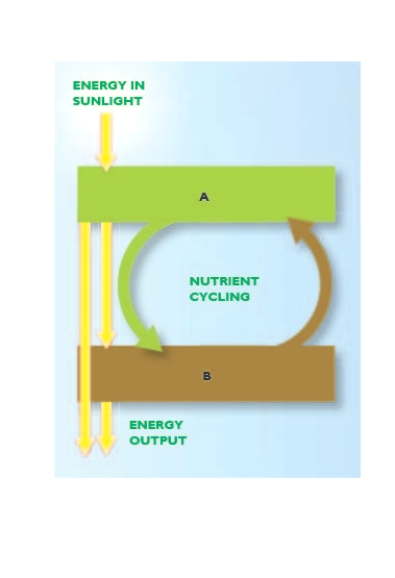 -In Figure 1.4,"A" and "B" should be labeled,respectively,____ and _____.
 (Multiple Choice)
4.9/5 (75)
(75) Classification. Match the following descriptions with the most appropriate group listed below.
-Prokaryotic
(Multiple Choice)
4.9/5 (69)
(69) Which of the following is a substance that an organism needs for growth and survival but cannot make for itself?
(Multiple Choice)
4.8/5 (66)
(66) Copernicus,Galileo,and Darwin found that ____ caused their science to be controversial.
(Multiple Choice)
4.9/5 (90)
(90) The choice of whether a particular organism belongs to the experimental group or the control group should be based on ___________.
(Multiple Choice)
5.0/5 (76)
(76) 
Filters
- Essay(0)
- Multiple Choice(0)
- Short Answer(0)
- True False(0)
- Matching(0)