



 Chat with AI
Exam 23: The Mechanics of Raising Equity Capital

Exam 1: The Corporation42 Questions
Exam 2: Introduction to Financial Statement Analysis74 Questions
Exam 3: Arbitrage and Financial Decision Making79 Questions
Exam 4: The Time Value of Money84 Questions
Exam 5: Interest Rates69 Questions
Exam 6: Valuing Bonds104 Questions
Exam 7: Valuing Stocks88 Questions
Exam 8: Investment Decision Rules83 Questions
Exam 9: Fundamentals of Capital Budgeting94 Questions
Exam 10: Capital Markets and the Pricing of Risk98 Questions
Exam 11: Optimal Portfolio Choice and the Capital Asset Pricing Model108 Questions
Exam 12: Estimating the Cost of Capital108 Questions
Exam 13: Investor Behaviour and Capital Market Efficiency74 Questions
Exam 14: Financial Options56 Questions
Exam 15: Option Valuation42 Questions
Exam 16: Real Options57 Questions
Exam 17: Capital Structure in a Perfect Market86 Questions
Exam 18: Debt and Taxes84 Questions
Exam 19: Financial Distress, managerial Incentives, and Information99 Questions
Exam 20: Payout Policy92 Questions
Exam 21: Capital Budgeting and Valuation With Leverage94 Questions
Exam 22: Valuation and Financial Modelling: a Case Study47 Questions
Exam 23: The Mechanics of Raising Equity Capital49 Questions
Exam 24: Debt Financing49 Questions
Exam 25: Leasing58 Questions
Exam 26: Working Capital Management45 Questions
Exam 27: Short-Term Financial Planning49 Questions
Exam 28: Mergers and Acquisitions52 Questions
Exam 29: Corporate Governance49 Questions
Exam 30: Risk Management52 Questions
Exam 31: International Corporate Finance45 Questions
Select questions type


Which of the following statements is NOT true regarding venture capitalists?
(Multiple Choice)
4.8/5  (84)
(84) Use the information for the question(s) below.
You founded your own firm three years ago. You initially contributed $200,000 of your own money and in return you received 2 million shares of stock. Since then, you have sold an additional 1 million shares of stock to angel investors. You are now considering raising capital from a venture capital firm. This venture capital firm would invest $5 million and would receive 2 million newly issued shares in return.
-Assuming that this is the venture capitalist's first investment in your firm,the post-money valuation of your shares are closest to:
(Multiple Choice)
4.8/5 (77)
(77) Use the information for the question(s) below.
During the most recent fiscal year, KD Industries had revenues of $400 million and earnings of $30 million. KD has filed a registration statement with the SEC for its IPO. Before it is offered, KD's investment bankers would like to estimate the value of the company using comparable companies. The investment bankers have assembled the following information based on data for other companies in the same industry that have recently gone public. In each case the ratios are based upon the IPO price.
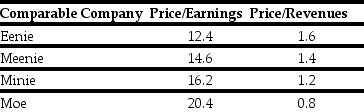 -Based upon the price/revenue ratio,what would be a reasonable value for KD?
 (Essay)
4.8/5 (85)
(85) The fees for Canadian IPOs are ________ those for similar-sized IPOs in the U.S.but the total fee as a percent of the IPO size is calculated for every IPO,and the average percentage spread across all IPOs in Canada is ________ the average percentage spread across all IPOs in the U.S.
(Multiple Choice)
4.8/5 (87)
(87) Prior to an IPO,in Canada,the first step is the preparation of ________.
(Multiple Choice)
4.9/5 (77)
(77) Use the information for the question(s) below.
Luther Industries has sold 10 million shares of stock in an SEO. The market price of Luther at the time was $25 per share. Of the 10 million shares sold, 6 million shares were primary shares being sold by the company, and the remaining 4 million shares were being sold by venture capitalists. Luther's underwriter charges 5% of the gross proceeds as an underwriting fee.
-How much money did the venture capitalists receive?
(Essay)
4.7/5 (84)
(84) Use the information for the question(s) below.
You founded your own firm three years ago. You initially contributed $200,000 of your own money and in return you received 2 million shares of stock. Since then, you have sold an additional 1 million shares of stock to angel investors. You are now considering raising capital from a venture capital firm. This venture capital firm would invest $5 million and would receive 2 million newly issued shares in return.
-Assuming that this is the venture capitalist's first investment in your firm,what percentage of the firm will you own?
(Multiple Choice)
4.8/5 (72)
(72) 
Filters
- Essay(0)
- Multiple Choice(0)
- Short Answer(0)
- True False(0)
- Matching(0)