



 Chat with AI
Exam 23: The Mechanics of Raising Equity Capital

Exam 1: The Corporation42 Questions
Exam 2: Introduction to Financial Statement Analysis74 Questions
Exam 3: Arbitrage and Financial Decision Making79 Questions
Exam 4: The Time Value of Money84 Questions
Exam 5: Interest Rates69 Questions
Exam 6: Valuing Bonds104 Questions
Exam 7: Valuing Stocks88 Questions
Exam 8: Investment Decision Rules83 Questions
Exam 9: Fundamentals of Capital Budgeting94 Questions
Exam 10: Capital Markets and the Pricing of Risk98 Questions
Exam 11: Optimal Portfolio Choice and the Capital Asset Pricing Model108 Questions
Exam 12: Estimating the Cost of Capital108 Questions
Exam 13: Investor Behaviour and Capital Market Efficiency74 Questions
Exam 14: Financial Options56 Questions
Exam 15: Option Valuation42 Questions
Exam 16: Real Options57 Questions
Exam 17: Capital Structure in a Perfect Market86 Questions
Exam 18: Debt and Taxes84 Questions
Exam 19: Financial Distress, managerial Incentives, and Information99 Questions
Exam 20: Payout Policy92 Questions
Exam 21: Capital Budgeting and Valuation With Leverage94 Questions
Exam 22: Valuation and Financial Modelling: a Case Study47 Questions
Exam 23: The Mechanics of Raising Equity Capital49 Questions
Exam 24: Debt Financing49 Questions
Exam 25: Leasing58 Questions
Exam 26: Working Capital Management45 Questions
Exam 27: Short-Term Financial Planning49 Questions
Exam 28: Mergers and Acquisitions52 Questions
Exam 29: Corporate Governance49 Questions
Exam 30: Risk Management52 Questions
Exam 31: International Corporate Finance45 Questions
Select questions type


The two advantages of going public are ________ and ________.

Free
(Multiple Choice)
4.9/5  (81)
(81) Correct Answer: Verified
A
A) Underwriters appear to use the information they acquire during the book-building stage to intentionally underprice the IPO, thereby reducing their exposure to losses.
B) The blue tooth option allows the underwriter to issue more stock, amounting to 15% of the original offer size, at the IPO offer price.
C) The lead underwriter usually makes a market in the stock and assigns an analyst to cover it.
D) In most cases, the preexisting shareholders are subject to a 180-day lockup; they cannot sell their shares for 180 days after the IPO. Once the lockup period expires, they are free to sell their shares.
Answer: B
Explanation: B) The green shoe option allows the underwriter to issue more stock, amounting to 15% of the original offer size, at the IPO offer price.
Diff: 3 Type: MC
Topic: 23.2 The Initial Public Offering
-Which of the following statements regarding exit strategies is false?
Free
(Multiple Choice)
4.8/5 (69)
(69) Correct Answer:Verified
VerifiedD
Which of the following statements is false?
Free
(Multiple Choice)
4.9/5 (78)
(78) Correct Answer:Verified
VerifiedB
Use the information for the question(s) below.
Luther Industries is in the process of selling shares of stock in an auction IPO. At the end of the bidding period, Luther's investment bank has received the following bids:
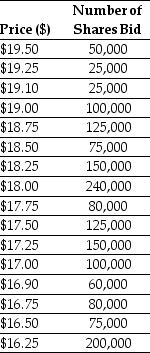 -The proceeds from the IPO if Luther is selling 1.25 million shares is closest to:
 (Multiple Choice)
4.8/5 (96)
(96) Which of the following statements is NOT true regarding angel investors?
(Multiple Choice)
4.8/5 (80)
(80) A) Underwriters appear to use the information they acquire during the book-building stage to intentionally underprice the IPO, thereby reducing their exposure to losses.
B) The blue tooth option allows the underwriter to issue more stock, amounting to 15% of the original offer size, at the IPO offer price.
C) The lead underwriter usually makes a market in the stock and assigns an analyst to cover it.
D) In most cases, the preexisting shareholders are subject to a 180-day lockup; they cannot sell their shares for 180 days after the IPO. Once the lockup period expires, they are free to sell their shares.
Answer: B
Explanation: B) The green shoe option allows the underwriter to issue more stock, amounting to 15% of the original offer size, at the IPO offer price.
Diff: 3 Type: MC
Topic: 23.2 The Initial Public Offering
-Which of the following is NOT one of the four characteristics of IPOs that puzzle financial economists?
(Multiple Choice)
4.9/5 (68)
(68) In Canada the average size of an IPO in 2007 was about ________,which is quite ________ compared to IPOs in other countries.
(Multiple Choice)
4.9/5 (82)
(82) Luther Industries currently has 100 million shares of stock outstanding at a price of $25 per share.The company would like to raise money and has announced a rights issue.Every existing shareholder will be sent one right per share of stock that he or she owns.The company plans to require twenty rights to purchase one share at a price of $20 per share.The amount of money that Luther will raise through its rights offering is closest to:
(Multiple Choice)
4.9/5 (76)
(76) What will the offer price of these shares be if Luther is selling 800,000 shares?
(Essay)
4.9/5 (92)
(92) Use the information for the question(s) below.
Luther Industries has sold 10 million shares of stock in an SEO. The market price of Luther at the time was $25 per share. Of the 10 million shares sold, 6 million shares were primary shares being sold by the company, and the remaining 4 million shares were being sold by venture capitalists. Luther's underwriter charges 5% of the gross proceeds as an underwriting fee.
-How much money did Luther raise?
(Essay)
4.8/5 (85)
(85) Describe the four characteristics of IPOs that puzzle financial economists.
(Essay)
4.7/5 (78)
(78) Use the information for the question(s) below.
Luther Industries is in the process of selling shares of stock in an auction IPO. At the end of the bidding period, Luther's investment bank has received the following bids:
-What will the offer price of these shares be if Luther is selling 1 million shares?
-What will the offer price of these shares be if Luther is selling 1 million shares? (Multiple Choice)
4.9/5 (78)
(78) 
Filters
- Essay(0)
- Multiple Choice(0)
- Short Answer(0)
- True False(0)
- Matching(0)