



 Chat with AI
Exam 19: Financial Distress, managerial Incentives, and Information

Exam 1: The Corporation42 Questions
Exam 2: Introduction to Financial Statement Analysis74 Questions
Exam 3: Arbitrage and Financial Decision Making79 Questions
Exam 4: The Time Value of Money84 Questions
Exam 5: Interest Rates69 Questions
Exam 6: Valuing Bonds104 Questions
Exam 7: Valuing Stocks88 Questions
Exam 8: Investment Decision Rules83 Questions
Exam 9: Fundamentals of Capital Budgeting94 Questions
Exam 10: Capital Markets and the Pricing of Risk98 Questions
Exam 11: Optimal Portfolio Choice and the Capital Asset Pricing Model108 Questions
Exam 12: Estimating the Cost of Capital108 Questions
Exam 13: Investor Behaviour and Capital Market Efficiency74 Questions
Exam 14: Financial Options56 Questions
Exam 15: Option Valuation42 Questions
Exam 16: Real Options57 Questions
Exam 17: Capital Structure in a Perfect Market86 Questions
Exam 18: Debt and Taxes84 Questions
Exam 19: Financial Distress, managerial Incentives, and Information99 Questions
Exam 20: Payout Policy92 Questions
Exam 21: Capital Budgeting and Valuation With Leverage94 Questions
Exam 22: Valuation and Financial Modelling: a Case Study47 Questions
Exam 23: The Mechanics of Raising Equity Capital49 Questions
Exam 24: Debt Financing49 Questions
Exam 25: Leasing58 Questions
Exam 26: Working Capital Management45 Questions
Exam 27: Short-Term Financial Planning49 Questions
Exam 28: Mergers and Acquisitions52 Questions
Exam 29: Corporate Governance49 Questions
Exam 30: Risk Management52 Questions
Exam 31: International Corporate Finance45 Questions
Select questions type


Which of the following statements is false?

Free
(Multiple Choice)
4.9/5  (82)
(82) Correct Answer: Verified
C
Assume that capital markets are perfect except for the existence of corporate taxes and that your firm pays 35% of earnings in taxes.If you want to maintain ownership of at least 50% of your firm,then calculate the minimum amount of debt that you must issue to fund the expansion.
Free
(Essay)
4.7/5 (66)
(66) Correct Answer:Verified
VerifiedVU = $75 million
% Ownership = 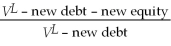 Given:
VL = VU + τcD
New equity = $50 million needed for expansion - the amount of new debt:
% Ownership =  % Ownership =
 = .50 (given we want 50% ownership)
$25 + .35(debt)= .50($75 - .65(debt))
50 + 1.35(debt)= 75
Debt =  = $18.52 million
Economic distress represents a significant decline in the value of ________,whether or not it experiences financial distress due to leverage.
Free
(Multiple Choice)
4.9/5 (95)
(95) Correct Answer:Verified
VerifiedB
List five general categories of indirect costs associated with bankruptcy.
(Essay)
4.9/5 (74)
(74) The agency costs are the costs that arise when there are conflicts of interest
(Multiple Choice)
4.8/5 (75)
(75) Use the information for the question(s) below.
Big Blue Banana (BBB) is a clothing retailer with a current share price of $10.00 and with 25 million shares outstanding. Suppose that Big Blue Banana announces plans to lower its corporate taxes by borrowing $100 million and using the proceeds to repurchase shares.
-Suppose that BBB pays corporate taxes of 40% and that shareholders expect the change in debt to be permanent.Assume that capital markets are perfect except for the existence of corporate taxes and financial distress costs.If the price of BBB's stock rises to $10.80 per share following the announcement,then the present value of BBB's financial distress costs is closest to:
(Essay)
4.8/5 (96)
(96) Under the BIA,a firm may put forth a proposal that can either be accepted or rejected by its ________.
(Multiple Choice)
4.8/5 (73)
(73) Use the information for the question(s) below.
Luther Industries has no debt and expects to generate free cash flows of $48 million each year. Luther believes that if it permanently increases its level of debt to $100 million, the risk of financial distress may cause it to lose some customers and receive less favourable terms from its suppliers. As a result, Luther's expected free cash flows with debt will be only $44 million per year. Suppose Luther's tax rate is 40%, the risk-free rate is 6%, the expected return of the market is 14%, and the beta of Luther's free cash flows is 1.25 (with or without leverage).
-The value of Luther without leverage is closest to:
(Multiple Choice)
4.8/5 (67)
(67) The idea that claims in one's self-interest are credible only if they are supported by actions that would be too costly to take if the claims were untrue is known as the
(Multiple Choice)
4.8/5 (64)
(64) In many Canadian cases the actual ownership and exposure to the resources of the firm is ________ while the voting control is ________.This is accomplished by dominant shareholders (usually controlling families)that utilize super-voting shares,cross ownership,or pyramidal ownership structures.
(Multiple Choice)
4.7/5 (88)
(88) In aggregate,Canadian firms tend to issue debt ________ equity or trust units.
(Multiple Choice)
4.9/5 (78)
(78) Which of the following is NOT an indirect cost of bankruptcy?
(Multiple Choice)
4.7/5 (92)
(92) Use the information for the question(s) below.
Monsters Incorporated (MI) is ready to launch a new product. Depending upon the success of this product, MI will have a value of either $100 million, $150 million, or $191 million, with each outcome being equally likely. The cash flows are unrelated to the state of the economy (i.e. risk from the project is diversifiable) so that the project has a beta of 0 and a cost of capital equal to the risk-free rate, which is currently 5%. Assume that the capital markets are perfect.
-Assume that in the event of default,20% of the value of MI's assets will be lost in bankruptcy costs and suppose that MI has zero-coupon debt with a $125 million face value due next year.The total value of MI with leverage is closest to:
(Multiple Choice)
4.9/5 (76)
(76) 
Filters
- Essay(0)
- Multiple Choice(0)
- Short Answer(0)
- True False(0)
- Matching(0)