



 Chat with AI
Exam 10: Capital Markets and the Pricing of Risk

Exam 1: The Corporation42 Questions
Exam 2: Introduction to Financial Statement Analysis74 Questions
Exam 3: Arbitrage and Financial Decision Making79 Questions
Exam 4: The Time Value of Money84 Questions
Exam 5: Interest Rates69 Questions
Exam 6: Valuing Bonds104 Questions
Exam 7: Valuing Stocks88 Questions
Exam 8: Investment Decision Rules83 Questions
Exam 9: Fundamentals of Capital Budgeting94 Questions
Exam 10: Capital Markets and the Pricing of Risk98 Questions
Exam 11: Optimal Portfolio Choice and the Capital Asset Pricing Model108 Questions
Exam 12: Estimating the Cost of Capital108 Questions
Exam 13: Investor Behaviour and Capital Market Efficiency74 Questions
Exam 14: Financial Options56 Questions
Exam 15: Option Valuation42 Questions
Exam 16: Real Options57 Questions
Exam 17: Capital Structure in a Perfect Market86 Questions
Exam 18: Debt and Taxes84 Questions
Exam 19: Financial Distress, managerial Incentives, and Information99 Questions
Exam 20: Payout Policy92 Questions
Exam 21: Capital Budgeting and Valuation With Leverage94 Questions
Exam 22: Valuation and Financial Modelling: a Case Study47 Questions
Exam 23: The Mechanics of Raising Equity Capital49 Questions
Exam 24: Debt Financing49 Questions
Exam 25: Leasing58 Questions
Exam 26: Working Capital Management45 Questions
Exam 27: Short-Term Financial Planning49 Questions
Exam 28: Mergers and Acquisitions52 Questions
Exam 29: Corporate Governance49 Questions
Exam 30: Risk Management52 Questions
Exam 31: International Corporate Finance45 Questions
Select questions type


Use the table for the question(s) below.
Consider the following realized annual returns:
 -Suppose that you want to use the 10 year historical average return on Microsoft to forecast the expected future return on Microsoft.Calculate the 95% confidence interval for your estimate of the expect return.
 (Essay)
4.9/5  (76)
(76) Use the table for the question(s) below.
Consider the following average annual returns:
 -What is the excess return for the S&P 500?
 (Multiple Choice)
4.8/5 (78)
(78) Use the table for the question(s) below.
Consider the following average annual returns:
-What is the excess return for Corporate Bonds?
-What is the excess return for Corporate Bonds? (Multiple Choice)
4.8/5 (89)
(89) Use the information for the question(s) below.
Suppose that in the coming year, you expect Exxon-Mobil stock to have a volatility of 42% and a beta of 0.9, and Merck's stock to have a volatility of 24% and a beta of 1.1. The risk free interest rate is 4% and the market's expected return is 12%.
-Which stock has the highest systematic risk?
(Multiple Choice)
4.8/5 (82)
(82) Use the table for the question(s) below.
Consider the following Price and Dividend data for General Motors:
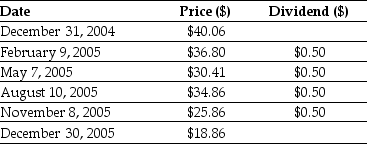 -Assume that you purchased General Motors stock at the closing price on December 31,2004 and sold it at the closing price on December 30,2005.Calculate your realized annual return is for the year 2005.
 (Essay)
5.0/5 (94)
(94) Use the information for the question(s) below.
Suppose the market portfolio's excess return tends to increase by 30% when the economy is strong and decline by 20% when the economy is weak. A type S firm has excess returns increase by 45% when the economy is strong and decrease by 30% when the economy is weak. A type I firm will also have excess returns of either 45% or -30%, but the type I firm's excess returns will depend only upon firm-specific events and will be completely independent of the state of the economy.
-What is the beta for a type I firm?
(Multiple Choice)
4.8/5 (86)
(86) Use the information for the question(s) below.
Suppose the market portfolio's excess return tends to increase by 30% when the economy is strong and decline by 20% when the economy is weak. A type S firm has excess returns increase by 45% when the economy is strong and decrease by 30% when the economy is weak. A type I firm will also have excess returns of either 45% or -30%, but the type I firm's excess returns will depend only upon firm-specific events and will be completely independent of the state of the economy.
-What is the beta for a type S firm?
(Multiple Choice)
4.7/5 (74)
(74) Use the information for the question(s) below.
Consider an economy with two types of firms, S and I. S firms always move together, but I firms move independently of each other. For both types of firms there is a 70% probability that the firm will have a 20% return and a 30% probability that the firm will have a -30% return.
-What is the expected return for an individual firm?
(Multiple Choice)
4.8/5 (76)
(76) Which of the following investment opportunities provides lowest variation in average annual return?
(Multiple Choice)
4.9/5 (85)
(85) Use the table for the question(s) below.
Consider the following Price and Dividend data for Ford Motor Company:
 -Assume that you purchased Ford Motor Company stock at the closing price on December 31,2004 and sold it after the dividend had been paid at the closing price on January 26,2005.Your total return rate (yield)for this period is closest to:
 (Multiple Choice)
4.8/5 (68)
(68) The key step to measuring systematic risk is finding a portfolio that contains ONLY ________ risk.
(Multiple Choice)
4.9/5 (85)
(85) The standard deviation for the return on an portfolio of 20 type I firms is closest to:
(Multiple Choice)
4.9/5 (79)
(79) 
Filters
- Essay(0)
- Multiple Choice(0)
- Short Answer(0)
- True False(0)
- Matching(0)