



 Chat with AI
Exam 15: Thermodynamics

Exam 1: Introduction and Mathematical Concepts70 Questions
Exam 2: Kinematics in One Dimension103 Questions
Exam 3: Kinematics in Two Dimensions68 Questions
Exam 4: Forces and Newtons Laws of Motion103 Questions
Exam 5: Dynamics of Uniform Circular Motion59 Questions
Exam 6: Work and Energy78 Questions
Exam 7: Impulse and Momentum66 Questions
Exam 8: Rotational Kinematics55 Questions
Exam 9: Rotational Dynamics57 Questions
Exam 10: Simple Harmonic Motion and Elasticity63 Questions
Exam 11: Fluids65 Questions
Exam 12: Temperature and Heat66 Questions
Exam 13: The Transfer of Heat42 Questions
Exam 14: The Ideal Gas Law and Kinetic Theory55 Questions
Exam 15: Thermodynamics79 Questions
Exam 16: Waves and Sound67 Questions
Exam 17: The Principle of Linear Superposition and Interference Phenomena46 Questions
Exam 18: Electric Forces and Electric Fields61 Questions
Exam 19: Electric Potential Energy and the Electric Potential70 Questions
Exam 20: Electric Circuits100 Questions
Exam 21: Magnetic Forces and Magnetic Fields66 Questions
Exam 22: Electromagnetic Induction71 Questions
Exam 23: Alternating Current Circuits84 Questions
Exam 24: Electromagnetic Waves66 Questions
Exam 25: The Refl Ection of Light: Mirrors43 Questions
Exam 26: The Refraction of Light: Lenses and Optical Instruments102 Questions
Exam 27: Interference and the Wave Nature of Light57 Questions
Exam 28: Special Relativity63 Questions
Exam 29: Particles and Waves54 Questions
Exam 30: The Nature of the Atom74 Questions
Exam 31: Nuclear Physics and Radioactivity37 Questions
Exam 32: Ionizing Radiation, Nuclear Energy, and Elementary Particles45 Questions
Select questions type


Which one of the following statements is not a consequence of the second law of thermodynamics?
(Multiple Choice)
4.9/5  (85)
(85) An engine is used to lift a 2700-kg truck to a height of 3.0 m at constant speed. In the lifting process, the engine received 4.18 × 10⁵ J of heat from the fuel burned in its interior. What is the efficiency of the engine?
(Multiple Choice)
4.8/5 (84)
(84) In an isothermal process, 1.59 moles of an ideal gas is compressed to one-fifth of its initial volume at 285 K. What quantity of heat is added to, or removed from, the system during this process?
(Multiple Choice)
4.8/5 (78)
(78) In which one of these processes will there be no net change in the entropy of the system?
(Multiple Choice)
4.8/5 (71)
(71) A block that slides on a rough surface slows down and eventually stops. The reverse process never occurs. That is, a block at rest never begins to move and accelerate on a rough surface without the action of an external agent. The second situation is forbidden because it would violate
(Multiple Choice)
5.0/5 (80)
(80) Complete the following statement: The first law of thermodynamics states that
(Multiple Choice)
4.8/5 (87)
(87) If one complete cycle of a reversible process is carried out on a sample of an ideal gas so that its final state is the same as its initial state, which one of the following quantities is the only one which can be non-zero?
(Multiple Choice)
4.9/5 (89)
(89) A Carnot engine has a heat input of 3700 J and heat exhaust of 1400 J. What is the ratio of the Kelvin temperature of the hot reservoir to that of the cold reservoir, TH/TC?
(Multiple Choice)
4.8/5 (78)
(78) Under which one of the following conditions would a Carnot heat engine be 100% efficient?
(Multiple Choice)
4.8/5 (76)
(76) A heat pump is found to remove 2400 J of heat from the exterior of a house and deliver 3500 J of heat to the interior of the house. What is the coefficient of performance of the heat pump?
(Multiple Choice)
5.0/5 (79)
(79) A heat engine operates between a hot reservoir at 1500 K and a cold reservoir at 500 K. During each cycle, 1.0 × 10⁵ J of heat is removed from the hot reservoir and 5.0 × 10⁴ J of work is performed.
-What is the actual efficiency of this engine?
(Multiple Choice)
4.8/5 (88)
(88) A heat engine operates between a hot reservoir at 1500 K and a cold reservoir at 500 K. During each cycle, 1.0 × 10⁵ J of heat is removed from the hot reservoir and 5.0 × 10⁴ J of work is performed.
-Determine the Carnot efficiency of this engine.
(Multiple Choice)
5.0/5 (81)
(81) Beneath the moveable piston in the drawing,2.25 moles of a monatomic ideal gas is enclosed at 314 K. The initial volume of the gas is 3.0 m3. The gas is compressed isothermally to a final volume of 1.0 m3. How much heat is removed from the gas during this process? 
(Multiple Choice)
4.9/5 (76)
(76) A fixed amount of ideal gas is compressed adiabatically. Which entry in the table below correctly indicates the sign of the work done, the change in the internal energy, and the heat exchanged with the environment? work done change in internal energy heat exchanged
(Multiple Choice)
4.8/5 (84)
(84) An ideal gas is taken from state A to state B through process shown on the pressure-volume graph. How much heat is added to the gas in this process? 
(Multiple Choice)
4.8/5 (79)
(79) An ideal monatomic gas expands isothermally from state A to state B. The gas then cools at constant volume to state C. The gas is then compressed isobarically to D before it is heated until it returns to state A. 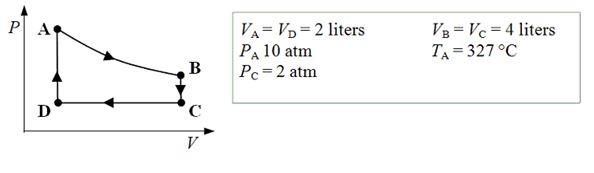 -What is the pressure of the gas when it is in state B?
 (Multiple Choice)
4.8/5 (78)
(78) Two engines are identical except that engine A is two years old and engine B is new. If engine A does 15% less work than engine B under identical operating conditions, what is the ratio of the efficiencies of the two engines, eA/eB?
(Multiple Choice)
4.9/5 (69)
(69) What are the SI units of the product of pressure and volume, PV?
(Multiple Choice)
4.9/5 (78)
(78) During one stage of a reversible process, the temperature of an ideal gas remains constant as its volume is decreased. Which one of the following statements concerning this situation is true?
(Multiple Choice)
4.9/5 (73)
(73) 
Filters
- Essay(0)
- Multiple Choice(0)
- Short Answer(0)
- True False(0)
- Matching(0)