



 Chat with AI
Exam 15: Thermodynamics

Exam 1: Introduction and Mathematical Concepts70 Questions
Exam 2: Kinematics in One Dimension103 Questions
Exam 3: Kinematics in Two Dimensions68 Questions
Exam 4: Forces and Newtons Laws of Motion103 Questions
Exam 5: Dynamics of Uniform Circular Motion59 Questions
Exam 6: Work and Energy78 Questions
Exam 7: Impulse and Momentum66 Questions
Exam 8: Rotational Kinematics55 Questions
Exam 9: Rotational Dynamics57 Questions
Exam 10: Simple Harmonic Motion and Elasticity63 Questions
Exam 11: Fluids65 Questions
Exam 12: Temperature and Heat66 Questions
Exam 13: The Transfer of Heat42 Questions
Exam 14: The Ideal Gas Law and Kinetic Theory55 Questions
Exam 15: Thermodynamics79 Questions
Exam 16: Waves and Sound67 Questions
Exam 17: The Principle of Linear Superposition and Interference Phenomena46 Questions
Exam 18: Electric Forces and Electric Fields61 Questions
Exam 19: Electric Potential Energy and the Electric Potential70 Questions
Exam 20: Electric Circuits100 Questions
Exam 21: Magnetic Forces and Magnetic Fields66 Questions
Exam 22: Electromagnetic Induction71 Questions
Exam 23: Alternating Current Circuits84 Questions
Exam 24: Electromagnetic Waves66 Questions
Exam 25: The Refl Ection of Light: Mirrors43 Questions
Exam 26: The Refraction of Light: Lenses and Optical Instruments102 Questions
Exam 27: Interference and the Wave Nature of Light57 Questions
Exam 28: Special Relativity63 Questions
Exam 29: Particles and Waves54 Questions
Exam 30: The Nature of the Atom74 Questions
Exam 31: Nuclear Physics and Radioactivity37 Questions
Exam 32: Ionizing Radiation, Nuclear Energy, and Elementary Particles45 Questions
Select questions type


A paddle wheel frictionally adds thermal energy to an ideal monatomic gas in a sealed, insulated container. The paddle wheel is driven by a cord connected to a falling object as shown in the drawing. In this experiment, a 5.0-kg object falls through a total distance of 3.0 m and the temperature of the gas is found to increase by 6 C°. Assume that all of the mechanical energy lost by the falling object goes into the gas. How many moles of gas must be present in this container? 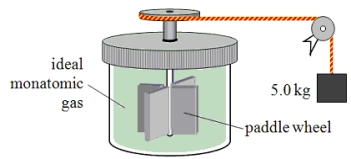
(Multiple Choice)
4.8/5  (86)
(86) A system containing an ideal gas at a constant pressure of 1.42 × 10⁵ Pa gains 2320 J of heat. During the process, the internal energy of the system increases by 2540 J. What is the change in volume of the gas?
(Multiple Choice)
4.7/5 (84)
(84) Which one of the following pressure-volume graphs represents an isochoric process? 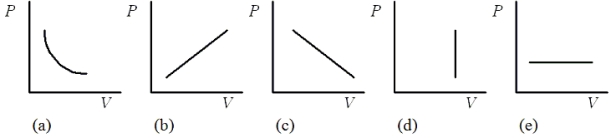
(Multiple Choice)
4.8/5 (67)
(67) Complete the following statement: Walls that separate a system from its surroundings and permit heat to flow through them are called
(Multiple Choice)
4.8/5 (86)
(86) Determine the quantity of heat added to 2.8 moles of the ideal gas argon if the temperature increases from 75 °C to 225 °C during an isobaric process. Note: The molar specific heats of argon are CV = 3.0 cal/K·mol and CP = 5.0 cal/K·mol.
(Multiple Choice)
4.7/5 (85)
(85) A container holding 1.2 kg of water at 20.0 °C is placed in a freezer that is kept at -20.0 °C. The water freezes and comes into thermal equilibrium with the interior of the freezer.
-How much heat is extracted from the water in this process?
(Multiple Choice)
4.9/5 (82)
(82) If the coefficient of performance for a refrigerator is 5.0 and 72 J of work are done on the system, how much heat is rejected to the room?
(Multiple Choice)
4.8/5 (74)
(74) A 1.00-kg sample of steam at 100.0 °C condenses to water at 100.0 °C. What is the entropy change of the sample if the heat of vaporization of water is 2.26 × 10⁶ J/kg?
(Multiple Choice)
4.9/5 (73)
(73) Which one of the following processes represents a decrease in entropy?
(Multiple Choice)
4.8/5 (75)
(75) Which one of the following statements is true concerning the ratio of the molar heat capacities Cp/Cv for an ideal gas?
(Multiple Choice)
4.7/5 (84)
(84) One mole of a monatomic gas at 433 K is reversibly taken to half of its original volume by an isobaric process. How much work is done by the gas?
(Multiple Choice)
4.8/5 (96)
(96) Neon is a monatomic gas with a molar heat capacity at constant volume of 12.66 J/(mol · K). Two moles of neon gas enclosed in a constant volume system receive 4250 J of heat. If the gas was initially at 293 K, what is the final temperature of the neon?
(Multiple Choice)
4.9/5 (80)
(80) A heat pump extracts 7.0 × 10⁶ J of heat per hour from a well at 280 K and delivers its output heat into a house at 320 K. If the heat pump uses an ideal Carnot cycle in its operation, what minimum work must be supplied to the heat pump per hour?
(Multiple Choice)
4.9/5 (86)
(86) A paddle wheel frictionally adds thermal energy to 4.0 moles of an ideal monatomic gas in a sealed insulated container. The paddle wheel is driven by a cord connected to a falling object as shown in the drawing. How far has the 5.0-kg object fallen when the temperature of the gas increases by 7.50 K? 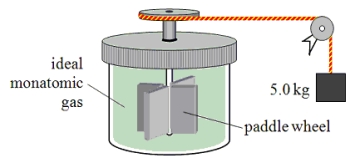
(Multiple Choice)
4.9/5 (88)
(88) Two moles of an ideal gas have an initial Kelvin temperature Ti and absolute pressure Pi. The gas undergoes a reversible isothermal compression from an initial volume Vi to a final volume 0.5Vi.
-How much heat is exchanged with the environment? If heat is exchanged, is it absorbed or released?
(Multiple Choice)
4.8/5 (87)
(87) A heat engine operates between a hot reservoir at 1500 K and a cold reservoir at 500 K. During each cycle, 1.0 × 10⁵ J of heat is removed from the hot reservoir and 5.0 × 10⁴ J of work is performed.
-Determine the change in entropy of the cold reservoir.
(Multiple Choice)
4.9/5 (75)
(75) Which of the following samples exhibits the highest degree of entropy?
(Multiple Choice)
4.8/5 (76)
(76) An ideal monatomic gas originally in state A is taken reversibly to state B along the straight-line path shown in the pressure-volume graph. 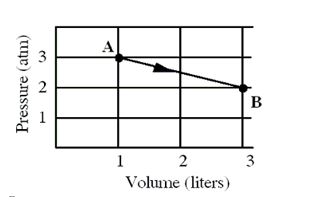 -What is the change in the internal energy, in calories, of the gas for this process?
 (Multiple Choice)
4.7/5 (69)
(69) A heat engine operates in a Carnot cycle between reservoirs of temperatures 1000 K and 400 K. It is found to discharge 20 J of heat per cycle to the cold reservoir. What is the work output per cycle?
(Multiple Choice)
4.8/5 (79)
(79) A fixed amount of ideal gas is compressed isothermally. Which entry in the table below correctly depicts the sign of the work done, the change in the internal energy, and the heat exchanged with the environment? work done change in internal energy heat exchanged
(Multiple Choice)
4.7/5 (69)
(69) 
Filters
- Essay(0)
- Multiple Choice(0)
- Short Answer(0)
- True False(0)
- Matching(0)