



 Chat with AI
Exam 15: Thermodynamics

Exam 1: Introduction and Mathematical Concepts70 Questions
Exam 2: Kinematics in One Dimension103 Questions
Exam 3: Kinematics in Two Dimensions68 Questions
Exam 4: Forces and Newtons Laws of Motion103 Questions
Exam 5: Dynamics of Uniform Circular Motion59 Questions
Exam 6: Work and Energy78 Questions
Exam 7: Impulse and Momentum66 Questions
Exam 8: Rotational Kinematics55 Questions
Exam 9: Rotational Dynamics57 Questions
Exam 10: Simple Harmonic Motion and Elasticity63 Questions
Exam 11: Fluids65 Questions
Exam 12: Temperature and Heat66 Questions
Exam 13: The Transfer of Heat42 Questions
Exam 14: The Ideal Gas Law and Kinetic Theory55 Questions
Exam 15: Thermodynamics79 Questions
Exam 16: Waves and Sound67 Questions
Exam 17: The Principle of Linear Superposition and Interference Phenomena46 Questions
Exam 18: Electric Forces and Electric Fields61 Questions
Exam 19: Electric Potential Energy and the Electric Potential70 Questions
Exam 20: Electric Circuits100 Questions
Exam 21: Magnetic Forces and Magnetic Fields66 Questions
Exam 22: Electromagnetic Induction71 Questions
Exam 23: Alternating Current Circuits84 Questions
Exam 24: Electromagnetic Waves66 Questions
Exam 25: The Refl Ection of Light: Mirrors43 Questions
Exam 26: The Refraction of Light: Lenses and Optical Instruments102 Questions
Exam 27: Interference and the Wave Nature of Light57 Questions
Exam 28: Special Relativity63 Questions
Exam 29: Particles and Waves54 Questions
Exam 30: The Nature of the Atom74 Questions
Exam 31: Nuclear Physics and Radioactivity37 Questions
Exam 32: Ionizing Radiation, Nuclear Energy, and Elementary Particles45 Questions
Select questions type


An ideal monatomic gas expands isobarically from state A to state B. It is then compressed isothermally from state B to state C and finally cooled at constant volume until it returns to its initial state A.
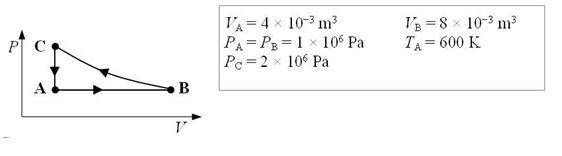 -How much work is done on the gas in going from B to C?
 (Multiple Choice)
4.8/5  (91)
(91) 5.00 kg of liquid water is heated to 100.0 °C in a closed system. At this temperature, the density of liquid water is 958 kg/m3. The pressure is maintained at atmospheric pressure of 1.01 × 10⁵ Pa. A moveable piston of negligible weight rests on the surface of the water. The water is then converted to steam by adding an additional amount of heat to the system. When all of the water is converted, the final volume of the steam is 8.50 m3. The latent heat of vaporization of water is 2.26 × 10⁶ J/kg. 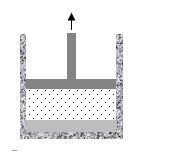 -What is the change in the internal energy during this isothermal process?
 (Multiple Choice)
4.8/5 (75)
(75) An ideal monatomic gas expands isothermally from state A to state B. The gas then cools at constant volume to state C. The gas is then compressed isobarically to D before it is heated until it returns to state A. 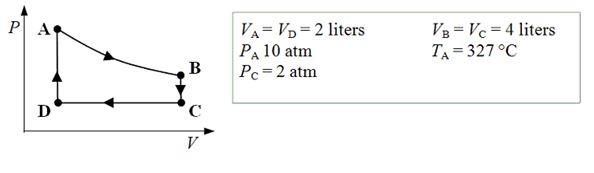 -What is the net amount of work done after one complete cycle?
 (Multiple Choice)
4.9/5 (84)
(84) An ideal monatomic gas expands isothermally from state A to state B. The gas then cools at constant volume to state C. The gas is then compressed isobarically to D before it is heated until it returns to state A.
-What is the ratio of the internal energy of the gas in state C to that in state A?
-What is the ratio of the internal energy of the gas in state C to that in state A? (Multiple Choice)
5.0/5 (80)
(80) 5.00 kg of liquid water is heated to 100.0 °C in a closed system. At this temperature, the density of liquid water is 958 kg/m3. The pressure is maintained at atmospheric pressure of 1.01 × 10⁵ Pa. A moveable piston of negligible weight rests on the surface of the water. The water is then converted to steam by adding an additional amount of heat to the system. When all of the water is converted, the final volume of the steam is 8.50 m3. The latent heat of vaporization of water is 2.26 × 10⁶ J/kg.
-How much work is done by this closed system during this isothermal process?
-How much work is done by this closed system during this isothermal process? (Multiple Choice)
4.9/5 (85)
(85) An ideal monatomic gas originally in state A is taken reversibly to state B along the straight-line path shown in the pressure-volume graph.  -Suppose that the same gas is originally in state A as described above, but its volume is increased isothermally until a new volume of 3.0 liters is reached. Which one of the following statements for this isothermal process is false?
 (Multiple Choice)
4.8/5 (82)
(82) An ideal monatomic gas expands isothermally from state A to state B. The gas then cools at constant volume to state C. The gas is then compressed isobarically to D before it is heated until it returns to state A.
-What is the internal energy of the gas at point B?
-What is the internal energy of the gas at point B? (Multiple Choice)
4.8/5 (82)
(82) In an isothermal and reversible process, 945 J of heat is removed from a system and transferred to the surroundings. The temperature is 314 K. What is the change in entropy of the system?
(Multiple Choice)
4.9/5 (76)
(76) Two moles of a confined ideal monatomic gas begin at state A on the pressure-volume graph and follow the path shown to state D. If the temperature of the gas at A is 54 K, what is the temperature of the gas at D? 
(Multiple Choice)
4.9/5 (74)
(74) The ratio of the molar specific heat capacity at constant pressure to that at constant volume, , for diatomic hydrogen gas is 7/5. In an adiabatic compression, the gas, originally at atmospheric pressure, is compressed from an original volume of 0.30 m3 to 0.10 m3. What is the final pressure of the gas?
(Multiple Choice)
4.8/5 (83)
(83) An ideal monatomic gas originally in state A is taken reversibly to state B along the straight-line path shown in the pressure-volume graph.
-How much heat, in calories, was exchanged during this process?
-How much heat, in calories, was exchanged during this process? (Multiple Choice)
4.8/5 (74)
(74) A container holding 1.2 kg of water at 20.0 °C is placed in a freezer that is kept at -20.0 °C. The water freezes and comes into thermal equilibrium with the interior of the freezer.
-What is the minimum amount of electrical energy required by the refrigerator to carry out this process if it operates between reservoirs at temperatures of 20.0 °C and -20.0 °C?
(Multiple Choice)
4.9/5 (91)
(91) An ideal monatomic gas expands isothermally from state A to state B. The gas then cools at constant volume to state C. The gas is then compressed isobarically to D before it is heated until it returns to state A.
-What is the temperature of the gas when it is in state C?
-What is the temperature of the gas when it is in state C? (Multiple Choice)
4.9/5 (82)
(82) An ideal gas absorbs 750 J of heat as it performs 625 J of work. What is the resulting change in temperature if there are 1.3 moles of the gas in the system?
(Multiple Choice)
4.8/5 (72)
(72) A Carnot heat engine is to be designed with an efficiency of 81%. If the low temperature reservoir is 25 °C, what is the temperature of the "hot" reservoir?
(Multiple Choice)
4.8/5 (68)
(68) An ideal monatomic gas originally in state A is taken reversibly to state B along the straight-line path shown in the pressure-volume graph.
-How much work, in calories, was done by the gas?
-How much work, in calories, was done by the gas? (Multiple Choice)
4.9/5 (75)
(75) An isobaric process is represented on a pressure-volume graph by which one of the following curves?
(Multiple Choice)
4.7/5 (75)
(75) Rick spends four hours researching on the internet and does 1090 J of work. In the process, his internal energy decreases by 2190 J. Determine the value of Q, including the algebraic sign.
(Multiple Choice)
5.0/5 (82)
(82) When the gas enclosed beneath the piston shown in the figure receives 2170 J of heat, Q, from its surroundings, it performs 2840 J of work in raising the piston. What is the change in the internal energy of the gas? 
(Multiple Choice)
4.7/5 (79)
(79) An ideal monatomic gas undergoes an adiabatic process; and its internal energy decreases by 50 J. Which pair of choices below is correct for this process? work done heat exchanged
(Multiple Choice)
4.8/5 (83)
(83) 
Filters
- Essay(0)
- Multiple Choice(0)
- Short Answer(0)
- True False(0)
- Matching(0)