



 Chat with AI
Exam 15: A: Partnerships: Termination and Liquidation

Exam 1: The Equity Method of Accounting for Investments121 Questions
Exam 1: A: the Equity Method of Accounting for Investments121 Questions
Exam 2: Consolidation of Financial Information116 Questions
Exam 2: A: Consolidation of Financial Information116 Questions
Exam 3: Consolidations - Subsequent to the Date of Acquisition120 Questions
Exam 3: A: Consolidations - Subsequent to the Date of Acquisition120 Questions
Exam 4: Consolidated Financial Statements and Outside Ownership117 Questions
Exam 4: A: Consolidated Financial Statements and Outside Ownership117 Questions
Exam 5: Consolidated Financial Statements Intra-Entity Asset Transactions123 Questions
Exam 5: A: Consolidated Financial Statements Intra-Entity Asset Transactions123 Questions
Exam 6: Variable Interest Entities, Intra-Entity Debt, Consolidated Cash Flows, and Other Issues117 Questions
Exam 6: A: Variable Interest Entities, Intra-Entity Debt, Consolidated Cash Flows, and Other Issues117 Questions
Exam 7: Consolidated Financial Statements - Ownership Patterns and Income Taxes112 Questions
Exam 7: A: Consolidated Financial Statements - Ownership Patterns and Income Taxes112 Questions
Exam 8: Segment and Interim Reporting105 Questions
Exam 8: A: Segment and Interim Reporting115 Questions
Exam 9: Foreign Currency Transactions and Hedging Foreign Exchange Risk99 Questions
Exam 9: A: Foreign Currency Transactions and Hedging Foreign Exchange Risk99 Questions
Exam 10: Translation of Foreign Currency Financial Statements96 Questions
Exam 10: A: Translation of Foreign Currency Financial Statements96 Questions
Exam 11: Worldwide Accounting Diversity and International Accounting Standards63 Questions
Exam 11: A: Worldwide Accounting Diversity and International Accounting Standards63 Questions
Exam 12: Financial Reporting and the Securities and Exchange Commission76 Questions
Exam 12: A: Financial Reporting and the Securities and Exchange Commission76 Questions
Exam 13: Accounting for Legal Reorganizations and Liquidations75 Questions
Exam 13: A: Accounting for Legal Reorganizations and Liquidations78 Questions
Exam 14: Partnerships: Formation and Operation89 Questions
Exam 14: A: Partnerships: Formation and Operation89 Questions
Exam 15: Partnerships: Termination and Liquidation69 Questions
Exam 15: A: Partnerships: Termination and Liquidation69 Questions
Exam 16: Accounting for State and Local Governments, Part I83 Questions
Exam 16: A: Accounting for State and Local Governments, Part I83 Questions
Exam 17: Accounting for State and Local Governments, Part II42 Questions
Exam 17: A: Accounting for State and Local Governments, Part II47 Questions
Exam 18: Accounting for Not-For-Profit Entities72 Questions
Exam 18: A: Accounting for Not-For-Profit Entities72 Questions
Exam 19: Accounting for Estates and Trusts81 Questions
Exam 19: A: Accounting for Estates and Trusts81 Questions
Select questions type


The Albert, Boynton, and Creamer partnership was in the process of liquidating its assets and going out of business.Albert, Boynton, and Creamer had capital account balances of $80,000, $120,000, and $200,000, respectively, and shared profits and losses in the ratio of 1:3:2.Equipment that had cost $90,000 and had a book value of $60,000 was sold for $24,000 cash.
Required:
Prepare the appropriate journal entry to record the sale of the equipment, distributing any gain or loss directly to the partners.
(Essay)
5.0/5  (66)
(66) If the land is sold for $450,000, how much cash will Mones receive in the final settlement?
(Multiple Choice)
4.7/5 (84)
(84) Prepare journal entries to record the actual liquidation transactions.
(Essay)
4.8/5 (74)
(74) For what amount would the noncash assets need to be sold in order for Quincy to receive some cash from the liquidation?
(Multiple Choice)
4.9/5 (70)
(70) Prepare a schedule to calculate the safe payments to be made to the partners at the end of March.
(Essay)
4.8/5 (81)
(81) If the noncash assets were sold for $234,000, what amount of the loss would have been allocated to Bartle with respect to the noncash assets?
(Multiple Choice)
4.8/5 (78)
(78) Prepare the journal entry for Donald, Chief & Berry LLP on August 1, 2018, to recognize proceeds from the sale of Other Assets.
(Essay)
4.9/5 (63)
(63) 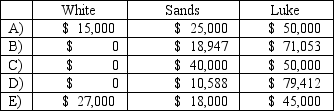
How much of the existing cash balance could be distributed safely to partners at this time?
(Essay)
4.9/5 (74)
(74) Assuming that, after the payment of liquidation expenses in the amount of $12,000 was made and the noncash assets were sold, if Creighton has a deficit of $8,000, for what amount would the noncash assets have been sold?
(Multiple Choice)
4.8/5 (87)
(87) Which item is not shown on the statement of partnership liquidation?
(Multiple Choice)
4.9/5 (74)
(74) The partnership of Rayne, Marin, and Fulton was being liquidated by the partners.Rayne was insolvent and did not have enough assets to pay all his personal creditors.Under what conditions might Rayne's personal creditors have claimed some of the partnership assets?
(Essay)
4.9/5 (64)
(64) Before liquidating any assets, the partners determined the amount of cash available for safe payments.How should the amount of safe cash payments be distributed?
(Multiple Choice)
4.9/5 (79)
(79) If the building is sold for $50,000, what amount should Waters receive in the final settlement?
(Multiple Choice)
4.8/5 (91)
(91) Describe the content of a journal entry to record a gain or loss resulting from the liquidation of a partnership asset for cash.
(Essay)
4.8/5 (77)
(77) Xygote, Yen, and Zen were partners who were liquidating their partnership.Each partner has a deficit balance in their respective capital account.Assuming all assets from the partnership have been liquidated, and all of the liabilities have been paid, how should any additional cash coming into the partnership be distributed to the partners?
(Essay)
4.8/5 (84)
(84) Assuming noncash assets were sold for $60,000, how much will each partner receive in the liquidation? 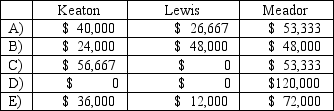
(Short Answer)
4.9/5 (92)
(92) 
Filters
- Essay(0)
- Multiple Choice(0)
- Short Answer(0)
- True False(0)
- Matching(0)