



 Chat with AI
Exam 15: Partnerships: Termination and Liquidation

Exam 1: The Equity Method of Accounting for Investments121 Questions
Exam 1: A: the Equity Method of Accounting for Investments121 Questions
Exam 2: Consolidation of Financial Information116 Questions
Exam 2: A: Consolidation of Financial Information116 Questions
Exam 3: Consolidations - Subsequent to the Date of Acquisition120 Questions
Exam 3: A: Consolidations - Subsequent to the Date of Acquisition120 Questions
Exam 4: Consolidated Financial Statements and Outside Ownership117 Questions
Exam 4: A: Consolidated Financial Statements and Outside Ownership117 Questions
Exam 5: Consolidated Financial Statements Intra-Entity Asset Transactions123 Questions
Exam 5: A: Consolidated Financial Statements Intra-Entity Asset Transactions123 Questions
Exam 6: Variable Interest Entities, Intra-Entity Debt, Consolidated Cash Flows, and Other Issues117 Questions
Exam 6: A: Variable Interest Entities, Intra-Entity Debt, Consolidated Cash Flows, and Other Issues117 Questions
Exam 7: Consolidated Financial Statements - Ownership Patterns and Income Taxes112 Questions
Exam 7: A: Consolidated Financial Statements - Ownership Patterns and Income Taxes112 Questions
Exam 8: Segment and Interim Reporting105 Questions
Exam 8: A: Segment and Interim Reporting115 Questions
Exam 9: Foreign Currency Transactions and Hedging Foreign Exchange Risk99 Questions
Exam 9: A: Foreign Currency Transactions and Hedging Foreign Exchange Risk99 Questions
Exam 10: Translation of Foreign Currency Financial Statements96 Questions
Exam 10: A: Translation of Foreign Currency Financial Statements96 Questions
Exam 11: Worldwide Accounting Diversity and International Accounting Standards63 Questions
Exam 11: A: Worldwide Accounting Diversity and International Accounting Standards63 Questions
Exam 12: Financial Reporting and the Securities and Exchange Commission76 Questions
Exam 12: A: Financial Reporting and the Securities and Exchange Commission76 Questions
Exam 13: Accounting for Legal Reorganizations and Liquidations75 Questions
Exam 13: A: Accounting for Legal Reorganizations and Liquidations78 Questions
Exam 14: Partnerships: Formation and Operation89 Questions
Exam 14: A: Partnerships: Formation and Operation89 Questions
Exam 15: Partnerships: Termination and Liquidation69 Questions
Exam 15: A: Partnerships: Termination and Liquidation69 Questions
Exam 16: Accounting for State and Local Governments, Part I83 Questions
Exam 16: A: Accounting for State and Local Governments, Part I83 Questions
Exam 17: Accounting for State and Local Governments, Part II42 Questions
Exam 17: A: Accounting for State and Local Governments, Part II47 Questions
Exam 18: Accounting for Not-For-Profit Entities72 Questions
Exam 18: A: Accounting for Not-For-Profit Entities72 Questions
Exam 19: Accounting for Estates and Trusts81 Questions
Exam 19: A: Accounting for Estates and Trusts81 Questions
Select questions type


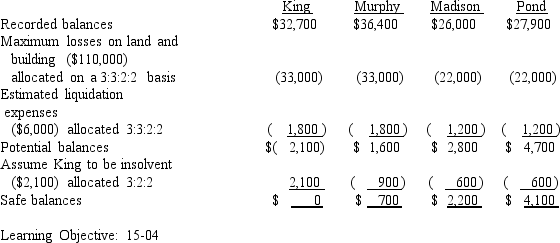
A partnership held three assets: Cash, $13,000; Land, $45,000; and a Building, $65,000.There were no recorded liabilities.The partners anticipated that expenses required to liquidate their partnership would amount to $6,000.Capital account balances were as follows:
King, Capital: $32,700
Murphy, Capital: 36,400
Madison, Capital: 26,000
Pond, Capital: 27,900
The partners shared profits and losses 30:30:20:20, respectively.
Required:
Prepare a proposed schedule of liquidation, showing how cash could be safely distributed to the partners at this time.

Free
(Essay)
4.9/5  (78)
(78) Correct Answer: Verified
Murphy received $700, Madison received $2,200, and Pond received $4,100.
A partnership had the following account balances: Cash, $91,000; Other Assets, $702,000; Liabilities, $338,000; Polk, Capital (50% of profits and losses), $221,000; Garfield, Capital (30%), $143,000; Arthur, Capital (20%), $91,000.The company liquidated and $10,400 became available to the partners.
Required:
Who would have received the $10,400?
Free
(Essay)
5.0/5 (91)
(91) Correct Answer:Verified
VerifiedSince the partnership had total capital of $455,000, the $10,400 that was available would have indicated maximum potential losses of $444,600. 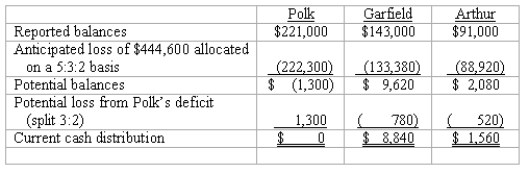 The $10,400 would have gone to Garfield ($8,840) and Arthur ($1,560).
For what amount would noncash assets need to be sold to generate enough cash in order that at least one partner would receive some cash upon liquidation?
Free
(Multiple Choice)
4.7/5 (65)
(65) Correct Answer:Verified
VerifiedD
Gonda, Herron, and Morse is considering possible liquidation because partner Morse is personally insolvent.The partners have the following capital account balances: $60,000, $70,000, and $40,000, respectively, and share profits and losses 30%, 45%, and 25%, respectively.The partnership has $200,000 in noncash assets that can be sold for $150,000.The partnership has $10,000 cash on hand, and $40,000 in liabilities.What is the minimum that partner Morse's creditors would receive if they have filed a claim for $50,000?
(Multiple Choice)
4.9/5 (84)
(84) Describe the content of a journal entry to record a gain or loss resulting from the liquidation of a partnership asset for cash.
(Essay)
4.8/5 (80)
(80) Harding, Jones, and Sandy, a partnership, is in the process of liquidating.The partners have the following capital account balances; $24,000, $24,000, and ($9,000) respectively.The partners share all profits and losses 16%, 48%, and 36%, respectively.Sandy has indicated that the ($9,000) deficit will be covered with a forthcoming contribution.The remaining partners have requested an immediate distribution of $20,000 in cash that is available.How should this cash be distributed?
(Multiple Choice)
4.9/5 (81)
(81) If the land is sold for $450,000, how much cash will Mones receive in the final settlement?
(Multiple Choice)
4.9/5 (83)
(83) Which one of the following statements is true for a predistribution plan?
(Multiple Choice)
4.8/5 (75)
(75) If the building is sold for $50,000 and there are no liquidation expenses what amount should Harry receive in the final settlement?
(Multiple Choice)
4.7/5 (81)
(81) The partnership of Rayne, Marin, and Fulton was being liquidated by the partners.Rayne was insolvent and did not have enough assets to pay all his personal creditors.Under what conditions might Rayne's personal creditors have claimed some of the partnership assets?
(Essay)
5.0/5 (85)
(85) Determine the cash to be retained and prepare a schedule to distribute $35,000 cash to the partners.
(Essay)
4.8/5 (68)
(68) Which of the following could result in the termination and liquidation of a partnership? 1) Partners are incompatible and choose to cease operations.
2) There are excessive losses that are expected to continue.
3) Retirement of a partner.
(Multiple Choice)
4.9/5 (74)
(74) When a partnership is insolvent and a partner has a deficit capital account balance, that partner is legally required to:
(Multiple Choice)
4.9/5 (82)
(82) Prepare a schedule to calculate the safe payments to be made to the partners at the end of January.
(Essay)
4.9/5 (81)
(81) For what amount would the noncash assets need to be sold in order for Quincy to receive some cash from the liquidation?
(Multiple Choice)
4.9/5 (60)
(60) What is the preferred method of resolving a partner's deficit balance, according to the Uniform Partnership Act?
(Multiple Choice)
4.7/5 (66)
(66) Before liquidating any assets, the partners determined the amount of cash for safe payments and distributed it.The noncash assets were then sold for $120,000.The liquidation expenses of $5,000 were paid prior to the sale of noncashassets.How would the $120,000 be distributed to the partners? (Hint: Either a predistribution plan or a schedule of safe capital balances would be appropriate for solving this item.) 
(Short Answer)
4.9/5 (72)
(72) If the assets could be sold, for $228,000 and there are no liquidation expenses what is the amount that Tillman would receive from the liquidation?
(Multiple Choice)
4.9/5 (87)
(87) 
Filters
- Essay(0)
- Multiple Choice(0)
- Short Answer(0)
- True False(0)
- Matching(0)