



 Chat with AI
Exam 15: Partnerships: Termination and Liquidation

Exam 1: The Equity Method of Accounting for Investments121 Questions
Exam 1: A: the Equity Method of Accounting for Investments121 Questions
Exam 2: Consolidation of Financial Information116 Questions
Exam 2: A: Consolidation of Financial Information116 Questions
Exam 3: Consolidations - Subsequent to the Date of Acquisition120 Questions
Exam 3: A: Consolidations - Subsequent to the Date of Acquisition120 Questions
Exam 4: Consolidated Financial Statements and Outside Ownership117 Questions
Exam 4: A: Consolidated Financial Statements and Outside Ownership117 Questions
Exam 5: Consolidated Financial Statements Intra-Entity Asset Transactions123 Questions
Exam 5: A: Consolidated Financial Statements Intra-Entity Asset Transactions123 Questions
Exam 6: Variable Interest Entities, Intra-Entity Debt, Consolidated Cash Flows, and Other Issues117 Questions
Exam 6: A: Variable Interest Entities, Intra-Entity Debt, Consolidated Cash Flows, and Other Issues117 Questions
Exam 7: Consolidated Financial Statements - Ownership Patterns and Income Taxes112 Questions
Exam 7: A: Consolidated Financial Statements - Ownership Patterns and Income Taxes112 Questions
Exam 8: Segment and Interim Reporting105 Questions
Exam 8: A: Segment and Interim Reporting115 Questions
Exam 9: Foreign Currency Transactions and Hedging Foreign Exchange Risk99 Questions
Exam 9: A: Foreign Currency Transactions and Hedging Foreign Exchange Risk99 Questions
Exam 10: Translation of Foreign Currency Financial Statements96 Questions
Exam 10: A: Translation of Foreign Currency Financial Statements96 Questions
Exam 11: Worldwide Accounting Diversity and International Accounting Standards63 Questions
Exam 11: A: Worldwide Accounting Diversity and International Accounting Standards63 Questions
Exam 12: Financial Reporting and the Securities and Exchange Commission76 Questions
Exam 12: A: Financial Reporting and the Securities and Exchange Commission76 Questions
Exam 13: Accounting for Legal Reorganizations and Liquidations75 Questions
Exam 13: A: Accounting for Legal Reorganizations and Liquidations78 Questions
Exam 14: Partnerships: Formation and Operation89 Questions
Exam 14: A: Partnerships: Formation and Operation89 Questions
Exam 15: Partnerships: Termination and Liquidation69 Questions
Exam 15: A: Partnerships: Termination and Liquidation69 Questions
Exam 16: Accounting for State and Local Governments, Part I83 Questions
Exam 16: A: Accounting for State and Local Governments, Part I83 Questions
Exam 17: Accounting for State and Local Governments, Part II42 Questions
Exam 17: A: Accounting for State and Local Governments, Part II47 Questions
Exam 18: Accounting for Not-For-Profit Entities72 Questions
Exam 18: A: Accounting for Not-For-Profit Entities72 Questions
Exam 19: Accounting for Estates and Trusts81 Questions
Exam 19: A: Accounting for Estates and Trusts81 Questions
Select questions type


What would be the maximum amount Garr might have to contribute to the partnership to eliminate a deficit balance in his account?
(Essay)
4.8/5  (81)
(81) How much cash should each partner receive at this time, pursuant to a proposed schedule of liquidation?
(Essay)
4.9/5 (84)
(84) How much of the existing cash balance could be distributed safely to partners at this time?
(Essay)
4.8/5 (63)
(63) Which one of the following statements is true for a predistribution plan?
(Multiple Choice)
4.7/5 (76)
(76) If the noncash assets are sold for $105,000, what would be the maximum amount of cash that Canton could expect to receive?
(Essay)
5.0/5 (79)
(79) If the assets could be sold for $228,000 and there are no liquidation expenses, what is the amount that Laurel would receive from the liquidation?
(Multiple Choice)
4.8/5 (76)
(76) Jones, Marge, and Tate LLP decided to dissolve and liquidate the partnership on September 30, 2018.After realization of a portion of the noncash assets, the capital account balances were Jones $50,000; Marge $40,000; and Tate $15,000.Cash of $35,000 and other assets with a carrying amount of $100,000 were on hand.Creditors' claims totaled $30,000.Jones, Marge, and Tate shared net income and losses in a 2:1:1 ratio, respectively.
Prepare a working paper to compute the amount of cash that may be paid to creditors and to partners at this time, assuming that no partner is solvent.
(Essay)
4.7/5 (95)
(95) Prepare a schedule to calculate the safe installment payments to be made to the partners at the end of February.
(Essay)
4.8/5 (84)
(84) The Amos, Billings, and Cleaver partnership had two assets: (1) cash of $40,000 and (2) an investment with a book value of $110,000.The ratio for sharing profits and losses is 2:1:1.The balances in the capital accounts were:
Amos, capital: $45,000
Billings, capital: $75,000
Cleaver, capital: $30,000
Required:
If the investment was sold for $80,000, how much cash would each partner receive upon liquidation?
(Essay)
4.8/5 (78)
(78) If the land is sold for $450,000, what amount will Roberts receive in the final settlement?
(Multiple Choice)
4.8/5 (77)
(77) 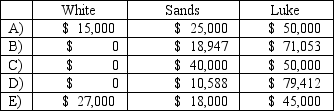
Assuming that, after the payment of liquidation expenses in the amount of $12,000 was made and the noncash assets were sold, if Creighton has a deficit of $8,000, for what amount would the noncash assets have been sold?
(Multiple Choice)
4.8/5 (58)
(58) If the assets could be sold for $228,000 and there are no liquidation expenses, what is the amount that Ding would receive from the liquidation?
(Multiple Choice)
4.8/5 (76)
(76) Which item is not shown on the statement of partnership liquidation?
(Multiple Choice)
4.9/5 (83)
(83) Assuming noncash assets were sold for $60,000, how much will each partner receive in the liquidation? 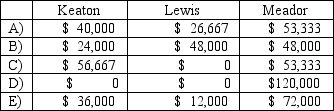
(Short Answer)
4.8/5 (98)
(98) Which of the following statements is false concerning the partnership Statement of Liquidation?
(Multiple Choice)
4.8/5 (79)
(79) Which of the following statements is true concerning the distribution of safe payments?
(Multiple Choice)
4.9/5 (70)
(70) 
Filters
- Essay(0)
- Multiple Choice(0)
- Short Answer(0)
- True False(0)
- Matching(0)