



 Chat with AI
Exam 15: A: Partnerships: Termination and Liquidation

Exam 1: The Equity Method of Accounting for Investments121 Questions
Exam 1: A: the Equity Method of Accounting for Investments121 Questions
Exam 2: Consolidation of Financial Information116 Questions
Exam 2: A: Consolidation of Financial Information116 Questions
Exam 3: Consolidations - Subsequent to the Date of Acquisition120 Questions
Exam 3: A: Consolidations - Subsequent to the Date of Acquisition120 Questions
Exam 4: Consolidated Financial Statements and Outside Ownership117 Questions
Exam 4: A: Consolidated Financial Statements and Outside Ownership117 Questions
Exam 5: Consolidated Financial Statements Intra-Entity Asset Transactions123 Questions
Exam 5: A: Consolidated Financial Statements Intra-Entity Asset Transactions123 Questions
Exam 6: Variable Interest Entities, Intra-Entity Debt, Consolidated Cash Flows, and Other Issues117 Questions
Exam 6: A: Variable Interest Entities, Intra-Entity Debt, Consolidated Cash Flows, and Other Issues117 Questions
Exam 7: Consolidated Financial Statements - Ownership Patterns and Income Taxes112 Questions
Exam 7: A: Consolidated Financial Statements - Ownership Patterns and Income Taxes112 Questions
Exam 8: Segment and Interim Reporting105 Questions
Exam 8: A: Segment and Interim Reporting115 Questions
Exam 9: Foreign Currency Transactions and Hedging Foreign Exchange Risk99 Questions
Exam 9: A: Foreign Currency Transactions and Hedging Foreign Exchange Risk99 Questions
Exam 10: Translation of Foreign Currency Financial Statements96 Questions
Exam 10: A: Translation of Foreign Currency Financial Statements96 Questions
Exam 11: Worldwide Accounting Diversity and International Accounting Standards63 Questions
Exam 11: A: Worldwide Accounting Diversity and International Accounting Standards63 Questions
Exam 12: Financial Reporting and the Securities and Exchange Commission76 Questions
Exam 12: A: Financial Reporting and the Securities and Exchange Commission76 Questions
Exam 13: Accounting for Legal Reorganizations and Liquidations75 Questions
Exam 13: A: Accounting for Legal Reorganizations and Liquidations78 Questions
Exam 14: Partnerships: Formation and Operation89 Questions
Exam 14: A: Partnerships: Formation and Operation89 Questions
Exam 15: Partnerships: Termination and Liquidation69 Questions
Exam 15: A: Partnerships: Termination and Liquidation69 Questions
Exam 16: Accounting for State and Local Governments, Part I83 Questions
Exam 16: A: Accounting for State and Local Governments, Part I83 Questions
Exam 17: Accounting for State and Local Governments, Part II42 Questions
Exam 17: A: Accounting for State and Local Governments, Part II47 Questions
Exam 18: Accounting for Not-For-Profit Entities72 Questions
Exam 18: A: Accounting for Not-For-Profit Entities72 Questions
Exam 19: Accounting for Estates and Trusts81 Questions
Exam 19: A: Accounting for Estates and Trusts81 Questions
Select questions type


Harding, Jones, and Sandy, a partnership, is in the process of liquidating.The partners have the following capital account balances; $24,000, $24,000, and ($9,000) respectively.The partners share all profits and losses 16%, 48%, and 36%, respectively.Sandy has indicated that the ($9,000) deficit will be covered with a forthcoming contribution.The remaining partners have requested an immediate distribution of $20,000 in cash that is available.How should this cash be distributed?

Free
(Multiple Choice)
4.8/5  (70)
(70) Correct Answer: Verified
B
What amount of cash was available for safe payments, based on the above information?
Free
(Multiple Choice)
4.8/5 (70)
(70) Correct Answer:Verified
VerifiedC
Jones, Marge, and Tate LLP decided to dissolve and liquidate the partnership on September 30, 2018.After realization of a portion of the noncash assets, the capital account balances were Jones $50,000; Marge $40,000; and Tate $15,000.Cash of $35,000 and other assets with a carrying amount of $100,000 were on hand.Creditors' claims totaled $30,000.Jones, Marge, and Tate shared net income and losses in a 2:1:1 ratio, respectively.
Prepare a working paper to compute the amount of cash that may be paid to creditors and to partners at this time, assuming that no partner is solvent.
Free
(Essay)
4.7/5 (92)
(92) Correct Answer:Verified
Verified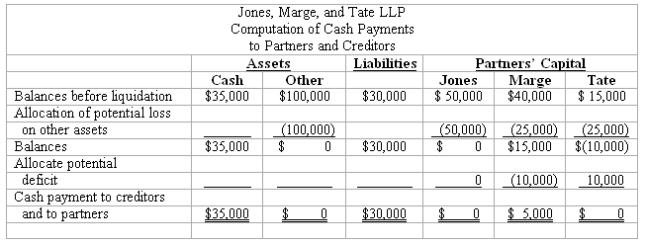
What events or circumstances might force the termination of a partnership and liquidation of its assets?
(Essay)
4.8/5 (69)
(69) How much cash should each partner receive at this time, pursuant to a proposed schedule of liquidation?
(Essay)
4.9/5 (88)
(88) Prepare the journal entry for Donald, Chief & Berry LLP on August 1, 2018, to record the offset of the loan receivable from Donald.
(Essay)
4.8/5 (86)
(86) If the building is sold for $50,000 and there are no liquidation expenses what amount should Harry receive in the final settlement?
(Multiple Choice)
4.9/5 (74)
(74) Prepare a schedule to calculate the safe payments to be made to the partners at the end of January.
(Essay)
4.7/5 (79)
(79) Gonda, Herron, and Morse is considering possible liquidation because partner Morse is personally insolvent.The partners have the following capital account balances: $60,000, $70,000, and $40,000, respectively, and share profits and losses 30%, 45%, and 25%, respectively.The partnership has $200,000 in noncash assets that can be sold for $150,000.The partnership has $10,000 cash on hand, and $40,000 in liabilities.What is the minimum that partner Morse's creditors would receive if they have filed a claim for $50,000?
(Multiple Choice)
4.8/5 (86)
(86) If the noncash assets are sold for $105,000, what would be the maximum amount of cash that Canton could expect to receive?
(Essay)
4.9/5 (79)
(79) If the assets could be sold for $228,000 and there are no liquidation expenses, what is the minimum amount that Ezzard would receive from the liquidation?
(Multiple Choice)
4.9/5 (91)
(91) 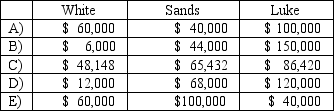
If the assets could be sold, for $228,000 and there are no liquidation expenses what is the amount that Tillman would receive from the liquidation?
(Multiple Choice)
4.9/5 (80)
(80) Which one of the following statements is true for a predistribution plan?
(Multiple Choice)
4.9/5 (86)
(86) Before liquidating any assets, the partners determined the amount of cash for safe payments and distributed it.The noncash assets were then sold for $120,000.The liquidation expenses of $5,000 were paid prior to the sale of noncashassets.How would the $120,000 be distributed to the partners? (Hint: Either a predistribution plan or a schedule of safe capital balances would be appropriate for solving this item.) 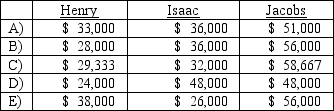
(Short Answer)
4.8/5 (92)
(92) The Arnold, Bates, Carlton, and Delbert partnership was liquidating.It had paid all its liabilities and had some assets yet to be sold.The partners had capital account balances of ($50,000), $90,000, $110,000, and $130,000.There was $40,000 cash available for distribution to the partners.What procedures would be followed to determine the amount of cash that could safely be distributed to each partner?
(Essay)
4.9/5 (72)
(72) Which of the following statements is true concerning the distribution of safe payments?
(Multiple Choice)
4.9/5 (75)
(75) Prepare the journal entry for Donald, Chief & Berry LLP on August 1, 2018, to record payment of liabilities.
(Essay)
4.8/5 (94)
(94) 
Filters
- Essay(0)
- Multiple Choice(0)
- Short Answer(0)
- True False(0)
- Matching(0)