



 Chat with AI
Exam 18: A: Accounting for Not-For-Profit Entities

Exam 1: The Equity Method of Accounting for Investments121 Questions
Exam 1: A: the Equity Method of Accounting for Investments121 Questions
Exam 2: Consolidation of Financial Information116 Questions
Exam 2: A: Consolidation of Financial Information116 Questions
Exam 3: Consolidations - Subsequent to the Date of Acquisition120 Questions
Exam 3: A: Consolidations - Subsequent to the Date of Acquisition120 Questions
Exam 4: Consolidated Financial Statements and Outside Ownership117 Questions
Exam 4: A: Consolidated Financial Statements and Outside Ownership117 Questions
Exam 5: Consolidated Financial Statements Intra-Entity Asset Transactions123 Questions
Exam 5: A: Consolidated Financial Statements Intra-Entity Asset Transactions123 Questions
Exam 6: Variable Interest Entities, Intra-Entity Debt, Consolidated Cash Flows, and Other Issues117 Questions
Exam 6: A: Variable Interest Entities, Intra-Entity Debt, Consolidated Cash Flows, and Other Issues117 Questions
Exam 7: Consolidated Financial Statements - Ownership Patterns and Income Taxes112 Questions
Exam 7: A: Consolidated Financial Statements - Ownership Patterns and Income Taxes112 Questions
Exam 8: Segment and Interim Reporting105 Questions
Exam 8: A: Segment and Interim Reporting115 Questions
Exam 9: Foreign Currency Transactions and Hedging Foreign Exchange Risk99 Questions
Exam 9: A: Foreign Currency Transactions and Hedging Foreign Exchange Risk99 Questions
Exam 10: Translation of Foreign Currency Financial Statements96 Questions
Exam 10: A: Translation of Foreign Currency Financial Statements96 Questions
Exam 11: Worldwide Accounting Diversity and International Accounting Standards63 Questions
Exam 11: A: Worldwide Accounting Diversity and International Accounting Standards63 Questions
Exam 12: Financial Reporting and the Securities and Exchange Commission76 Questions
Exam 12: A: Financial Reporting and the Securities and Exchange Commission76 Questions
Exam 13: Accounting for Legal Reorganizations and Liquidations75 Questions
Exam 13: A: Accounting for Legal Reorganizations and Liquidations78 Questions
Exam 14: Partnerships: Formation and Operation89 Questions
Exam 14: A: Partnerships: Formation and Operation89 Questions
Exam 15: Partnerships: Termination and Liquidation69 Questions
Exam 15: A: Partnerships: Termination and Liquidation69 Questions
Exam 16: Accounting for State and Local Governments, Part I83 Questions
Exam 16: A: Accounting for State and Local Governments, Part I83 Questions
Exam 17: Accounting for State and Local Governments, Part II42 Questions
Exam 17: A: Accounting for State and Local Governments, Part II47 Questions
Exam 18: Accounting for Not-For-Profit Entities72 Questions
Exam 18: A: Accounting for Not-For-Profit Entities72 Questions
Exam 19: Accounting for Estates and Trusts81 Questions
Exam 19: A: Accounting for Estates and Trusts81 Questions
Select questions type


If the total acquisition value of an acquired not-for-profit entity is greater than the fair value of all identifiable net assets of the entity, and that entity's revenues are not generated by rendering goods or services or from membership dues, then the excess of acquisition value over identifiable net assets is immediately reported:
(Multiple Choice)
4.7/5  (81)
(81) Unconditional promises to transfer cash or other resources to an entity in a voluntary nonreciprocal transaction is the GAAP definition of
(Multiple Choice)
4.9/5 (80)
(80) What term is often used by voluntary health and welfare entities as a category for resources received from contributions, as opposed to those from providing goods or services?
(Essay)
4.8/5 (72)
(72) How does a not-for-profit entity account for: 1) cash contributions, and 2) donated goods that are received for operating purposes? What types of revenues are recognized by voluntary health and welfare entities?
(Essay)
4.9/5 (93)
(93) Unconditional transfers of cash or other resources to an entity in a voluntary nonreciprocal transaction is the GAAP definition of
(Multiple Choice)
4.9/5 (78)
(78) Which entry would be the correct entry on the donor's books when the donor retains control of an asset, such as cash, which it contributes to a not-for-profit entity? DEBIT CREDIT
(Multiple Choice)
4.9/5 (68)
(68) For the month of December 2017, patient charges at Northfield Hospital (a not-for-profit hospital) were $2,720,000. Third-party payors were billed $1,800,000.
-Prepare the necessary journal entry to record the revenue and receivables.
(Essay)
4.9/5 (77)
(77) In accruing patient charges for the current month, which one of the following accounts should a hospital credit?
(Multiple Choice)
4.7/5 (83)
(83) Which of the following types of health care entities follow FASB Accounting Standards Codification for preparing financial statements? 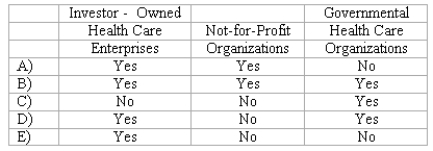
(Short Answer)
4.8/5 (66)
(66) Dura Foundation, a voluntary health and welfare entity dedicated to finding medical cures and supported by contributions from the general public, included the following costs in its Statement of Functional Expenses for the year ended December 31, 2018:
 -What should Dura Foundation report as supporting service expenses?
 (Essay)
5.0/5 (78)
(78) Not-for-profit entities that are eligible to obtain tax-exempt status under Internal Revenue Code section 501(c)(4) are
(Multiple Choice)
4.9/5 (72)
(72) For May 2018, Carlington Hospital's charges for patient services were $608,000, of which 80% was billed to third-party payors.
Required:
Prepare the journal entry to accrue patient charges for the month.
(Essay)
4.9/5 (86)
(86) 
Filters
- Essay(0)
- Multiple Choice(0)
- Short Answer(0)
- True False(0)
- Matching(0)