



 Chat with AI
Exam 10: Translation of Foreign Currency Financial Statements

Exam 1: The Equity Method of Accounting for Investments121 Questions
Exam 1: A: the Equity Method of Accounting for Investments121 Questions
Exam 2: Consolidation of Financial Information116 Questions
Exam 2: A: Consolidation of Financial Information116 Questions
Exam 3: Consolidations - Subsequent to the Date of Acquisition120 Questions
Exam 3: A: Consolidations - Subsequent to the Date of Acquisition120 Questions
Exam 4: Consolidated Financial Statements and Outside Ownership117 Questions
Exam 4: A: Consolidated Financial Statements and Outside Ownership117 Questions
Exam 5: Consolidated Financial Statements Intra-Entity Asset Transactions123 Questions
Exam 5: A: Consolidated Financial Statements Intra-Entity Asset Transactions123 Questions
Exam 6: Variable Interest Entities, Intra-Entity Debt, Consolidated Cash Flows, and Other Issues117 Questions
Exam 6: A: Variable Interest Entities, Intra-Entity Debt, Consolidated Cash Flows, and Other Issues117 Questions
Exam 7: Consolidated Financial Statements - Ownership Patterns and Income Taxes112 Questions
Exam 7: A: Consolidated Financial Statements - Ownership Patterns and Income Taxes112 Questions
Exam 8: Segment and Interim Reporting105 Questions
Exam 8: A: Segment and Interim Reporting115 Questions
Exam 9: Foreign Currency Transactions and Hedging Foreign Exchange Risk99 Questions
Exam 9: A: Foreign Currency Transactions and Hedging Foreign Exchange Risk99 Questions
Exam 10: Translation of Foreign Currency Financial Statements96 Questions
Exam 10: A: Translation of Foreign Currency Financial Statements96 Questions
Exam 11: Worldwide Accounting Diversity and International Accounting Standards63 Questions
Exam 11: A: Worldwide Accounting Diversity and International Accounting Standards63 Questions
Exam 12: Financial Reporting and the Securities and Exchange Commission76 Questions
Exam 12: A: Financial Reporting and the Securities and Exchange Commission76 Questions
Exam 13: Accounting for Legal Reorganizations and Liquidations75 Questions
Exam 13: A: Accounting for Legal Reorganizations and Liquidations78 Questions
Exam 14: Partnerships: Formation and Operation89 Questions
Exam 14: A: Partnerships: Formation and Operation89 Questions
Exam 15: Partnerships: Termination and Liquidation69 Questions
Exam 15: A: Partnerships: Termination and Liquidation69 Questions
Exam 16: Accounting for State and Local Governments, Part I83 Questions
Exam 16: A: Accounting for State and Local Governments, Part I83 Questions
Exam 17: Accounting for State and Local Governments, Part II42 Questions
Exam 17: A: Accounting for State and Local Governments, Part II47 Questions
Exam 18: Accounting for Not-For-Profit Entities72 Questions
Exam 18: A: Accounting for Not-For-Profit Entities72 Questions
Exam 19: Accounting for Estates and Trusts81 Questions
Exam 19: A: Accounting for Estates and Trusts81 Questions
Select questions type


If the subsidiary's local currency is its functional currency, what total amount should be included in Tulip's balance sheet in U.S.dollars?
(Multiple Choice)
4.9/5  (81)
(81) Prepare a statement of retained earnings for this subsidiary in stickles and then translate the amounts into U.S.dollars.
(Essay)
4.8/5 (82)
(82) What exchange rate should have been used in translating Darron's revenues and expenses for 2018?
(Multiple Choice)
4.7/5 (86)
(86) Assume the functional currency is the Euro; compute the U.S.balance sheet amount for equipment for 2018.
(Multiple Choice)
4.9/5 (69)
(69) Sinkal Co.was formed on January 1, 2018 as a wholly owned foreign subsidiary of a U.S.corporation.Sinkal's functional currency was the stickle (§).The following transactions and events occurred during 2018:  What was the amount of the translation adjustment for 2018?
 (Multiple Choice)
4.8/5 (96)
(96) What exchange rate should be used to translate (a) revenues and expenses that occur throughout the year and (b) a gain or loss that occurs on a specific day?
(Essay)
4.7/5 (72)
(72) What was the amount of the translation adjustment for 2018?
(Multiple Choice)
4.9/5 (87)
(87) On January 1, 2018, Fandu Corp.began operations of a foreign subsidiary.On April 1, 2018, the subsidiary purchased inventory costing 150,000 stickles.One-fourth of this inventory remained unsold at the end of 2018 while 40% of the liability from the purchase had not yet been paid.The pertinent indirect exchange rates were:
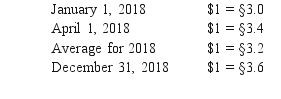 Required:
What should have been the December 31, 2018 inventory and accounts payable balances for this foreign subsidiary as translated into U.S.dollars? (Round your answers to the nearest whole dollar.)
Required:
What should have been the December 31, 2018 inventory and accounts payable balances for this foreign subsidiary as translated into U.S.dollars? (Round your answers to the nearest whole dollar.) (Essay)
5.0/5 (85)
(85) A net liability balance sheet exposure exists and the foreign currency appreciates.Which of the following statements is true?
(Multiple Choice)
4.9/5 (94)
(94) Contrast the purpose of remeasurement with the purpose of translation.
(Essay)
4.9/5 (79)
(79) Assume the functional currency is the U.S.Dollar; compute the U.S.balance sheet amount for accumulated depreciation for 2018.
(Multiple Choice)
4.7/5 (80)
(80) The financial statements for Perez are translated by its U.S.parent.What amount of gain or loss would be reported in its translated income statement?
(Multiple Choice)
4.9/5 (75)
(75) A U.S.company's foreign subsidiary had the following amounts in stickles (§), the functional currency, in 2018:  The average exchange rate during 2018 was §1 = $.96.The beginning inventory was acquired when the exchange rate was §1 = $1.20.The ending inventory was acquired when the exchange rate was §1 = $.90.The exchange rate at December 31, 2018 was §1 = $.84.Assuming that the foreign nation for the subsidiary had a highly inflationary economy, at what amount should that foreign subsidiary's purchases have been reflected in the 2018 U.S.dollar income statement?
 (Multiple Choice)
4.8/5 (80)
(80) Under what circumstances would the remeasurement of a foreign subsidiary's financial statements be required?
(Essay)
5.0/5 (80)
(80) A net asset balance sheet exposure exists and the foreign currency depreciates.Which of the following statements is true?
(Multiple Choice)
4.8/5 (79)
(79) Compute the December 31, 2018, inventory balance using the lower of cost or net realizable value method under the temporal method.
(Multiple Choice)
4.9/5 (68)
(68) 
Filters
- Essay(0)
- Multiple Choice(0)
- Short Answer(0)
- True False(0)
- Matching(0)