



 Chat with AI
Exam 14: Partnerships: Formation and Operation

Exam 1: The Equity Method of Accounting for Investments121 Questions
Exam 1: A: the Equity Method of Accounting for Investments121 Questions
Exam 2: Consolidation of Financial Information116 Questions
Exam 2: A: Consolidation of Financial Information116 Questions
Exam 3: Consolidations - Subsequent to the Date of Acquisition120 Questions
Exam 3: A: Consolidations - Subsequent to the Date of Acquisition120 Questions
Exam 4: Consolidated Financial Statements and Outside Ownership117 Questions
Exam 4: A: Consolidated Financial Statements and Outside Ownership117 Questions
Exam 5: Consolidated Financial Statements Intra-Entity Asset Transactions123 Questions
Exam 5: A: Consolidated Financial Statements Intra-Entity Asset Transactions123 Questions
Exam 6: Variable Interest Entities, Intra-Entity Debt, Consolidated Cash Flows, and Other Issues117 Questions
Exam 6: A: Variable Interest Entities, Intra-Entity Debt, Consolidated Cash Flows, and Other Issues117 Questions
Exam 7: Consolidated Financial Statements - Ownership Patterns and Income Taxes112 Questions
Exam 7: A: Consolidated Financial Statements - Ownership Patterns and Income Taxes112 Questions
Exam 8: Segment and Interim Reporting105 Questions
Exam 8: A: Segment and Interim Reporting115 Questions
Exam 9: Foreign Currency Transactions and Hedging Foreign Exchange Risk99 Questions
Exam 9: A: Foreign Currency Transactions and Hedging Foreign Exchange Risk99 Questions
Exam 10: Translation of Foreign Currency Financial Statements96 Questions
Exam 10: A: Translation of Foreign Currency Financial Statements96 Questions
Exam 11: Worldwide Accounting Diversity and International Accounting Standards63 Questions
Exam 11: A: Worldwide Accounting Diversity and International Accounting Standards63 Questions
Exam 12: Financial Reporting and the Securities and Exchange Commission76 Questions
Exam 12: A: Financial Reporting and the Securities and Exchange Commission76 Questions
Exam 13: Accounting for Legal Reorganizations and Liquidations75 Questions
Exam 13: A: Accounting for Legal Reorganizations and Liquidations78 Questions
Exam 14: Partnerships: Formation and Operation89 Questions
Exam 14: A: Partnerships: Formation and Operation89 Questions
Exam 15: Partnerships: Termination and Liquidation69 Questions
Exam 15: A: Partnerships: Termination and Liquidation69 Questions
Exam 16: Accounting for State and Local Governments, Part I83 Questions
Exam 16: A: Accounting for State and Local Governments, Part I83 Questions
Exam 17: Accounting for State and Local Governments, Part II42 Questions
Exam 17: A: Accounting for State and Local Governments, Part II47 Questions
Exam 18: Accounting for Not-For-Profit Entities72 Questions
Exam 18: A: Accounting for Not-For-Profit Entities72 Questions
Exam 19: Accounting for Estates and Trusts81 Questions
Exam 19: A: Accounting for Estates and Trusts81 Questions
Select questions type


What was Young's total share of net loss for the first year?
(Multiple Choice)
4.8/5  (85)
(85) Cherryhill and Hace had been partners for several years, and they decided to admit Quincy to the partnership.The accountant for the partnership believed that the dissolved partnership and the newly formed partnership were two separate entities.What method would the accountant have used for recording the admission of Quincy to the partnership?
(Multiple Choice)
4.8/5 (81)
(81) Anne retires and is paid $80,000 based on the terms of the original partnership agreement.If the bonus method is used, what is the capital of the remaining partners?
(Multiple Choice)
4.8/5 (77)
(77) Jipsom and Klark were partners with capital account balances of $80,000 and $100,000, respectively.Looney directly paid $32,000 to Jipsom and $40,000 to Klark for 30% of their interests in the partnership.Jipsom and Klark shared income in the ratio of 2:3.They believed that revaluation of the partnership was appropriate when a new partner was admitted.
Required:
Prepare the journal entries to record the admission of Looney to the partnership.
(Essay)
4.8/5 (75)
(75) The partners of Apple, Bere, and Carroll LLP share net income and losses in a 5:3:2 ratio, respectively.The capital account balances on January 1, 2018, were as follows: 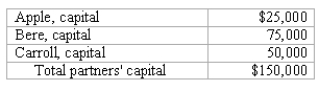 The carrying amounts of the assets and liabilities of the partnership are the same as their current fair values.Dorr will be admitted to the partnership with a 20% capital interest and a 20% share of net income and losses in exchange for a cash investment.The amount of cash that Dorr should invest in the partnership is:
 (Multiple Choice)
4.9/5 (85)
(85) Brown and Green are forming a business as partners.If they do not create a formal written partnership agreement, what risks are they exposing themselves to?
(Essay)
4.8/5 (61)
(61) What was Thurman's total share of net income for the second year?
(Multiple Choice)
4.9/5 (76)
(76) Determine the amount of net income allocated to each partner for 2017.
(Essay)
4.9/5 (79)
(79) What was the remainder portion of net income allocated to Nolan for 2018?
(Multiple Choice)
4.8/5 (85)
(85) The disadvantages of the partnership form of business organization, compared to corporations, include
(Multiple Choice)
4.8/5 (64)
(64) Prepare the journal entries for the dissolution of Howell's partnership interest, assuming the goodwill method is to be applied.
(Essay)
5.0/5 (91)
(91) Record the journal entry for the admission of Noris.Goodwill is not to be recorded.
(Essay)
4.9/5 (81)
(81) What was the balance in Thurman's Capital account at the end of the first year?
(Multiple Choice)
4.9/5 (71)
(71) What is the total partnership capital after Roberts retires receiving $160,000 and using the goodwill method?
(Multiple Choice)
4.9/5 (76)
(76) 
Filters
- Essay(0)
- Multiple Choice(0)
- Short Answer(0)
- True False(0)
- Matching(0)